



ISSN 1004-132X
CN 42-1294/TH
CN 42-1294/TH
中国机械工程 ›› 2026, Vol. 37 ›› Issue (6): 1508-1517.DOI: 10.3969/j.issn.1004-132X.2026.06.023
刘金锋1( ), 顾世民1, 张占虎2, 李苏1, 陈宇1, 王学敏3, 钱天龙3
收稿日期:2025-06-06
出版日期:2026-06-25
发布日期:2026-07-17
通讯作者:
刘金锋
作者简介:刘金锋*(通信作者),男,1987年生,教授、博士研究生导师。研究方向为船舶智能制造关键使能技术。E-mail: liujinfeng@just.edu.cn。
基金资助:
LIU Jinfeng1(), GU Shimin1, ZHANG Zhanhu2, LI Su1, CHEN Yu1, WANG Xuemin3, QIAN Tianlong3
Received:2025-06-06
Online:2026-06-25
Published:2026-07-17
Contact:
LIU Jinfeng
摘要:
针对船舶狭小空间焊接时作业空间受限、焊枪姿态约束多、轨迹干涉风险高、焊接可达性差等挑战,以机械臂最短时间完成焊接为目标,提出基于改进遗传粒子群算法(IGA-PSO)的时间优化方案以优化焊接轨迹。构建便携式机器人、工件和场景的三维模型,明确机器人运动逻辑,建立焊接轨迹模型并确定焊接工艺;综合考虑焊接时间和可达性,设计多目标约束适应度函数,并建立时间优化与可达率目标函数;结合遗传和粒子群算法,对惯性权重引入线性递减和指数递减机制,对学习因子设计探索、开发和收敛阶段,对变异进行非线性调整,以提高算法的性能。通过算法测试、仿真验证和现场验证对该方法进行了案例验证,结果表明,优化后的机械臂位移、速度、加速度曲线平滑、无突变,且焊接可达率达到90%,验证了IGA-PSO算法的有效性。
中图分类号:
刘金锋, 顾世民, 张占虎, 李苏, 陈宇, 王学敏, 钱天龙. 基于多目标约束的狭小空间便携式机器人轨迹优化方法[J]. 中国机械工程, 2026, 37(6): 1508-1517.
LIU Jinfeng, GU Shimin, ZHANG Zhanhu, LI Su, CHEN Yu, WANG Xuemin, QIAN Tianlong. Trajectory Optimization Method for Portable Robots in Confined Spaces Based on Multi-objective Constraints[J]. China Mechanical Engineering, 2026, 37(6): 1508-1517.
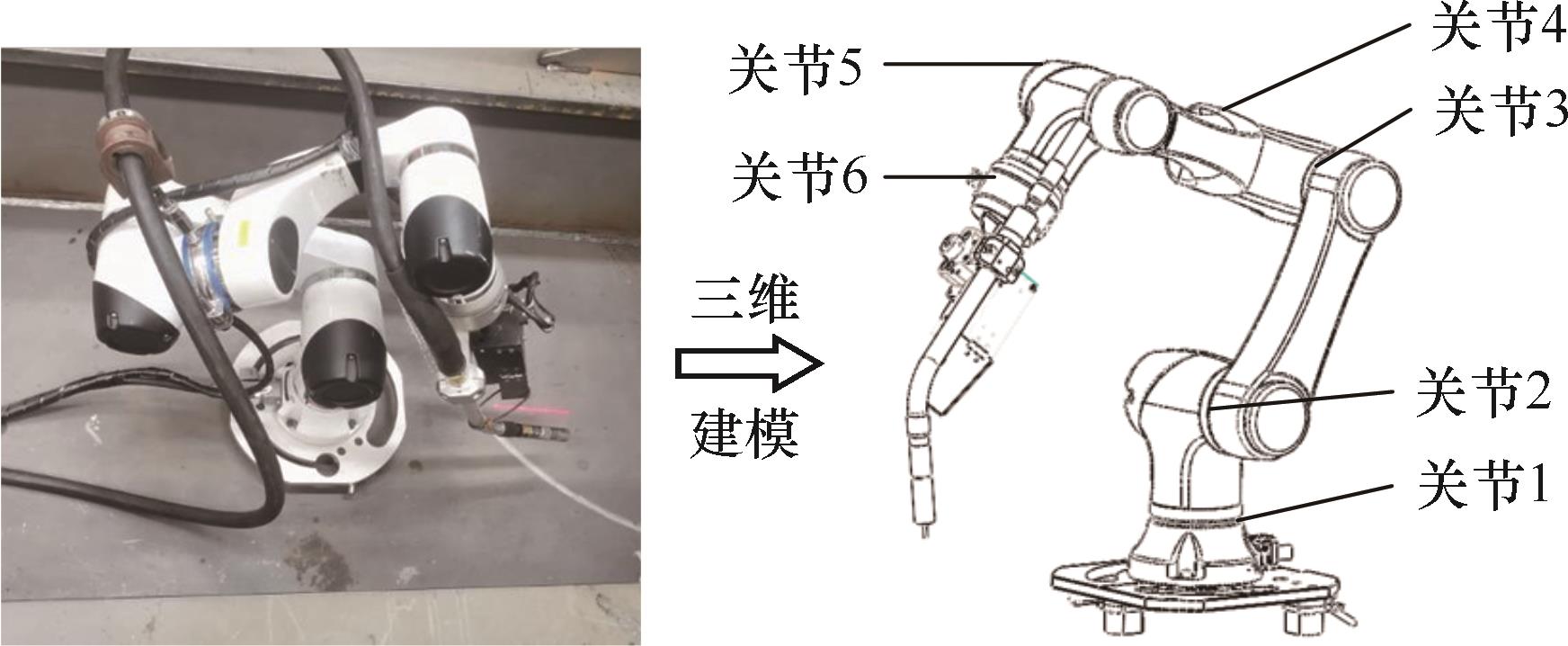
图1 机器人模型
Fig.1 Robot model
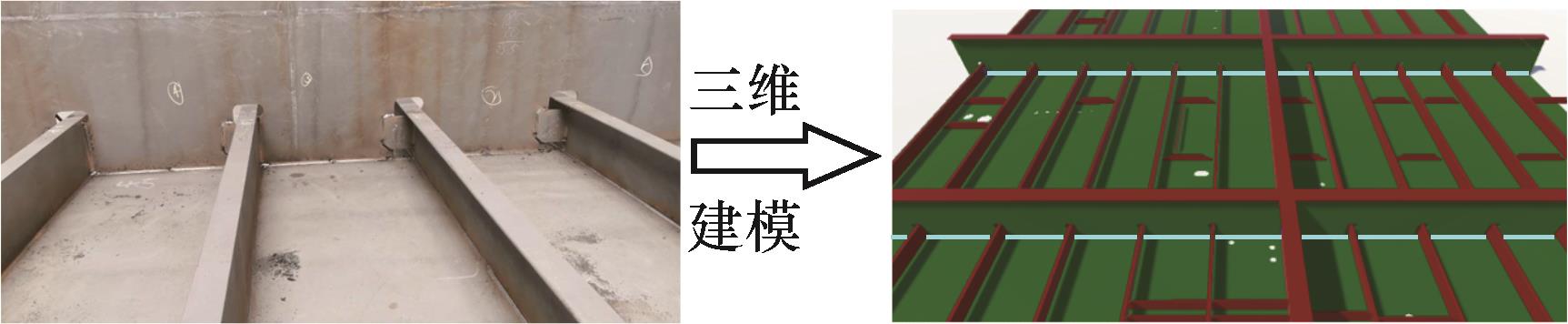
图2 散货船底边舱模型
Fig.2 Bottom and side compartment model of bulk carrier
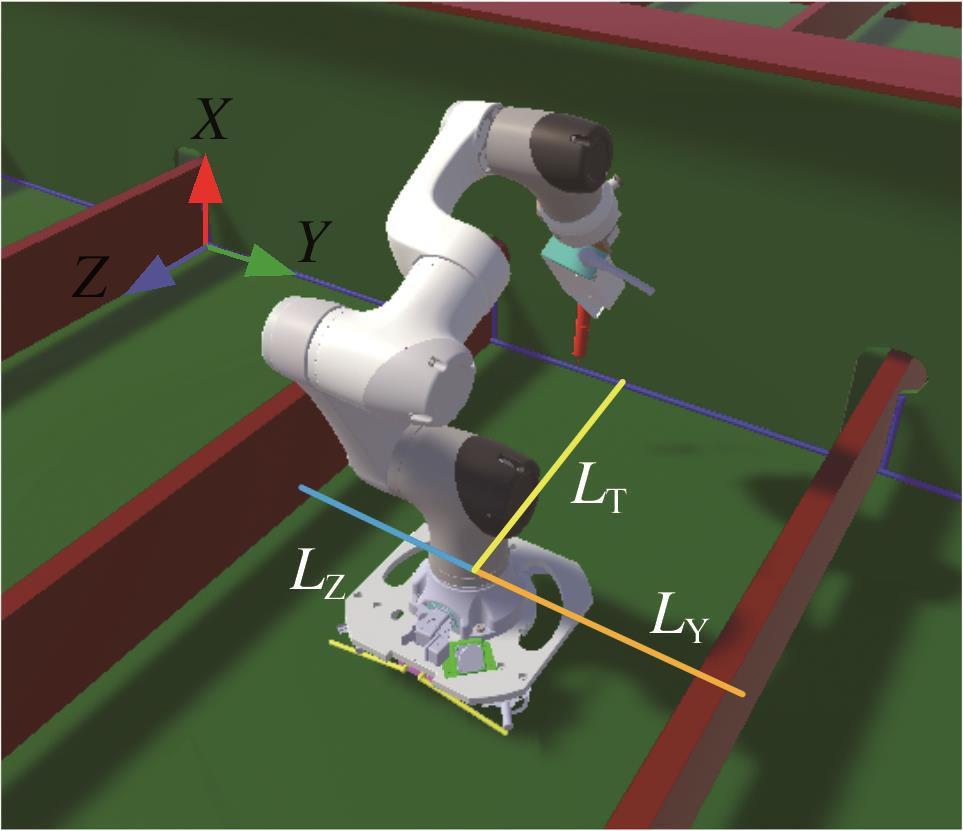
图3 焊接仿真环境
Fig.3 Welding simulation environment
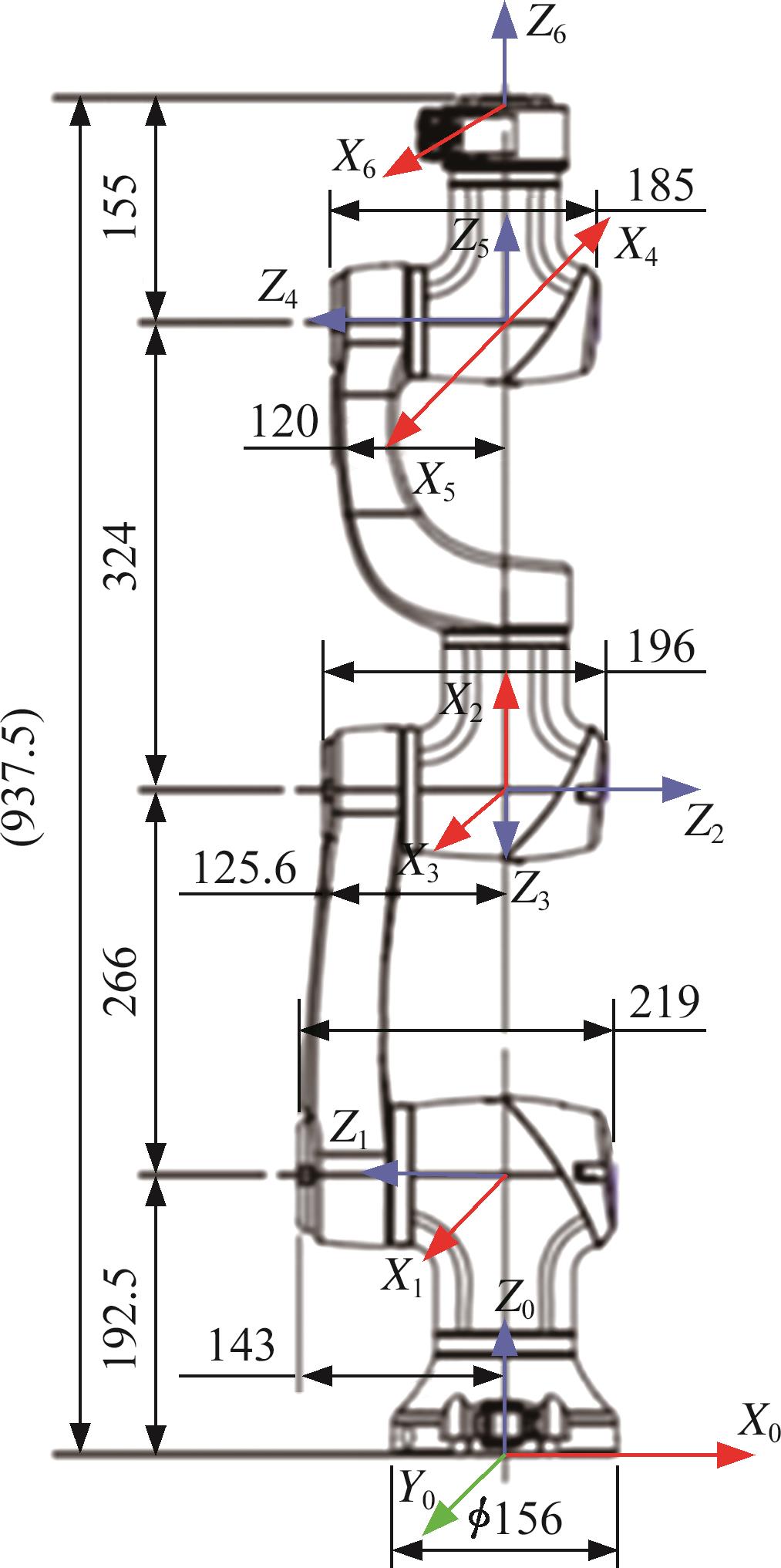
图4 D-H坐标系
Fig.4 The D-H coordinate system
| 关节i | 连杆长度 | 连杆扭角 | 连杆偏距 | 关节角 | 关节角 范围/(°) |
|---|---|---|---|---|---|
| 0-1 | 0 | 90 | 192.5 | ||
| 1-2 | 266 | 180 | 0 | ||
| 2-3 | 0 | 0 | |||
| 3-4 | 0 | 90 | 324 | ||
| 4-5 | 0 | 0 | |||
| 5-6 | 0 | 0 | 155 |
表1 D-H参数
Tab.1 D-H parameters
| 关节i | 连杆长度 | 连杆扭角 | 连杆偏距 | 关节角 | 关节角 范围/(°) |
|---|---|---|---|---|---|
| 0-1 | 0 | 90 | 192.5 | ||
| 1-2 | 266 | 180 | 0 | ||
| 2-3 | 0 | 0 | |||
| 3-4 | 0 | 90 | 324 | ||
| 4-5 | 0 | 0 | |||
| 5-6 | 0 | 0 | 155 |

图5 插值轨迹示意图
Fig.5 Schematic diagram of the interpolation trajectory
| 算法 | 参数 |
|---|---|
| GA | ps=200;gm=1000;pc=0.8;pm=0.5 |
| POS | ps=100;gm=1000;w=0.9;c1=2;c2=2 |
| GA-POS | ps=200;gm=1000; w=0.5; c1=2;c2=2;pc=1;pm=0.2 |
| IGA-POS | ps=200;gm=1000 |
表2 算法参数设置
Tab.2 Algorithm parameter settings
| 算法 | 参数 |
|---|---|
| GA | ps=200;gm=1000;pc=0.8;pm=0.5 |
| POS | ps=100;gm=1000;w=0.9;c1=2;c2=2 |
| GA-POS | ps=200;gm=1000; w=0.5; c1=2;c2=2;pc=1;pm=0.2 |
| IGA-POS | ps=200;gm=1000 |
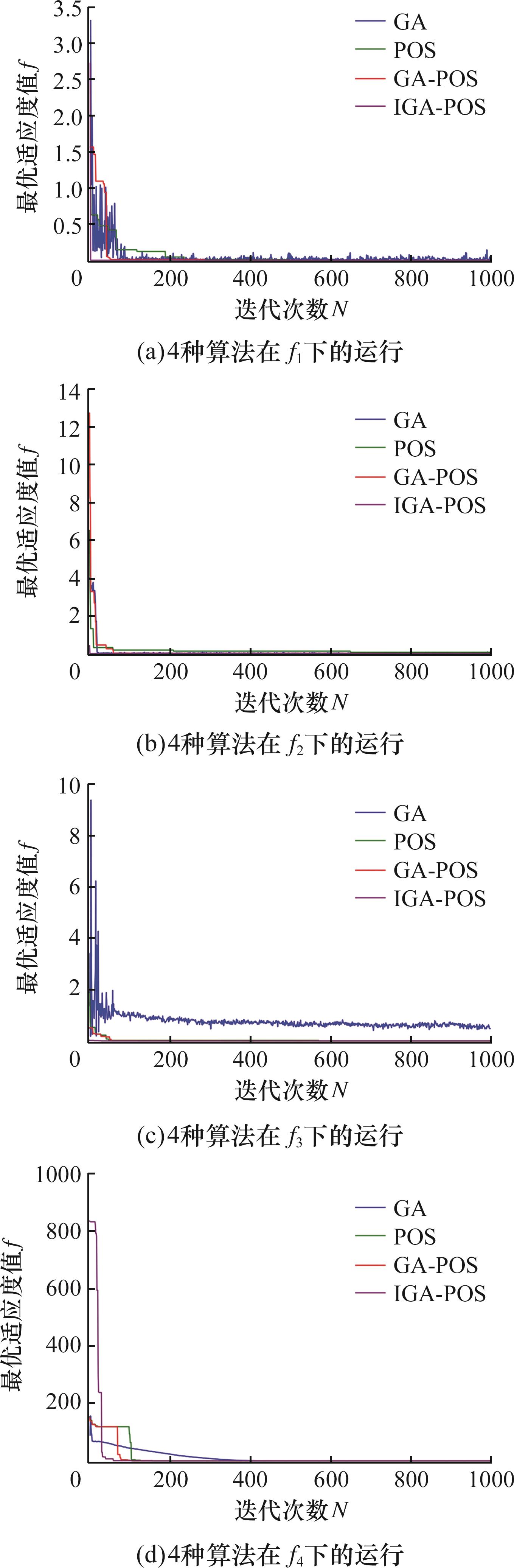
图6 4种算法测试
Fig.6 Tests of four algorithms
| 路径点 | 位置/mm | 姿态/(°) |
|---|---|---|
| 1 | 626.874、222.441、250.428 | 17.493、 |
| 2 | 570.753、112.298、222.240 | 15.658、 |
| 3 | 627.149、12.745、110.951 | 18.469、 |
| 4 | 602.183、 | 5.229、1.399、 |
表3 4个路径点参数
Tab.3 Parameters of four path points
| 路径点 | 位置/mm | 姿态/(°) |
|---|---|---|
| 1 | 626.874、222.441、250.428 | 17.493、 |
| 2 | 570.753、112.298、222.240 | 15.658、 |
| 3 | 627.149、12.745、110.951 | 18.469、 |
| 4 | 602.183、 | 5.229、1.399、 |
| 关节 | 路径点1 | 路径点2 | 路径点3 | 路径点4 |
|---|---|---|---|---|
| 1 | 26.760° | 5.462° | 13.161° | 4.288° |
| 2 | 3.281° | |||
| 3 | 6.322° | |||
| 4 | 12.382° | |||
| 5 | ||||
| 6 | 17.640° |
表4 关节位置
Tab.4 Joint positions
| 关节 | 路径点1 | 路径点2 | 路径点3 | 路径点4 |
|---|---|---|---|---|
| 1 | 26.760° | 5.462° | 13.161° | 4.288° |
| 2 | 3.281° | |||
| 3 | 6.322° | |||
| 4 | 12.382° | |||
| 5 | ||||
| 6 | 17.640° |
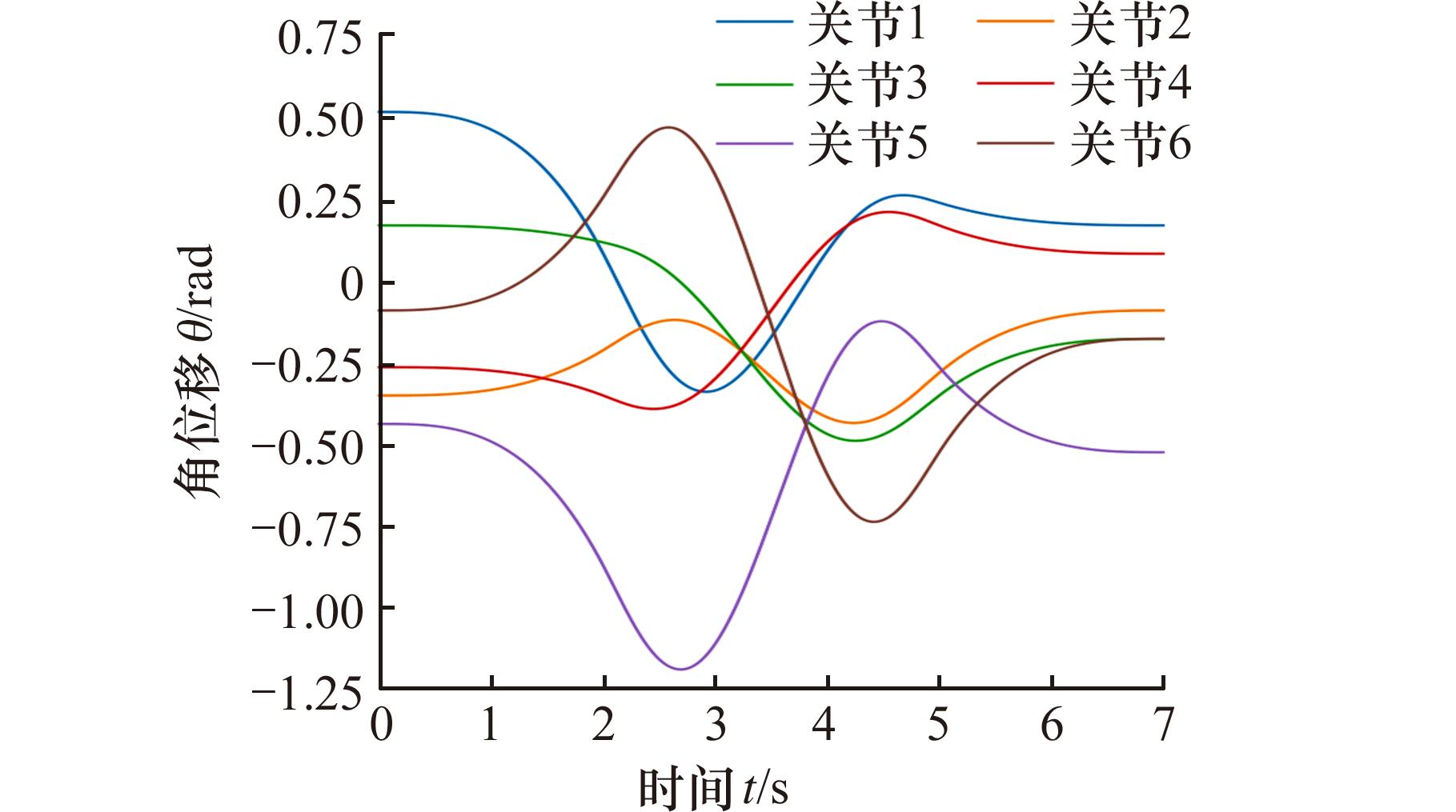
图7 六个关节角位移曲线(优化前)
Fig.7 Displacement curves of six joint angles (before optimization)
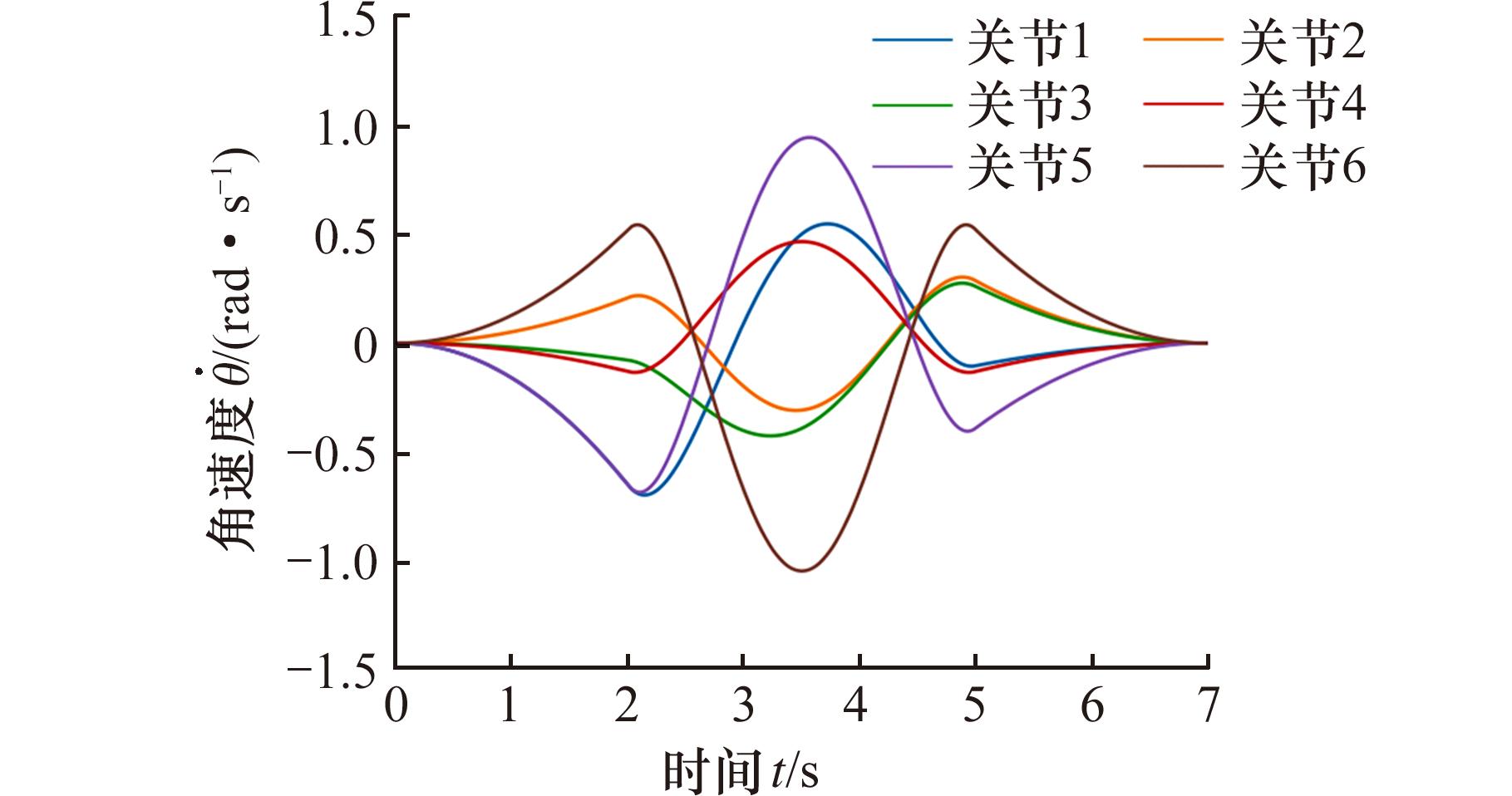
图8 六个关节角速度曲线(优化前)
Fig.8 Angular velocity curves of six joints (before optimization)
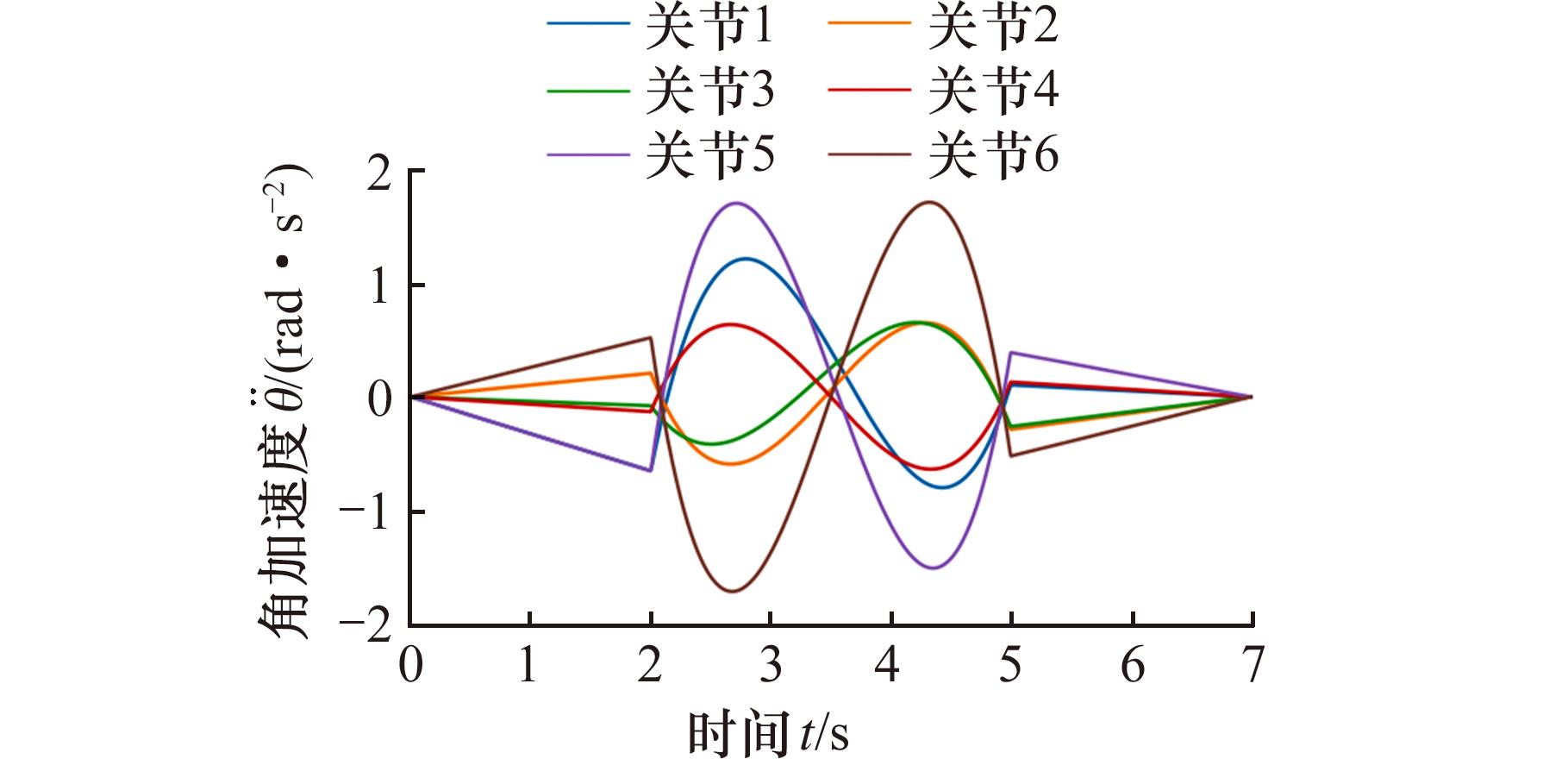
图9 六个关节角加速度曲线(优化前)
Fig.9 Angular acceleration curves of six joints (before optimization)
| 时间 | 关节序号 | |||||
|---|---|---|---|---|---|---|
| 1 | 2 | 3 | 4 | 5 | 6 | |
| t1 | 1.16 | 1.27 | 1.32 | 1.22 | 1.12 | 1.13 |
| t2 | 2.24 | 2.15 | 2.05 | 2.28 | 2.30 | 2.28 |
| t3 | 1.11 | 1.18 | 1.20 | 1.05 | 1.11 | 1.12 |
| 总时间t | 4.51 | 4.60 | 4.58 | 4.55 | 4.52 | 4.53 |
表5 六个关节轨迹规划运行时间 (s)
Tab.5 Running time of trajectory planning for six joints
| 时间 | 关节序号 | |||||
|---|---|---|---|---|---|---|
| 1 | 2 | 3 | 4 | 5 | 6 | |
| t1 | 1.16 | 1.27 | 1.32 | 1.22 | 1.12 | 1.13 |
| t2 | 2.24 | 2.15 | 2.05 | 2.28 | 2.30 | 2.28 |
| t3 | 1.11 | 1.18 | 1.20 | 1.05 | 1.11 | 1.12 |
| 总时间t | 4.51 | 4.60 | 4.58 | 4.55 | 4.52 | 4.53 |
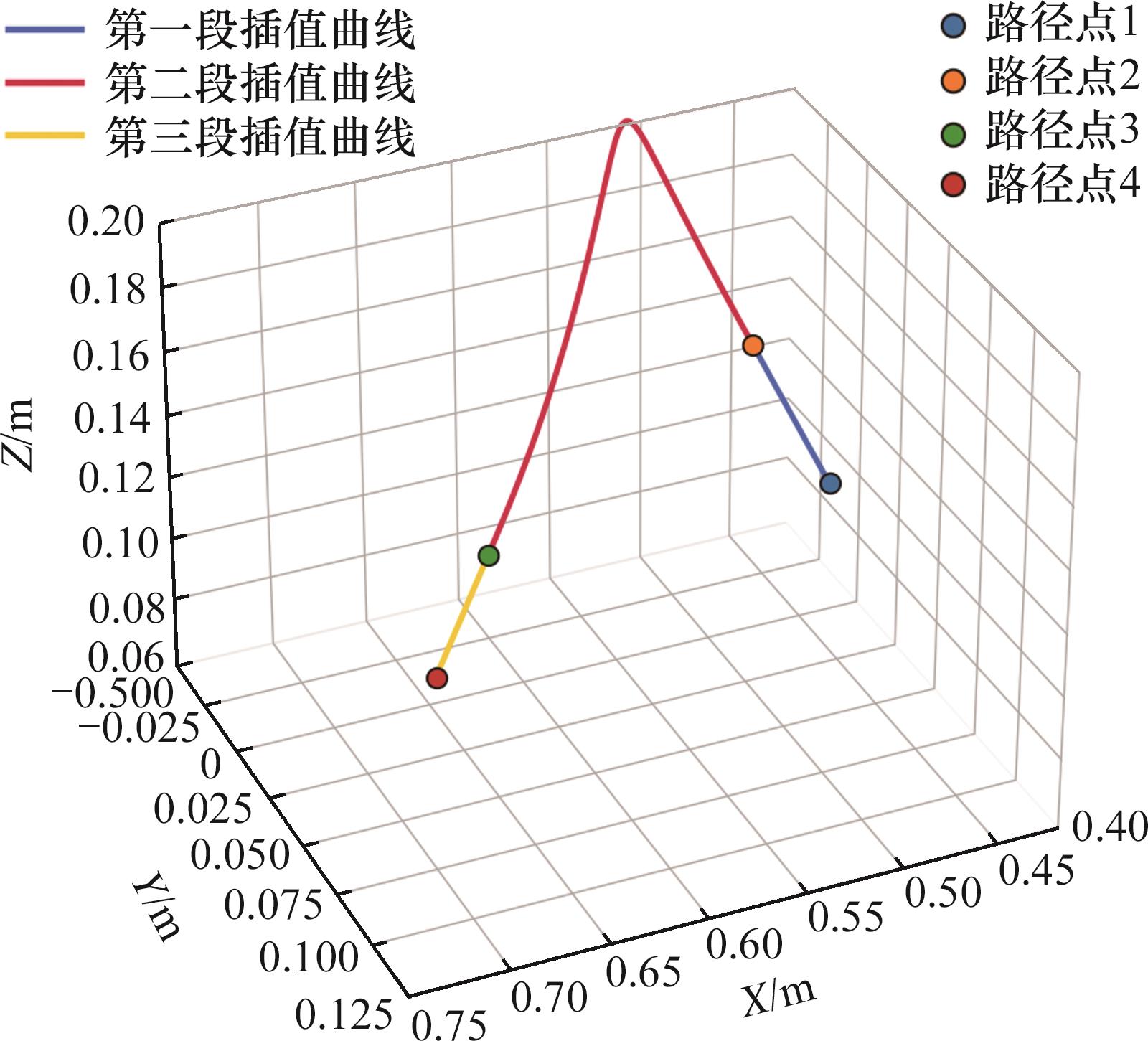
图10 分段多项式轨迹规划空间曲线
Fig.10 Spatial curve of piecewise polynomial trajectory planning
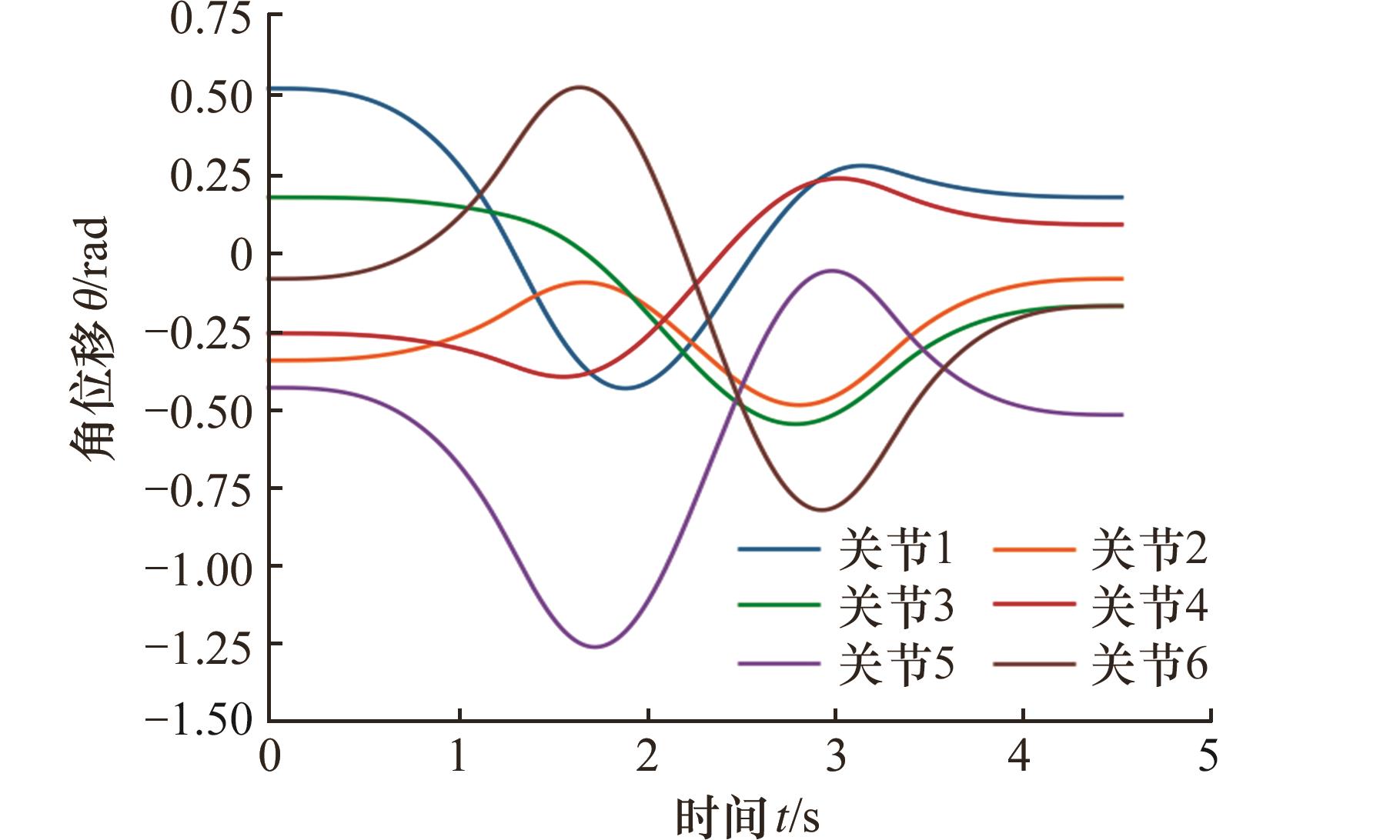
图11 六个关节角位移曲线(优化后)
Fig.11 Angular displacement curves of six joints (after optimization)
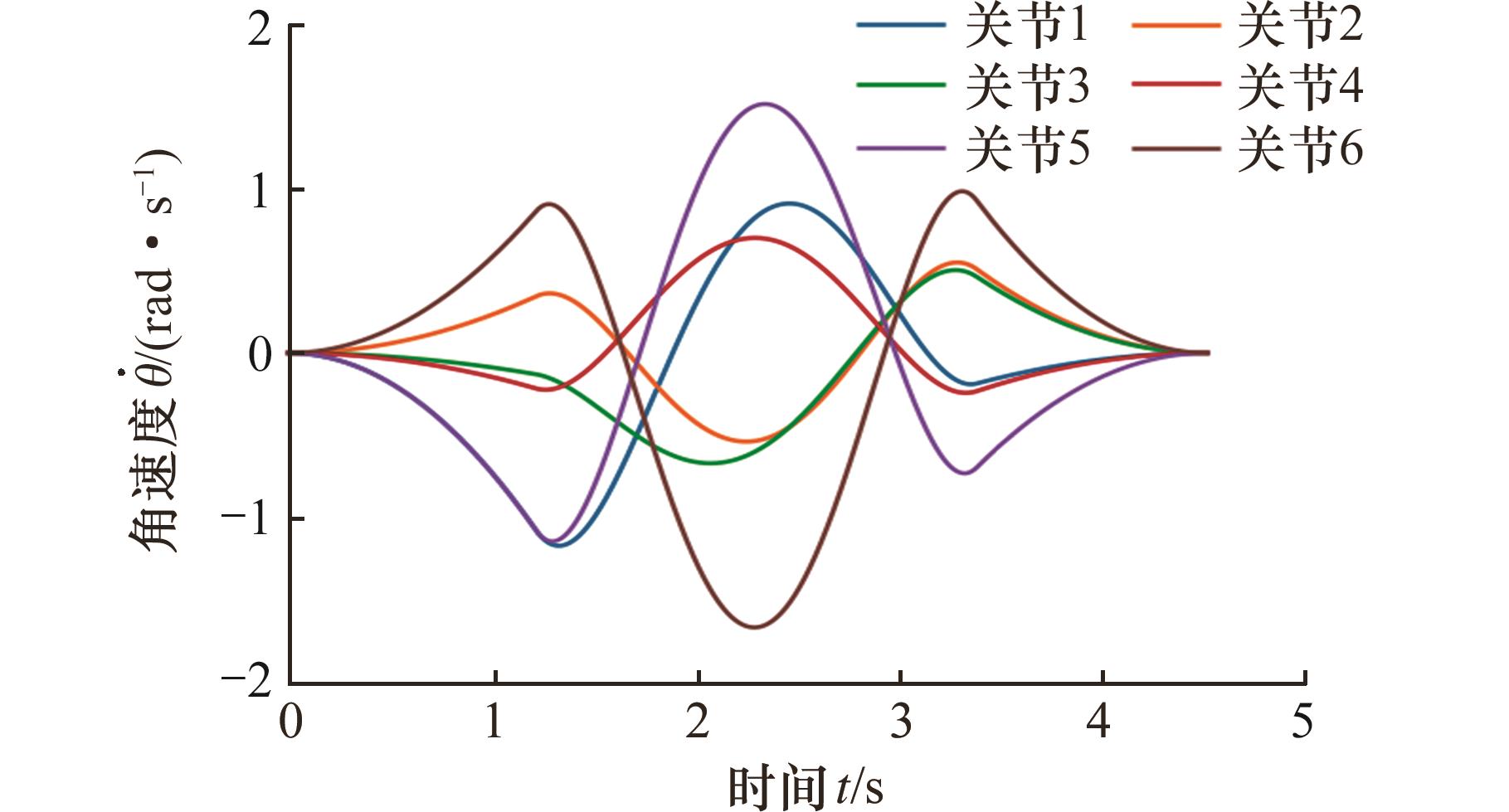
图12 六个关节角速度曲线(优化后)
Fig.12 Angular velocity curves of six joints (after optimization)
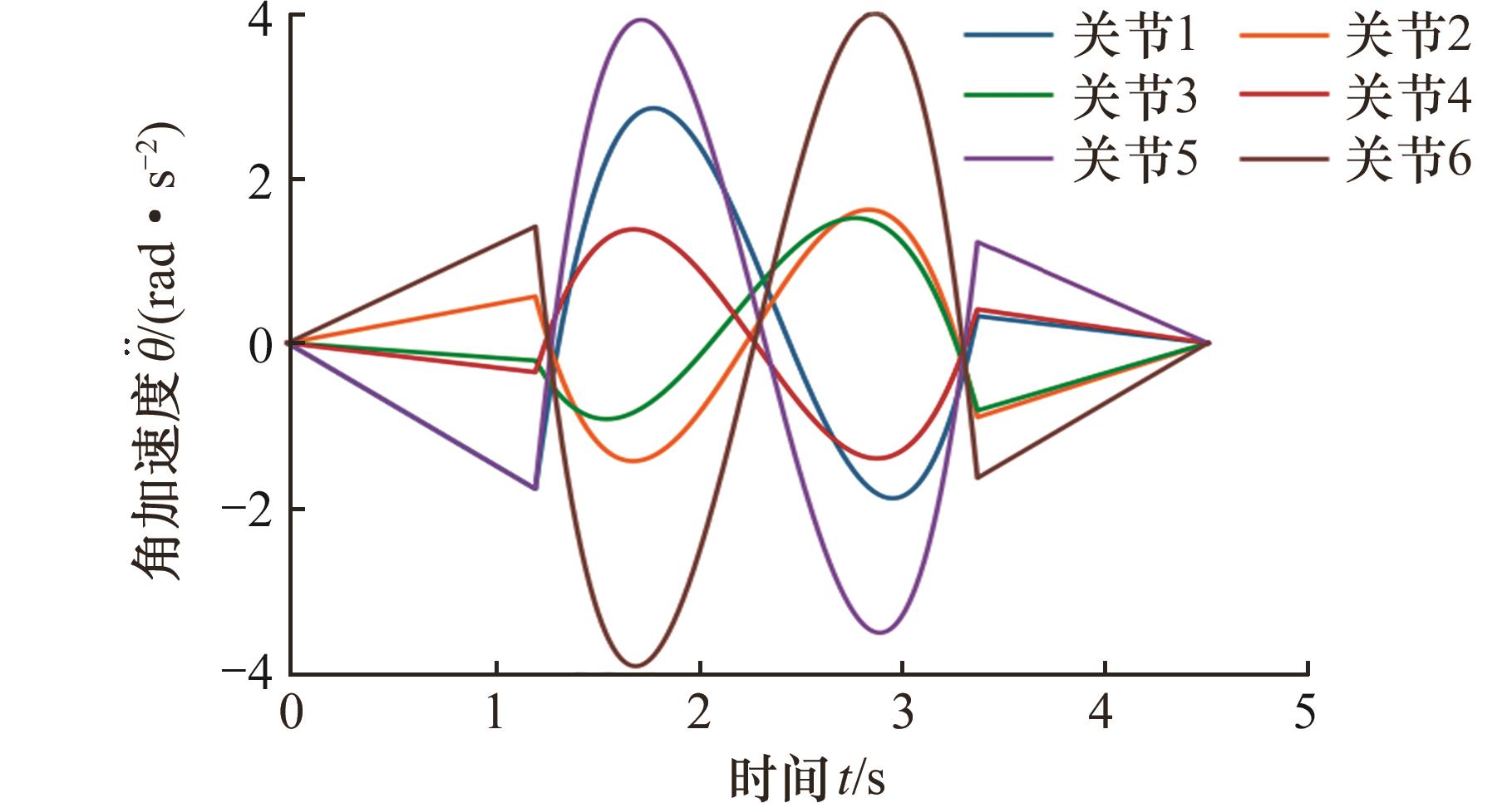
图13 六个关节角加速度曲线(优化后)
Fig.13 Angular acceleration curves of six joints (after optimization)
| 机器人 | 人工 | ||||
|---|---|---|---|---|---|
机器人 焊接 时间/min | 可达率/ % | 人工搬运 与焊接时间/min | 焊接 时间/min | 工人休息 时间/min | |
| 工位1 | 8.23 | 100 | 1.30 | 9.18 | 1.30 |
| 工位2 | 8.47 | 96 | 2.30 | 9.45 | 1.50 |
| 工位3 | 6.03 | 100 | 1.30 | 6.36 | 1.00 |
| 工位4 | 7.02 | 89 | 4.38 | 11.12 | 1.00 |
| 工位5 | 10.03 | 92 | 3.32 | 11.58 | 2.30 |
| 总时间 | 54.58 min | 56.39 min | |||
表6 实验结果对比
Tab.6 Comparison of experimental results
| 机器人 | 人工 | ||||
|---|---|---|---|---|---|
机器人 焊接 时间/min | 可达率/ % | 人工搬运 与焊接时间/min | 焊接 时间/min | 工人休息 时间/min | |
| 工位1 | 8.23 | 100 | 1.30 | 9.18 | 1.30 |
| 工位2 | 8.47 | 96 | 2.30 | 9.45 | 1.50 |
| 工位3 | 6.03 | 100 | 1.30 | 6.36 | 1.00 |
| 工位4 | 7.02 | 89 | 4.38 | 11.12 | 1.00 |
| 工位5 | 10.03 | 92 | 3.32 | 11.58 | 2.30 |
| 总时间 | 54.58 min | 56.39 min | |||
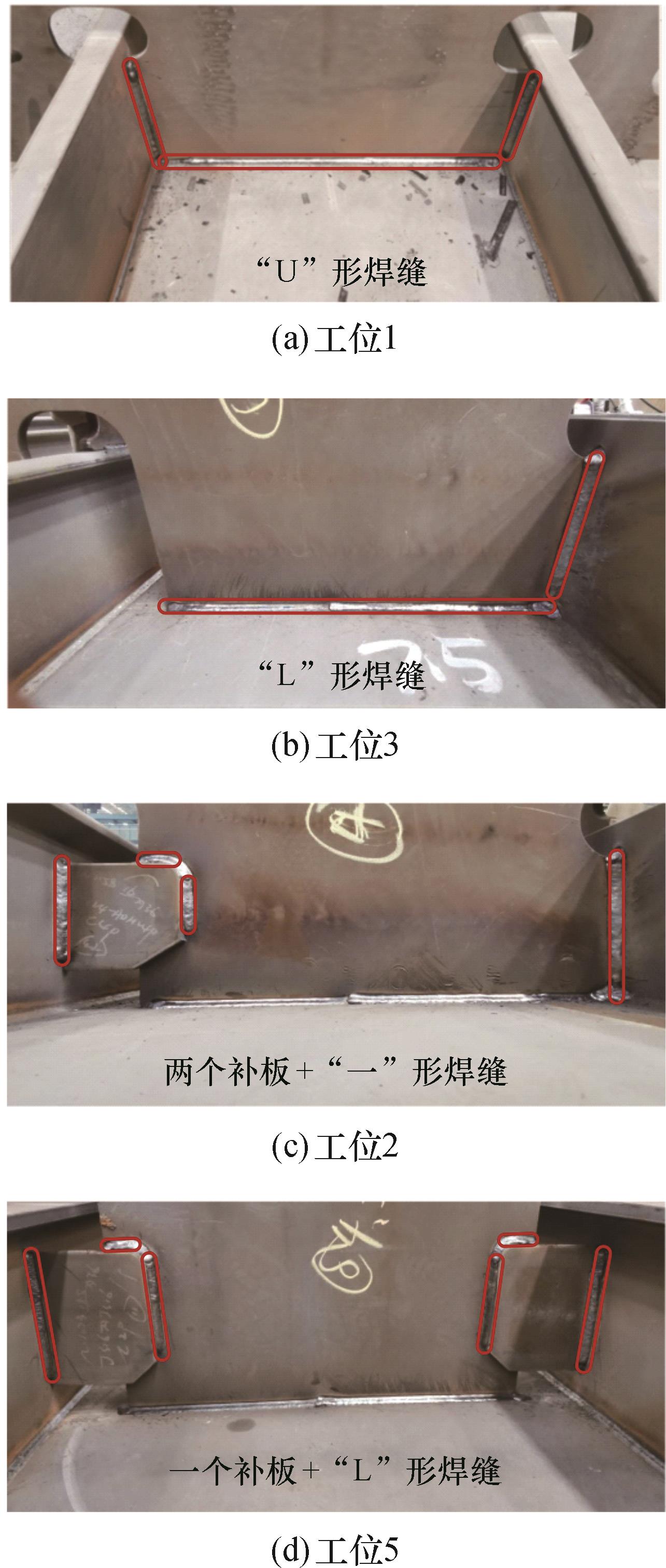
图14 焊接结果对比
Fig. 14 Comparison of welding results
| [1] | LIU Jinfeng, ZHANG Yiming, LIU Zhuoyao, et al. Digital Twins Enable Shipbuilding[J]. Alexandria Engineering Journal, 2024, 107: 915-931. |
| [2] | WANG Xuewu, ZHOU Xin, XIA Zelong, et al. A Survey of Welding Robot Intelligent Path Optimization[J]. Journal of Manufacturing Processes, 2021, 63: 14-23. |
| [3] | MU Song, WANG Jianyong, MU Chunyang. The Chaos Sparrow Search Algorithm: Multi-layer and Multi-pass Welding Robot Trajectory Optimization for Medium and Thick Plates[J]. Journal of Bionic Engineering, 2024, 21(5): 2602-2618. |
| [4] | DOAN N C N, LIN Wei. Optimal Robot Placement with Consideration of Redundancy Problem for Wrist-partitioned 6R Articulated Robots[J]. Robotics and Computer-Integrated Manufacturing, 2017, 48: 233-242. |
| [5] | 吴继春, 张斋武, 杨永达, 等. 基于改进金枪鱼群算法的机械臂时间最优轨迹规划[J]. 计算机集成制造系统, 2024, 30(12): 4292-4301. |
| WU Jichun, ZHANG Zhaiwu, YANG Yongda, et al. Time Optimal Trajectory Planning of Robotic Arm Based on Improved Tuna Swarm Algorithm[J]. Computer Integrated Manufacturing Systems, 2024, 30(12): 4292-4301. | |
| [6] | 高跃, 房立金, 姜雪洁, 等. 一种基于D-H参数的7自由度机械臂机构精度综合方法研究[J]. 仪器仪表学报, 2022, 43(4): 137-145. |
| GAO Yue, FANG Lijin, JIANG Xuejie, et al. Research on the Precision Synthesis Method of a 7 DOF Manipulator Based on D-H Parameters[J]. Chinese Journal of Scientific Instrument, 2022, 43(4): 137-145. | |
| [7] | 伞红军, 杨晓园, 陈久朋, 等. Delta并联机器人运动学性能分析与结构参数优化[J]. 农业机械学报, 2024, 55(8): 446-458. |
| HongjunSAN, YANG Xiaoyuan, CHEN Jiupeng, et al. Kinematic Performance Analysis and Structural Parameter Optimization of Delta Parallel Robot[J]. Transactions of the Chinese Society for Agricultural Machinery, 2024, 55(8): 446-458. | |
| [8] | WANG Tao, XUE Zhilong, DONG Xiaoqing, et al. Autonomous Intelligent Planning Method for Welding Path of Complex Ship Components[J]. Robotica, 2021, 39(3): 428-437. |
| [9] | 刘汉强, 常志远, 王建伟, 等. 基于改进遗传粒子群算法的机械臂轨迹规划算法研究[J]. 制造技术与机床, 2024(12): 13-20. |
| LIU Hanqiang, CHANG Zhiyuan, WANG Jianwei, et al. Research on Trajectory Planning Algorithm of Robotic Arm Based on Improved Genetic Particle Swarm Optimization[J]. Manufacturing Technology & Machine Tool, 2024(12): 13-20. | |
| [10] | 李明伟, 王梓鹤, 杨中仪, 等. 计入船舶待闸时间影响的船闸调度优化方法研究[J]. 哈尔滨工程大学学报, 2025, 46(5): 848-857. |
| LI Mingwei, WANG Zihe, YANG Zhongyi, et al. Research on Optimization Method for Ship Lock Scheduling Considering the Impact of Ship Waiting Time[J]. Journal of Harbin Engineering University, 2025, 46(5): 848-857. | |
| [11] | 张良力, 马晓凤. 基于改进粒子群算法的新能源汽车充电站选址方法[J]. 吉林大学学报(工学版), 2024, 54(8): 2275-2281. |
| ZHANG Liangli, MA Xiaofeng. New Energy Vehicle Charging Station Location Method Based on Improved Particle Swarm Optimization Algorithm[J]. Journal of Jilin University (Engineering and Technology Edition), 2024, 54(8): 2275-2281. | |
| [12] | 陈璐璐, 邱建林, 陈燕云, 等. 改进的遗传粒子群混合优化算法[J]. 计算机工程与设计, 2017, 38(2): 395-399. |
| CHEN Lulu, QIU Jianlin, CHEN Yanyun, et al. Improved Hybrid Optimization Algorithms Based on Genetic Algorithm and Particle Swarm Optimization[J]. Computer Engineering and Design, 2017, 38(2): 395-399. |
| [1] | 李明磊, 贾育秦, 张学良, 刘丽琴, 杜娟, 温淑花, 兰国生. 基于多目标差异演化算法的并联机构结构优化 [J]. J4, 201016, 21(16): 1915-1920. |
| [2] | 付昊成, 吴少伟, 姜潮. 基于蒙特卡罗减方差方法的图像传感器辐射屏蔽结构多目标优化设计[J]. 中国机械工程, 2026, 37(5): 1045-1053. |
| [3] | 王冰旭, 高彤, 万敏, 焦龙飞, 蔚飞, 张卫红. 结合部对精密机床动态特性影响的分析[J]. 中国机械工程, 2026, 37(5): 1111-1121. |
| [4] | 曹卫东, 汪袁烁, 李闽榕, 陈富祺, 陈行政, 吴电建, 胡可心. 滚齿刀具和控制参数超启发优化与决策[J]. 中国机械工程, 2026, 37(4): 846-854. |
| [5] | 张雷, 张振, 刘润泽. 制造特征智能解析驱动的零件低碳工艺优化方法[J]. 中国机械工程, 2026, 37(4): 929-938. |
| [6] | 杨洁, 江志刚, 朱硕, 陈鑫, 张华. 多寿命特征下再制造机电产品全工作域可靠性设计研究进展[J]. 中国机械工程, 2026, 37(4): 987-998. |
| [7] | 赵丁选, 郭瑞, 王硕, 闫长长, 王子鹤, 张天赐. 复杂地形环境下无人步履式挖掘机的车身姿态规划方法[J]. 中国机械工程, 2026, 37(1): 233-242. |
| [8] | 党旭, 刘涛, 闫敏, 徐智为. 变截面涡旋盘精密铣削参数多目标优化[J]. 中国机械工程, 2025, 36(12): 2854-2861. |
| [9] | 刘建林, 黄海松, 范青松, 马驰, 张浪浪. 基于改进樽海鞘群算法的机械臂多目标轨迹规划研究[J]. 中国机械工程, 2025, 36(09): 2047-2056. |
| [10] | 林述温, 陆哲, 危世佳, 陈剑雄, 顾天奇, 谢钰. 挖掘机工作过程动力特性仿真及主构件参数多目标优化设计方法[J]. 中国机械工程, 2025, 36(06): 1371-1379. |
| [11] | 饶远1, 孙见君1, 闻兰2. 扩压式自泵送机械密封端面的液膜汽化及其结构优化研究[J]. 中国机械工程, 2025, 36(05): 933-941,953. |
| [12] | 张道德, 卢子健, 赵坤, 杨智勇. 非平坦环境下履带机器人多目标路径规划方法研究[J]. 中国机械工程, 2025, 36(02): 305-314. |
| [13] | 刘桂源1, 王曾2, 杨子艺2, 胡明珠1, 刘怀举1. 航空发动机附件机匣齿轮传动设计分析软件开发与应用[J]. 中国机械工程, 2024, 35(11): 1938-1947. |
| [14] | 胡福清, 孙江宏, 孙英杰, 孙雨彤, 马超, 周福强, . 基于新型旋转直线往复机构的切片机设计分析及参数优化[J]. 中国机械工程, 2024, 35(04): 614-623,635. |
| [15] | 魏书鹏, 唐红涛, 李西兴, 杨冠宇, 张健. 考虑双资源约束的柔性机械加工车间逆调度问题研究[J]. 中国机械工程, 2024, 35(03): 457-471. |
| 阅读次数 | ||||||
|
全文 |
|
|||||
|
摘要 |
|
|||||
