



ISSN 1004-132X
CN 42-1294/TH
CN 42-1294/TH
中国机械工程 ›› 2025, Vol. 36 ›› Issue (11): 2738-2746.DOI: 10.3969/j.issn.1004-132X.2025.11.032
胡梦杰( ), 方宇航, 秦绪佳(), 吴正强
收稿日期:2024-10-18
出版日期:2025-11-25
发布日期:2025-12-09
通讯作者:
秦绪佳
作者简介:胡梦杰,女,2000年生,硕士研究生。研究方向为计算机图形学以及数字图像处理。E-mail:2756173160@qq.com
Mengjie HU(), Yuhang FANG, Xujia QIN(), Zhengqiang WU
Received:2024-10-18
Online:2025-11-25
Published:2025-12-09
Contact:
Xujia QIN
摘要:
针对基于点云的深度学习自动排牙方法数据依赖性强、咬合准确度低等问题,提出了一种基于网格特征的深度学习自动排牙方法。设计的模型包括形状编码器、全局特征编码器、特征解码与映射器以及牙齿咬合生成网络。形状编码器从牙齿模型表面的三角网格数据中提取牙齿形状特征,全局特征编码器从简化后的牙齿点云中提取牙列全局特征,特征解码与映射器则对牙齿全局特征、牙齿局部特征进行融合降维,生成最终的排牙结果,减少了数据依赖性,牙齿咬合生成网络基于颌骨空间位置关系和牙齿特征生成上下牙咬合面,提高了上下牙咬合准确性。为进一步提高模型性能,在损失函数中引入了相似性损失函数,有助于防止过拟合,提高了自动排牙的质量。实验结果表明,与四种现有方法相比,该方法在ADD指标上均有降低,显著提高了深度学习自动排牙的准确度。
中图分类号:
胡梦杰, 方宇航, 秦绪佳, 吴正强. 基于网格特征的自动排牙方法[J]. 中国机械工程, 2025, 36(11): 2738-2746.
Mengjie HU, Yuhang FANG, Xujia QIN, Zhengqiang WU. Automatic Tooth Alignment Method Based on Mesh Features[J]. China Mechanical Engineering, 2025, 36(11): 2738-2746.
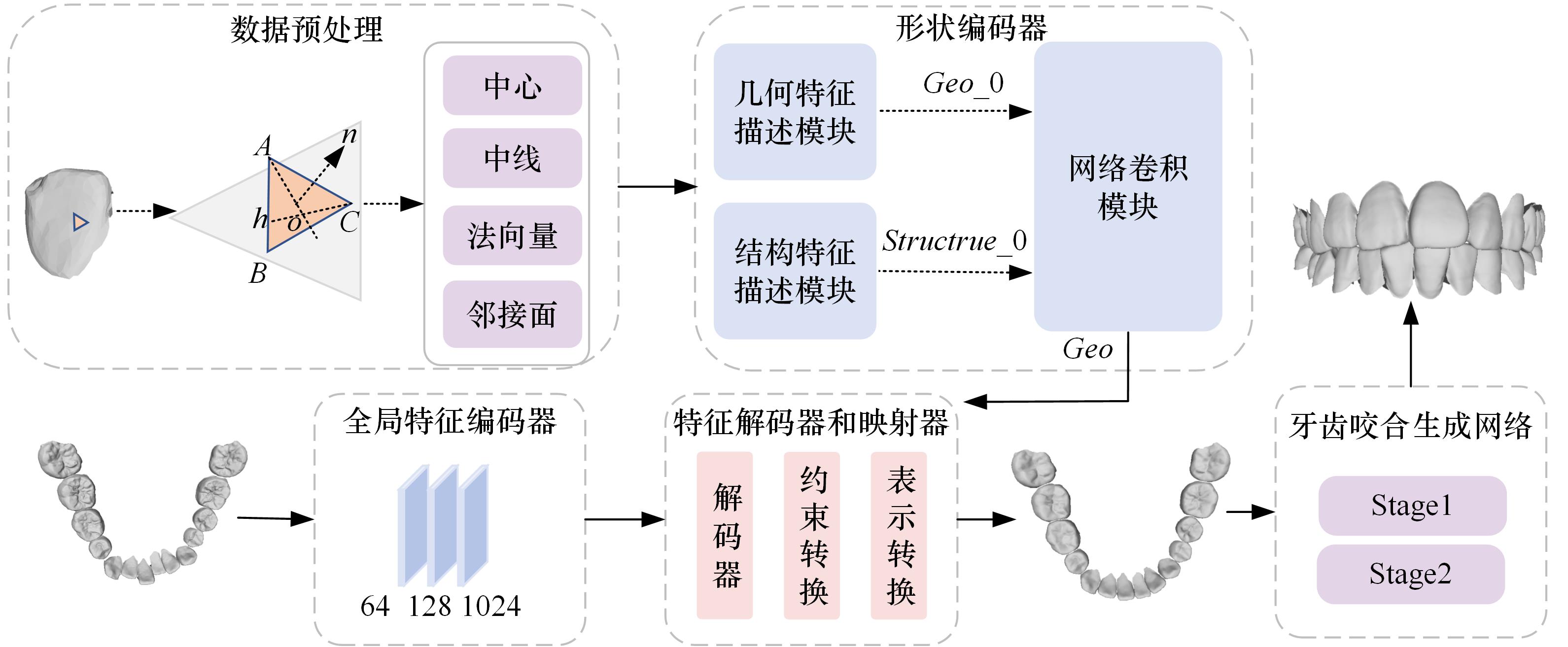
图1 Mbtanet模型结构
Fig.1 Structure of Mbtanet model
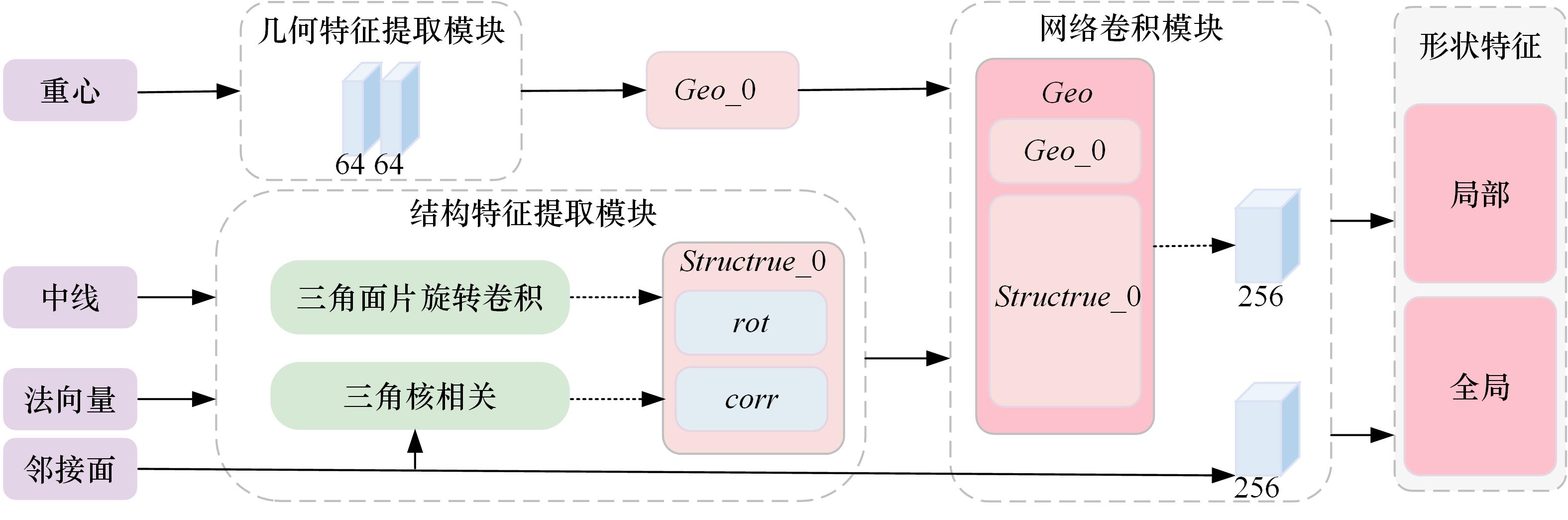
图2 形状编码器
Fig.2 Shape encoder
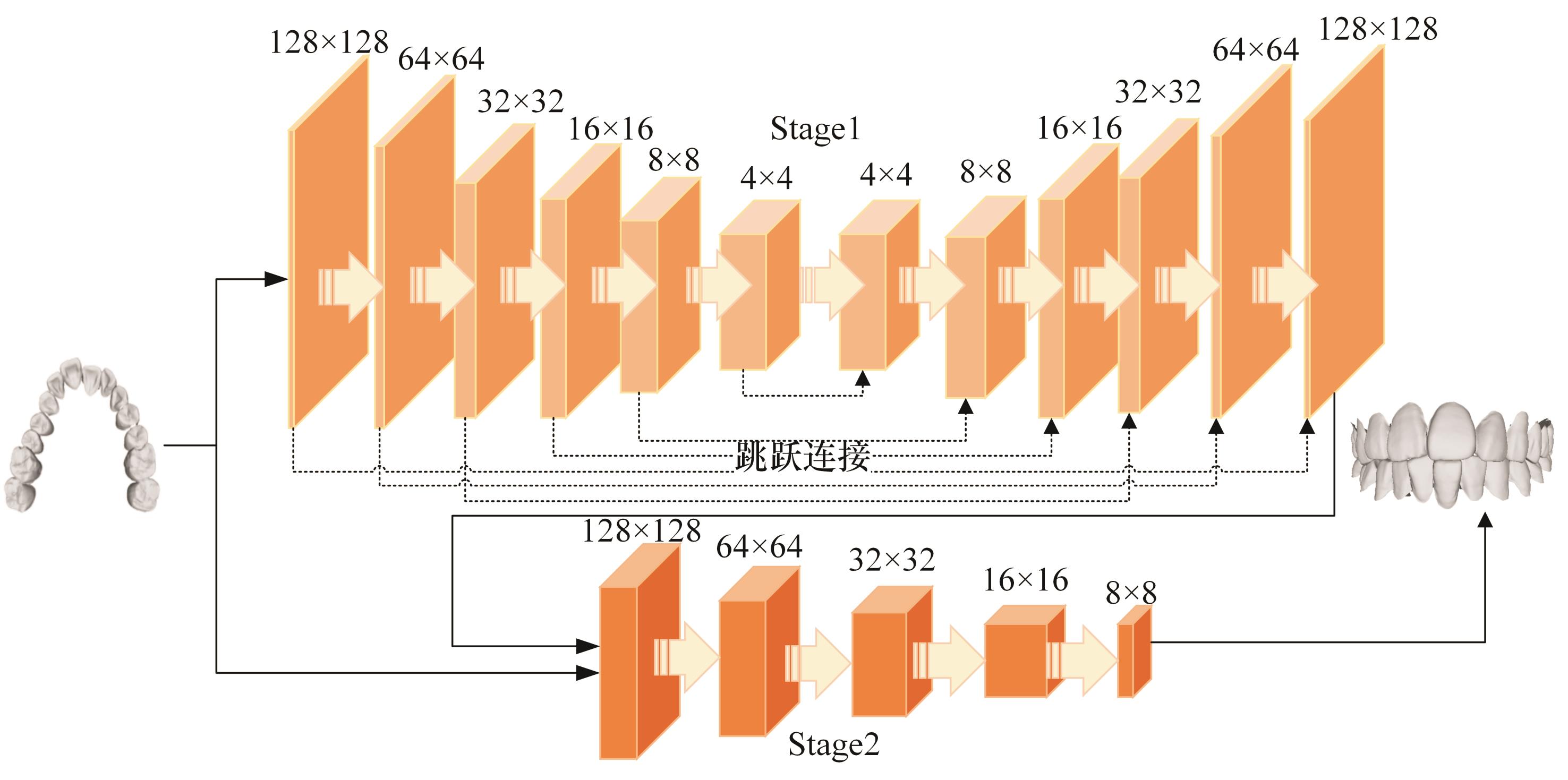
图3 牙齿咬合生成网络
Fig.3 Tooth occlusion generating network
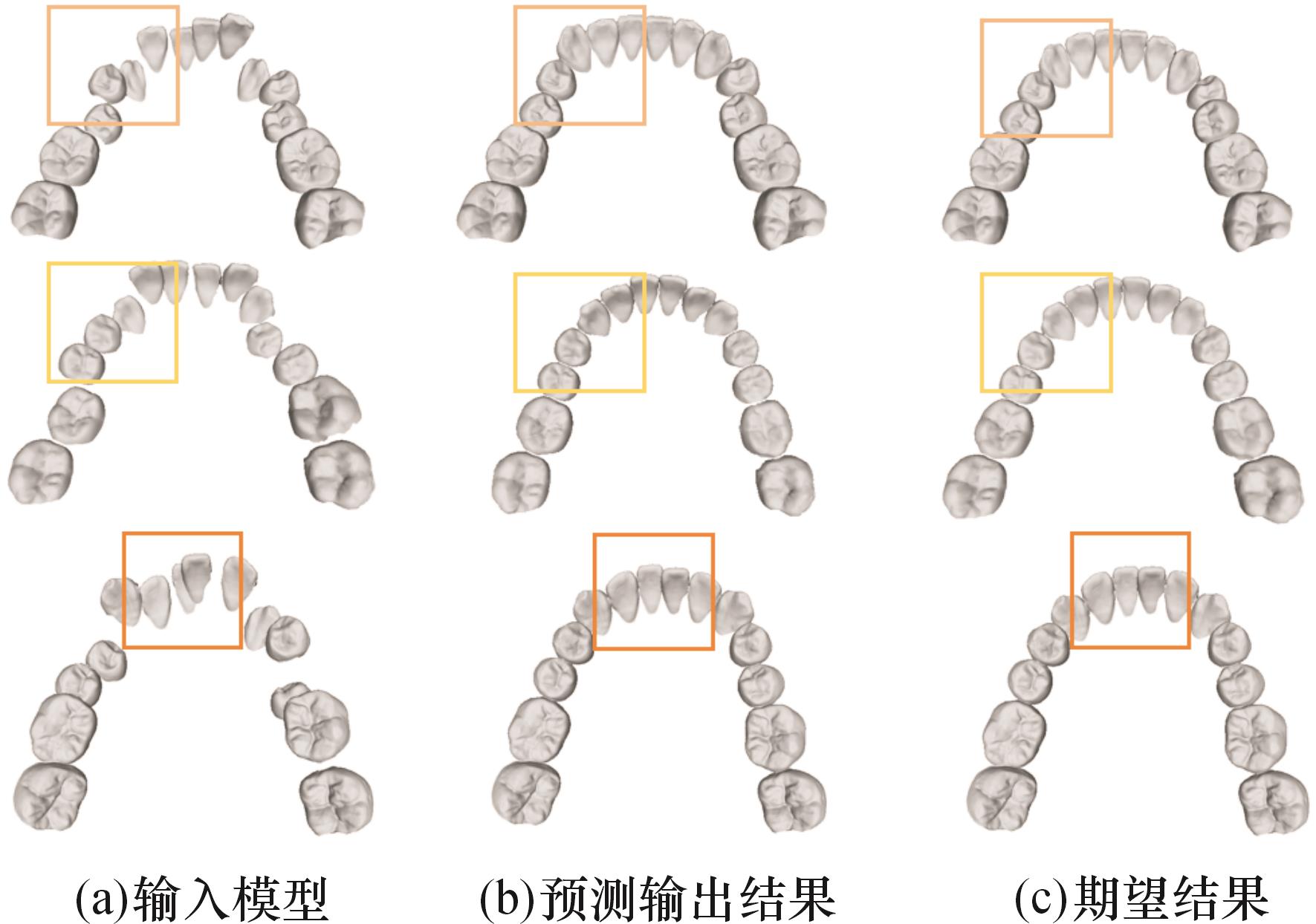
图4 增强模型输出结果
Fig.4 Results of enhance model
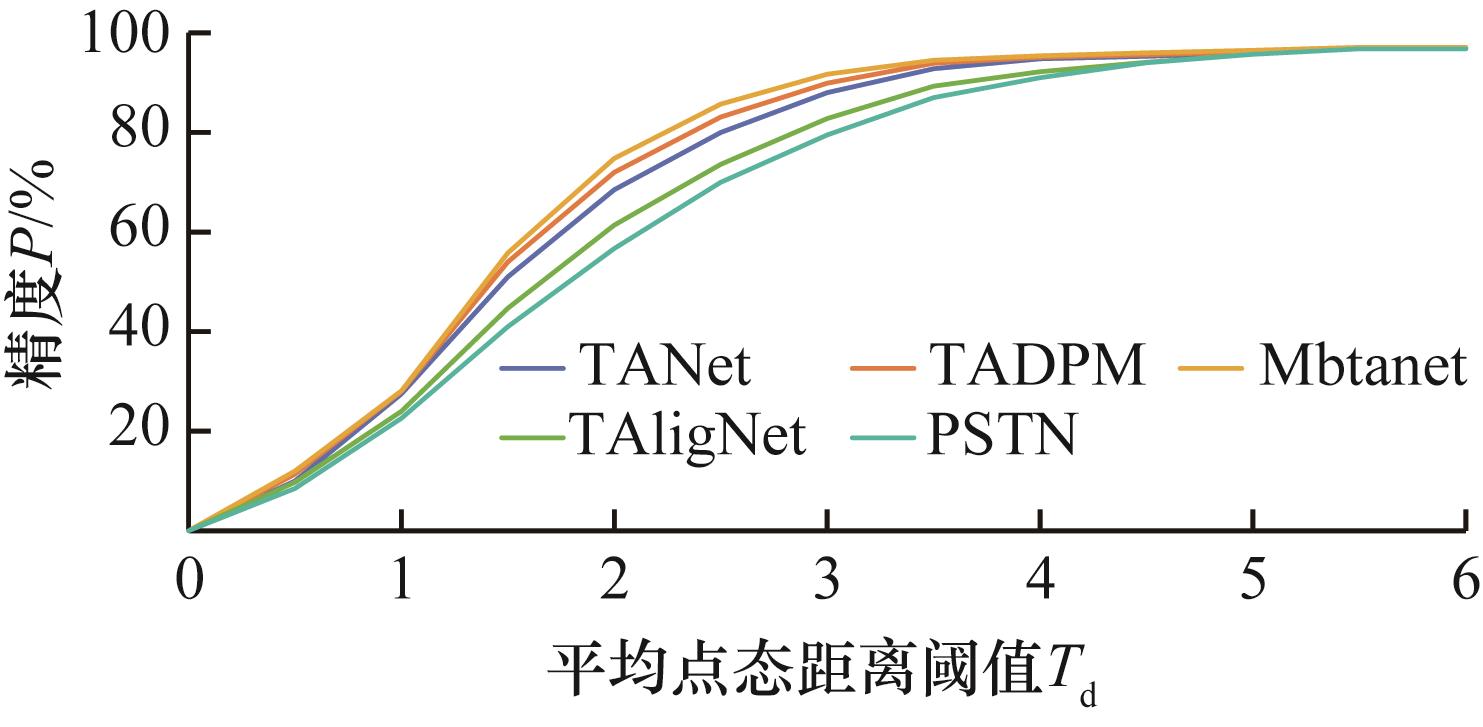
图5 不同方法下精度对比图
Fig.5 Comparison of precision under different methods
| 方法 | ADD | PA-ADD | CSA | MErot | FDcur | Mean TRE |
|---|---|---|---|---|---|---|
| PSTN | 1.793 | 1.447 | 0.785 | 6.103 | 2.565 | 0.3426 |
| TAligNet | 1.761 | 1.425 | 0.789 | 5.922 | 2.678 | 0.3354 |
| TANet | 1.597 | 1.333 | 0.823 | 5.585 | 2.321 | 0.3201 |
| TADPM | 1.582 | 1.316 | 0.859 | 5.581 | 2.229 | 0.3125 |
| Mbtanet(本文) | 1.562 | 1.299 | 0.878 | 5.585 | 2.207 | 0.3001 |
表1 不同方法的性能比较
Tab.1 Performance comparison of different methods
| 方法 | ADD | PA-ADD | CSA | MErot | FDcur | Mean TRE |
|---|---|---|---|---|---|---|
| PSTN | 1.793 | 1.447 | 0.785 | 6.103 | 2.565 | 0.3426 |
| TAligNet | 1.761 | 1.425 | 0.789 | 5.922 | 2.678 | 0.3354 |
| TANet | 1.597 | 1.333 | 0.823 | 5.585 | 2.321 | 0.3201 |
| TADPM | 1.582 | 1.316 | 0.859 | 5.581 | 2.229 | 0.3125 |
| Mbtanet(本文) | 1.562 | 1.299 | 0.878 | 5.585 | 2.207 | 0.3001 |
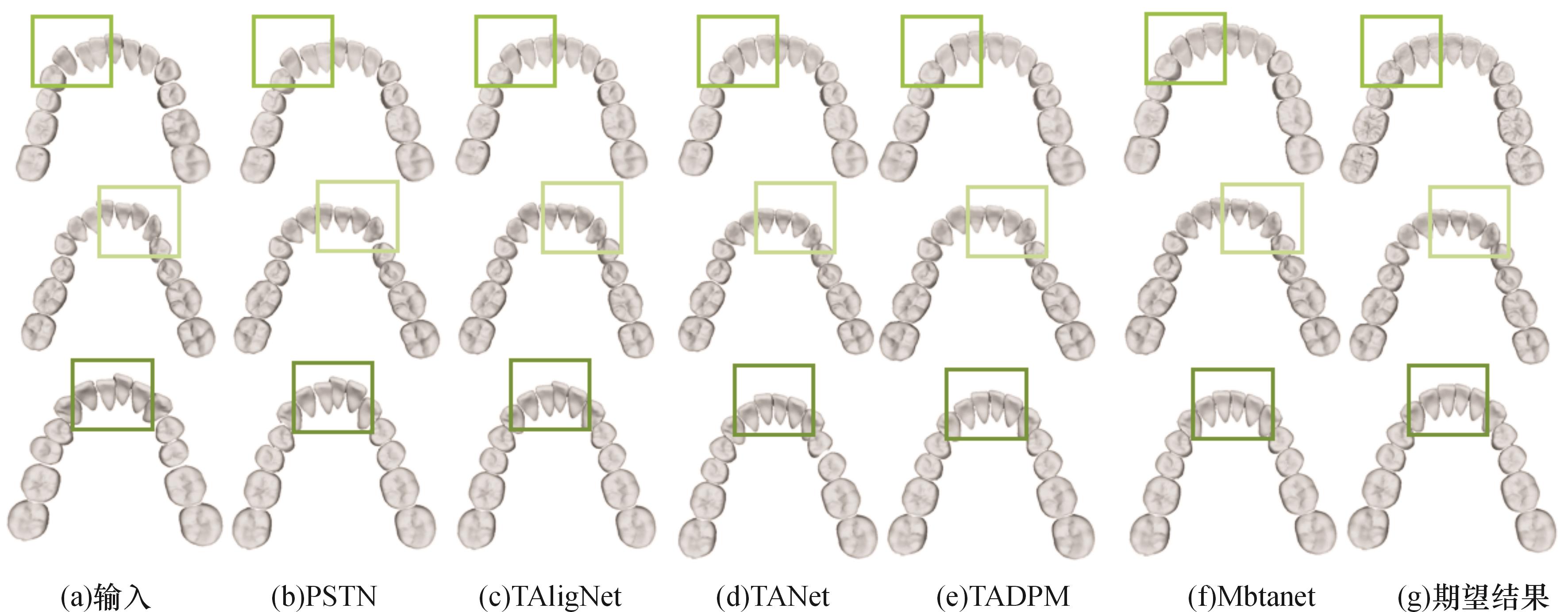
图6 牙列结果对比图
Fig.6 Comparison of dental alignment results
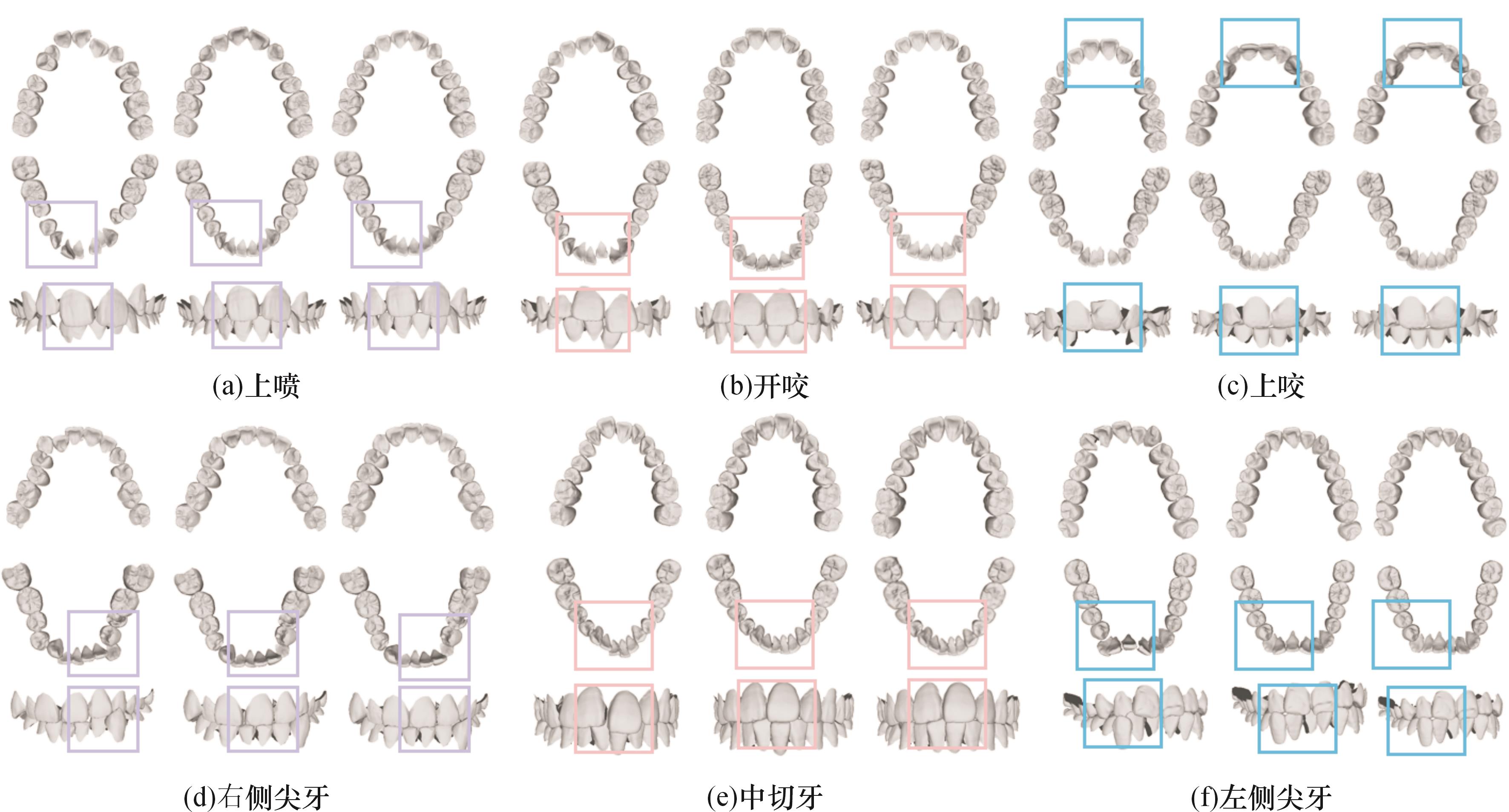
图7 不同咬合问题的输出结果
Fig.7 Results of different occlusion problems
| 损失 | ADD | PA-ADD | CSA | MErot | FDcur | Mean TRE |
|---|---|---|---|---|---|---|
| 1.648 | 1.456 | 0.849 | 5.658 | 2.378 | 0.3194 | |
| 1.635 | 1.359 | 0.834 | 5.669 | 2.285 | 0.3207 | |
| 1.728 | 1.556 | 0.836 | 5.681 | 2.364 | 0.3266 | |
| 1.571 | 1.347 | 0.852 | 5.640 | 2.247 | 0.3139 | |
| 1.562 | 1.299 | 0.878 | 5.585 | 2.207 | 0.3001 |
表2 消融实验结果
Tab.2 Results of ablation experiment
| 损失 | ADD | PA-ADD | CSA | MErot | FDcur | Mean TRE |
|---|---|---|---|---|---|---|
| 1.648 | 1.456 | 0.849 | 5.658 | 2.378 | 0.3194 | |
| 1.635 | 1.359 | 0.834 | 5.669 | 2.285 | 0.3207 | |
| 1.728 | 1.556 | 0.836 | 5.681 | 2.364 | 0.3266 | |
| 1.571 | 1.347 | 0.852 | 5.640 | 2.247 | 0.3139 | |
| 1.562 | 1.299 | 0.878 | 5.585 | 2.207 | 0.3001 |
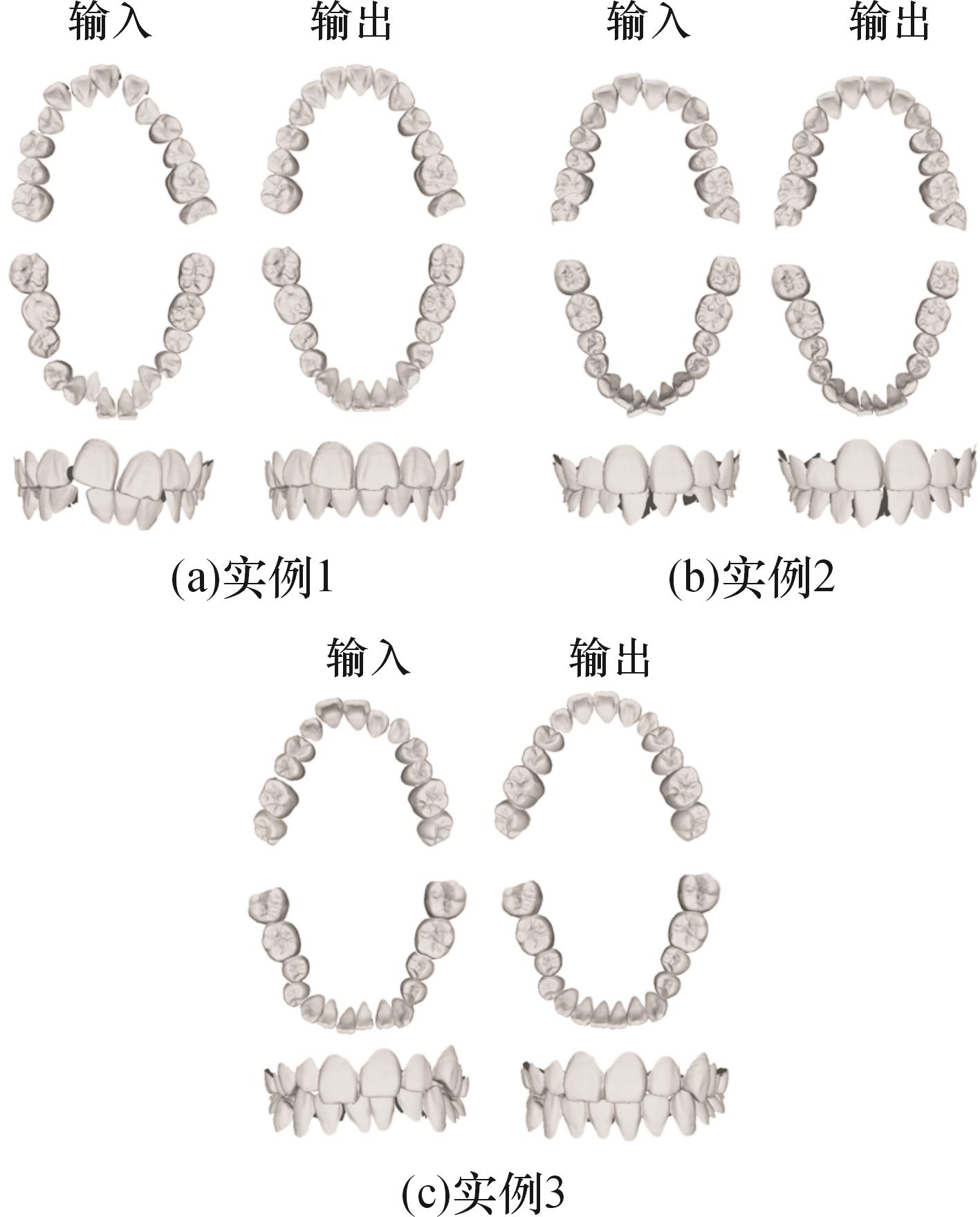
图8 排牙实例测试结果
Fig.8 Test result of dental alignment example
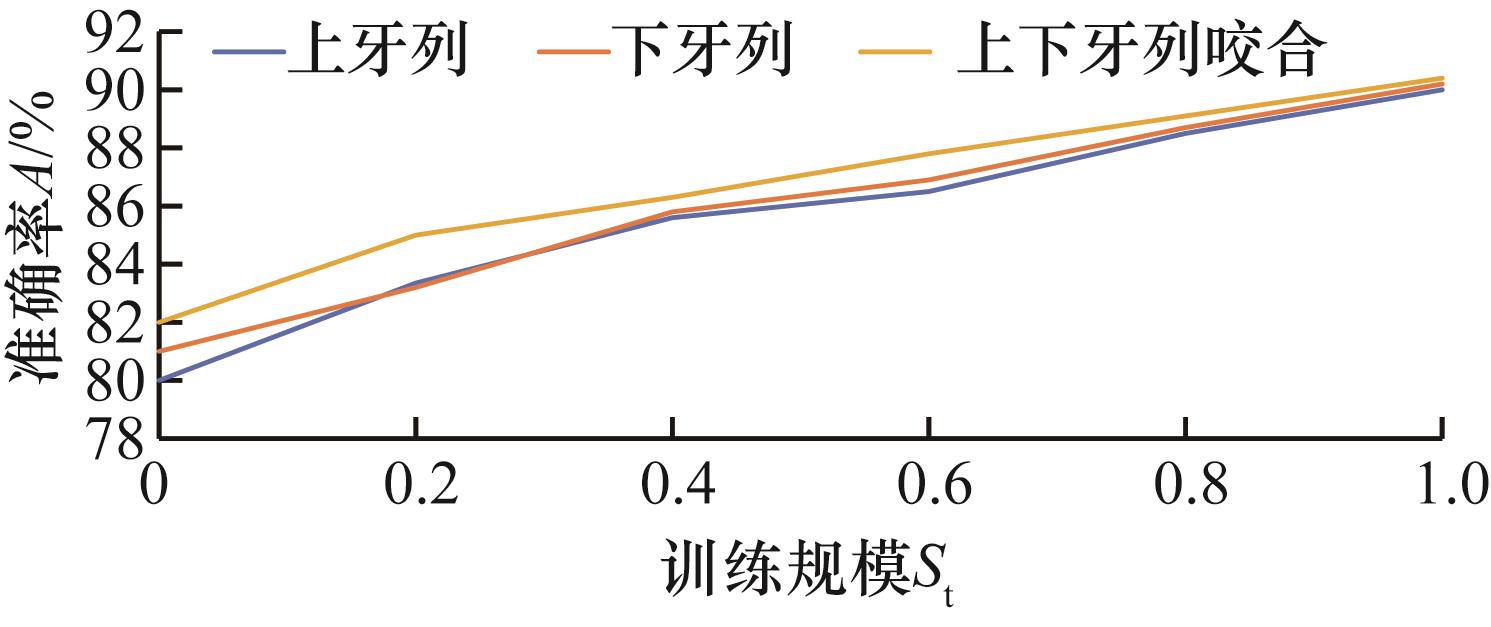
图9 排牙测试准确率
Fig.9 Accuracy of tooth arrangement testing
| [1] | DOU Y L, SHEN D G, CUI Z M, et al. 3D Structure Guided Network for Tooth Alignment in 2D Photograph[J]. arXiv: 2310. 11106, 2023. |
| [2] | 姜金刚,陈厚鋆,马雪峰,等.个性化正畸弓丝成形规划方法及实验研究[J]. 中国机械工程, 2020, 31(11): 1323-1330. |
| JIANG Jingang, CHEN Houjun, MA Xuefeng, et al. Forming Planning Method and Experimentation of Personalized Orthodontic Archwires[J]. China Mechanical Engineering, 2020, 31(11): 1323-1330. | |
| [3] | DAI N, YU X, FAN Q, et al. Complete Denture Tooth Arrangement Technology Driven by a Reconfigurable Rule[J]. PLoS ONE, 2018, 13(6): 452-457. |
| [4] | WANG C, WEI G, WANG W, et al. Tooth Alignment Network Based on Landmark Constraintsand Hierarchicalgraph Structure[C]∥IEEE Transactions on Visualization and Computer Graphics. Melbour-ne, 2022: 1457-1469. |
| [5] | AUBRY M, MATURANA D, EFROS A, et al. Seeing 3D Chairs: Exemplar Part-based 2D-3D Alignment Using a Large Dataset of CAD Models[C]∥Proceedings of the IEEE Conference on Computer Vision and Pattern Recognition(CVPR).Los Alamitos, 2014: 3762-3769. |
| [6] | FISHER M, RITCHIE D, SAVVA M, et al. Example-based Synthesis of 3D Object Arrangements[J]. ACM Transactions on Graphics(TOG), 2012, 31(6): 135. |
| [7] | 程筱胜, 郝国栋, 戴宁, 等. 三角网格牙颌模型上的牙弓线半自动探测方法[J]. 机械科学与技术, 2008, 27(8): 1043-1046. |
| CHENG Xiaosheng, HAO Guodong, DAI Ning, et al. Semi-automatic Detection Method for Dental Arch Line on Triangular Mesh Dental Model[J]. Mechanical Science and Technology for Aerospace Engineering, 2008, 27(8): 1043-1046. | |
| [8] | 张永德, 蒋济雄. 正畸弓丝弯制特性分析及实验研究[J]. 中国机械工程, 2011, 22(15): 1827-1831. |
| ZHANG Yongde, JIANG Jixiong. Bending Property Analysis and Experimental Study of Orthodontic Wires[J]. China Mechanical Engineering, 2011, 22(15): 1827-1831. | |
| [9] | LIN A C. Integration of 3D CAD, Reverse Engineering and Rapid Prototyping in Fabrication of Invisible Tooth Aligner[C]∥Proceedings of the IEEE International Conference on Systems, Man, and Cybernetics (SMC). Los Alamitos, 2005: 2431-2436. |
| [10] | WANG X Z, LI Z K, MA Y Q. A PSO Based Automated Tooth Arrangement Method[J]. Computer Engineeringand Applications, 2012, 48(5):211-212. |
| [11] | CHENG C, CHENG X, DAI N, et al. Personalized Orthodontic Accurate Tooth Arrangement System with Complete Teeth Model[J]. Journal of Medical Systems, 2015, 39(9): 1-12. |
| [12] | WEI G, CUI Z, ZHU J, et al. Dense Representative Toothlandmark/Axis Detection Network on 3D Model[J]. Computer-Aided Geometric Design, 2022, 94(1): 10277. |
| [13] | CHANG Y B, XIA J J, GATENO J, et al. An Automatic and Robust Algorithm of Reestablishment of Digital Dental Occlusion[J]. IEEE Transactions on Medical Imaging, 2010, 29(9): 1652-1663. |
| [14] | CUI Z M, LI C J, WANG W P, et al. ToothNet: Automatic Tooth Instance Segmentation and Identification from Cone Beam CT Images[C]∥Proceedings of the IEEE Conference on Computer Vision and Pattern Recognition(CVPR). Los Alamitos, 2019: 6368-6377. |
| [15] | CUI Z M, LI C J, CHEN N L, et al. TSegNet: an Efficient and Accurate Tooth Segmentation Network on 3D Dental Model[J]. Medical Image Analysis, 2021, 69(1): 101949. |
| [16] | WU W, QI Z, LI F P. PointConv: Deep Convolutional Networks on 3D Point Clouds[C]∥Proceedings of the IEEE/CVF Conference on Computer Vision and Pattern Recognition (CVPR). Los Alamitos, 2019: 9621-9630. |
| [17] | LIU Y, FAN B, XIANG S, et al. Relation Shape Convolutional Neural Network for Point Cloud Analysis[C]∥Proceedings of the IEEE/CVF Conference on Computer Vision and Pattern Recognition (CVPR). Los Alamitos, 2019: 8895-8904. |
| [18] | WANG Y, SUN Y, LIU Z, et al. Dynamic Graph CNN for Learning on Point Clouds[J]. ACM Transactions on Graphics, 2019, 38(5): 1-12. |
| [19] | WEI G, CUI Z, LIU Y, et al. TANet: Towards Fully Automatic Tooth Arrangement[C]∥Proceedings of the European Conference on Computer Vision (ECCV). Glasgow, 2020: 481-497. |
| [20] | QI C R, SU H, MO K, et al. PointNet: Deep Learning on Point Sets for 3D Classification and Segmentation[C]∥Proceedings of the IEEE Conference on Computer Vision and Pattern Recognition (CVPR). Los Alamitos, 2017: 652-660. |
| [21] | LI Y, TARLOW D, BROCKSCHMIDT M, et al. Gated Graph Sequence Neural Networks[J].arXiv: , 2015. |
| [22] | LING C, SHI Z F, WANG Y Q, et al. iOrthoPredictor: Model Guided Deep Prediction of Teeth Alignment[J]. ACM Transactions on Graphics, 2020, 39(6): 216. |
| [23] | LI X, BI L, KIM J, et al. Malocclusion Treatment Planning via PointNet-based Spatial Transformation Network[C]∥Proceedings of the International Conference on Medical Image Computing and Computer-assisted Intervention (MICCAI). Cham, 2020: 105-114. |
| [24] | RUIZHONGTAI Q C, LI Y, WU J, et al. PointNet++: Deep Hierarchical Feature Learning on Point Sets in a Metric Space[C]∥Advances in Neural Information Processing Systems(NeurIPS). Vancouver, 2017: 5105-5114. |
| [25] | LEI C S, XIA M F, WANG S F, et al. Automatic Tooth Arrangement with Joint Features of Point and Mesh Representations via Diffusion Probabilistic Models[J].arXiv:, 2024. |
| [26] | 田素坤, 戴宁, 袁福来. 基于条件生成对抗网络的缺失牙体功能性咬合面形态设计方法[J].中国机械工程, 2021, 32(3): 331-340. |
| TIAN Sukun, DAI Ning, YUAN Fulai. Functional Occlusal Surface Morphology Design Method for Missing Teeth Based on CGAN[J]. China Mechanical Engineering, 2021, 32(3): 331-340. | |
| [27] | LUO Y, DU H, YAN Y, et al. Mesh CNN-based BREP to CSG Conversion Algorithm for 3D CAD Models and Its Application[J]. Nuclear Science and Techniques, 2022, 33(6): 77-90. |
| [1] | 孟博洋, 李众杰, 向福星, 李松, 周佳琪, 岳彩旭. 基于机器视觉的刀具磨损状态检测研究进展[J]. 中国机械工程, 2026, 37(6): 1426-1441. |
| [2] | 张海柱, 陈向, 谷孙权, 黎荣, 朱学超, 马凯. 复杂产品设计指标分解动态演化关联定量分析方法[J]. 中国机械工程, 2026, 37(5): 1026-1036. |
| [3] | 穆俊齐, 魏奕扬, 侯旭萍, 宗小峰. 基于纤维-气动耦合的变刚度蛇形机器人分层驱动器设计及其多步态研究[J]. 中国机械工程, 2026, 37(5): 1095-1104. |
| [4] | 梅旗振, 孙旋. 基于改进Faster-RCNN的多种类工件识别方法[J]. 中国机械工程, 2026, 37(5): 1226-1235. |
| [5] | 鲍宏, 杨硕, 姚航, 李亚鹏. 小样本下基于比能值和ELM-AdaBoost的数控铣削能效优化模型构建方法[J]. 中国机械工程, 2026, 37(4): 821-830. |
| [6] | 任加琪, 许四祥, 董宾卉, 汤澳, 宋昱宸. 基于轻量化高分辨率网络的双目视觉定位与测量[J]. 中国机械工程, 2026, 37(1): 201-208. |
| [7] | 袁媛, 白一超, 周利东, 孟文俊, 王淼, 曲文斌. 改进YOLOv8的输送带损伤检测方法[J]. 中国机械工程, 2025, 36(12): 2829-2836. |
| [8] | 吴洪臣, 陈晓荣, 李柏杨. 多线程半全局立体匹配工件内部检测方法[J]. 中国机械工程, 2025, 36(11): 2783-2791. |
| [9] | 贾维昊, 王鹏, 陈凯, 仝飞, 王国彪. 快速单曝光高动态范围高反光金属表面缺陷辨识算法研究[J]. 中国机械工程, 2025, 36(09): 2039-2046. |
| [10] | 杨涛, 蒋芳. 基于R-GRA的云制造协同服务主体评价研究[J]. 中国机械工程, 2025, 36(09): 2097-2107. |
| [11] | 王俊, 高贵兵. 基于改进YOLOv5s的风电叶片表面缺陷检测方法[J]. 中国机械工程, 2025, 36(09): 2108-2116. |
| [12] | 徐林龙1, 纪小刚1, 2, 李华彬1, 江昊1. 分形互锁设计的皮肤缝合界面拉伸破坏行为研究[J]. 中国机械工程, 2025, 36(07): 1442-1452. |
| [13] | 谷孙权, 张海柱, 黎荣, 饶坝, 汪豪. 基于Lotka-Volterra模型的复杂产品设计指标分解关联定量分析[J]. 中国机械工程, 2025, 36(07): 1479-1486. |
| [14] | 赵昀杰, 贺岩松, 张志飞, 徐中明. 基于生成模型的三维波束形成图像压缩方法[J]. 中国机械工程, 2025, 36(07): 1520-1529. |
| [15] | 文笑雨1, 张昊1, 张玉彦1, 刘思仁2, 吉硕1, 郭伟飞1, 李浩1. 数字孪生环境下飞机装配过程中的激光跟踪仪位置优化[J]. 中国机械工程, 2025, 36(07): 1573-1581,1635. |
| 阅读次数 | ||||||
|
全文 |
|
|||||
|
摘要 |
|
|||||
