China Mechanical Engineering ›› 2026, Vol. 37 ›› Issue (10): 2492-2501.DOI: 10.3969/j.issn.1004-132X.2026.10.012
Previous Articles Next Articles
MA Feng1,2(
), WANG Hailei1,3, HUANG Shunhu1,3, ZHANG Hua2,3
Received:2025-10-17
Online:2026-10-25
Published:2026-11-10
Contact:
MA Feng
马峰1,2(
), 王海磊1,3, 黄顺虎1,3, 张华2,3
通讯作者:
马峰
作者简介:马峰*(通信作者),男,1989年生,副教授、博士研究生导师。研究方向为绿色低碳制造、资源高值化利用。E-mail:MF0425@163.com。
基金资助:CLC Number:
MA Feng, WANG Hailei, HUANG Shunhu, ZHANG Hua. Degradation Modeling and Remaining Useful Life Prediction of Retired Power Batteries Considering Energy Storage Conditions[J]. China Mechanical Engineering, 2026, 37(10): 2492-2501.
马峰, 王海磊, 黄顺虎, 张华. 考虑储能工况的退役动力电池退化建模与剩余寿命预测[J]. 中国机械工程, 2026, 37(10): 2492-2501.
Add to citation manager EndNote|Ris|BibTeX
URL: https://www.cmemo.org.cn/EN/10.3969/j.issn.1004-132X.2026.10.012
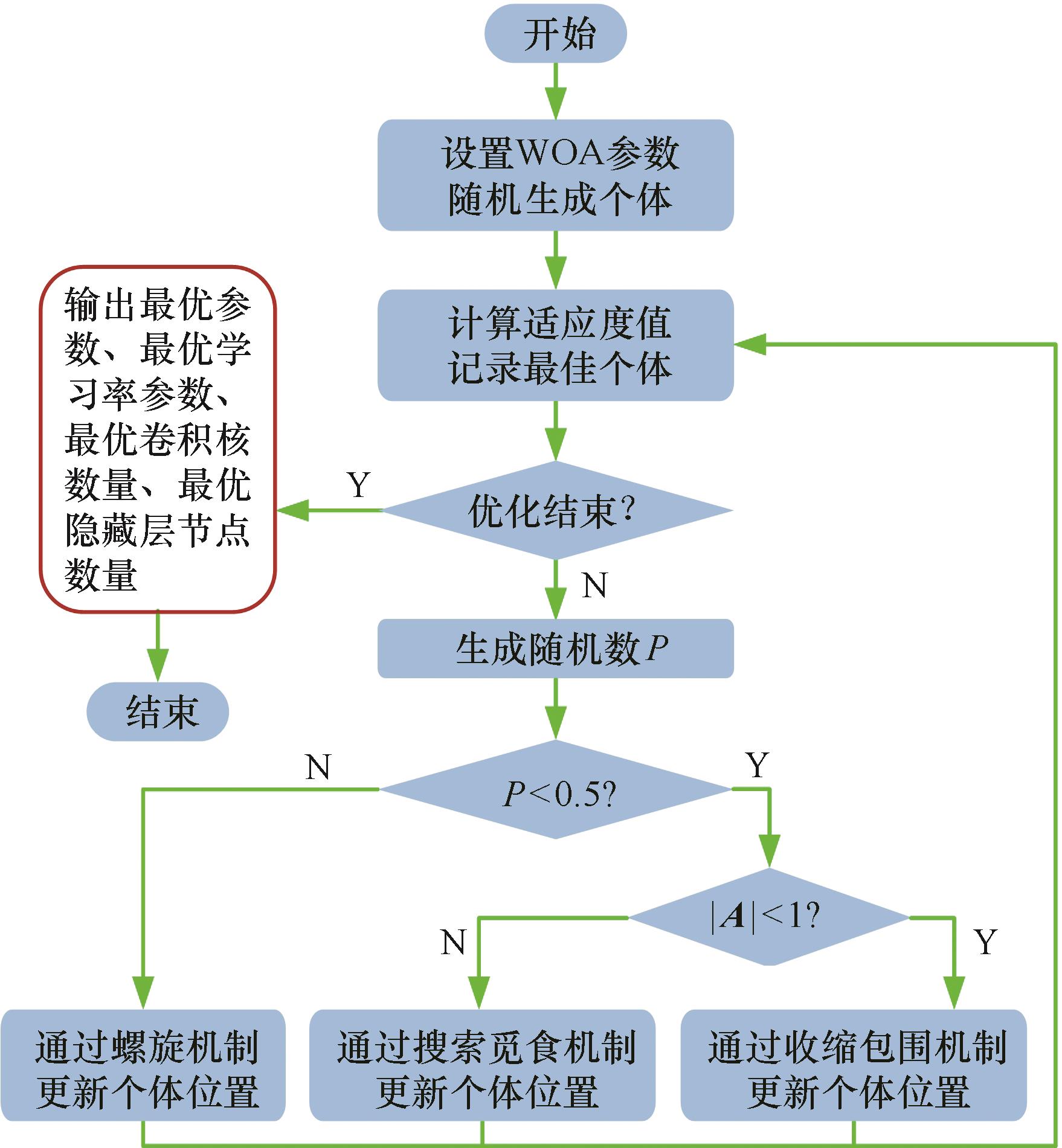
| 优化变量 | 类型 | 搜索范围 |
|---|---|---|
| 学习率η | 连续 | [0.001,0.01] |
| GRU隐藏层单元数H | 整数 | [50,100] |
| L2正则化系数λ | 连续 | [0.0001,0.1] |
Tab.1 Key hyperparameters optimized by WOA and their search ranges
| 优化变量 | 类型 | 搜索范围 |
|---|---|---|
| 学习率η | 连续 | [0.001,0.01] |
| GRU隐藏层单元数H | 整数 | [50,100] |
| L2正则化系数λ | 连续 | [0.0001,0.1] |
| 阶段 | 数据来源 | 划分规则 | 循环数 | 窗口参数 (L,s) | 样本数 |
|---|---|---|---|---|---|
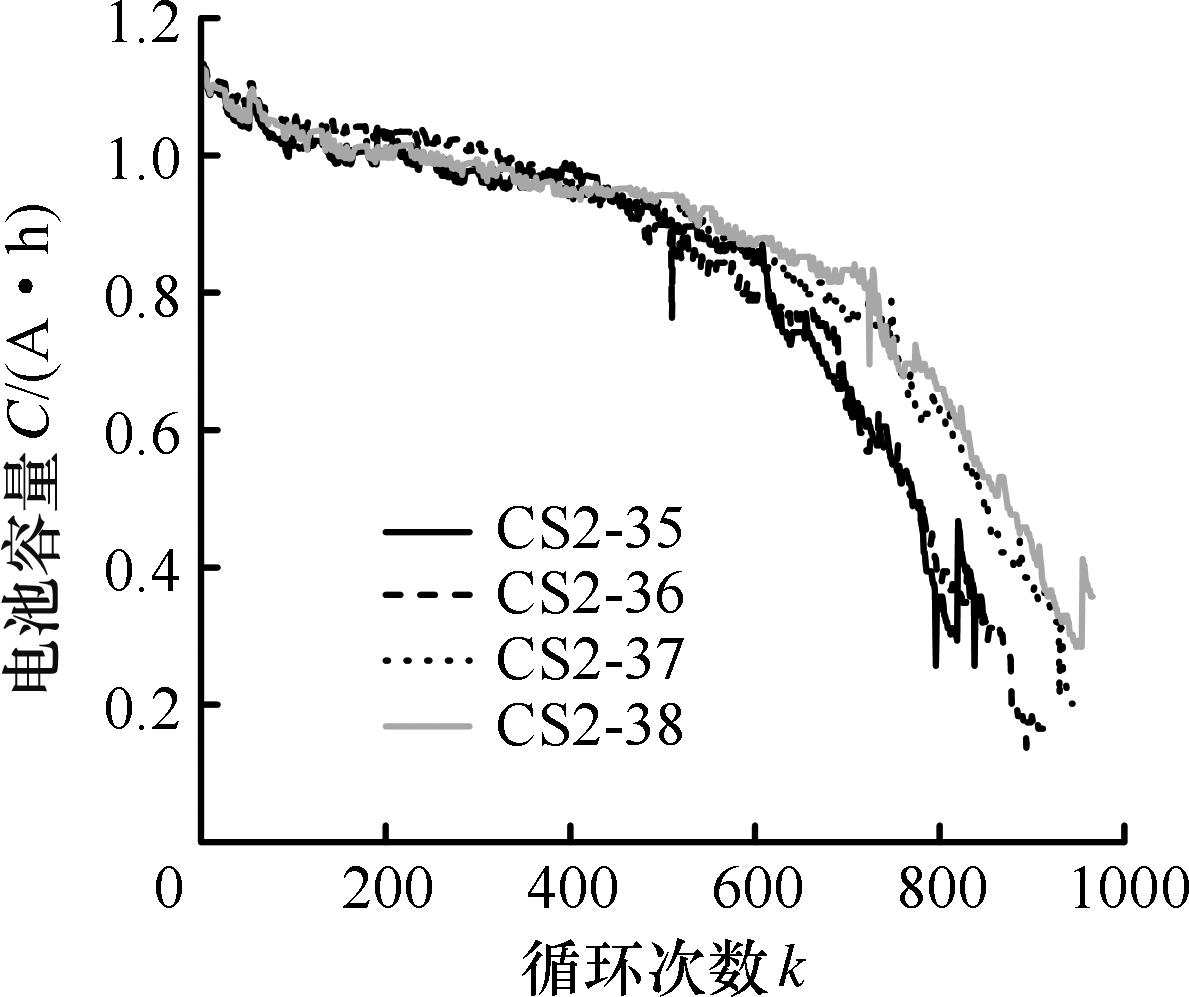
| 训练 | CS35+CS36+CS38 | 全寿命循环 | 2728 | (1, 1) | 2728 |
| 验证 | CS37 | 前 80% 循环(按时间顺序) | 755 | (1, 1) | 755 |
| 测试 | CS37 | 后20%循环(按时间顺序) | 189 | (1, 1) | 189 |
Tab.3 Dataset split
| 阶段 | 数据来源 | 划分规则 | 循环数 | 窗口参数 (L,s) | 样本数 |
|---|---|---|---|---|---|
| 训练 | CS35+CS36+CS38 | 全寿命循环 | 2728 | (1, 1) | 2728 |
| 验证 | CS37 | 前 80% 循环(按时间顺序) | 755 | (1, 1) | 755 |
| 测试 | CS37 | 后20%循环(按时间顺序) | 189 | (1, 1) | 189 |
| 模型 | 输入(L×F) | CNN配置(filters/层数) | RNN(类型/层数/单元) | Attention | Dropout | 输出 |
|---|---|---|---|---|---|---|
| WOA-CNN-GRU-SA | 1×3 | 16→32(2层) | GRU/2层/h* | Self-Attention×2 | 0.01 | 1 |
| WOA-CNN-LSTM-SA | 1×3 | 16→32(2层) | LSTM/2层/h* | Self-Attention×2 | 0.01 | 1 |
| WOA-CNN-GRU | 1×3 | 16→32(2层) | GRU/2层/h* | 无 | 0.01 | 1 |
| WOA-CNN-LSTM | 1×3 | 16→32(2层) | LSTM/2层/h* | 无 | 0.01 | 1 |
| CNN-GRU | 1×3 | 16→32(2层) | GRU/2层/h0 | 无 | 0.01 | 1 |
| CNN-LSTM | 1×3 | 16→32(2层) | LSTM/2层/h0 | 无 | 0.01 | 1 |
Tab.4 Baseline model parameter settings
| 模型 | 输入(L×F) | CNN配置(filters/层数) | RNN(类型/层数/单元) | Attention | Dropout | 输出 |
|---|---|---|---|---|---|---|
| WOA-CNN-GRU-SA | 1×3 | 16→32(2层) | GRU/2层/h* | Self-Attention×2 | 0.01 | 1 |
| WOA-CNN-LSTM-SA | 1×3 | 16→32(2层) | LSTM/2层/h* | Self-Attention×2 | 0.01 | 1 |
| WOA-CNN-GRU | 1×3 | 16→32(2层) | GRU/2层/h* | 无 | 0.01 | 1 |
| WOA-CNN-LSTM | 1×3 | 16→32(2层) | LSTM/2层/h* | 无 | 0.01 | 1 |
| CNN-GRU | 1×3 | 16→32(2层) | GRU/2层/h0 | 无 | 0.01 | 1 |
| CNN-LSTM | 1×3 | 16→32(2层) | LSTM/2层/h0 | 无 | 0.01 | 1 |
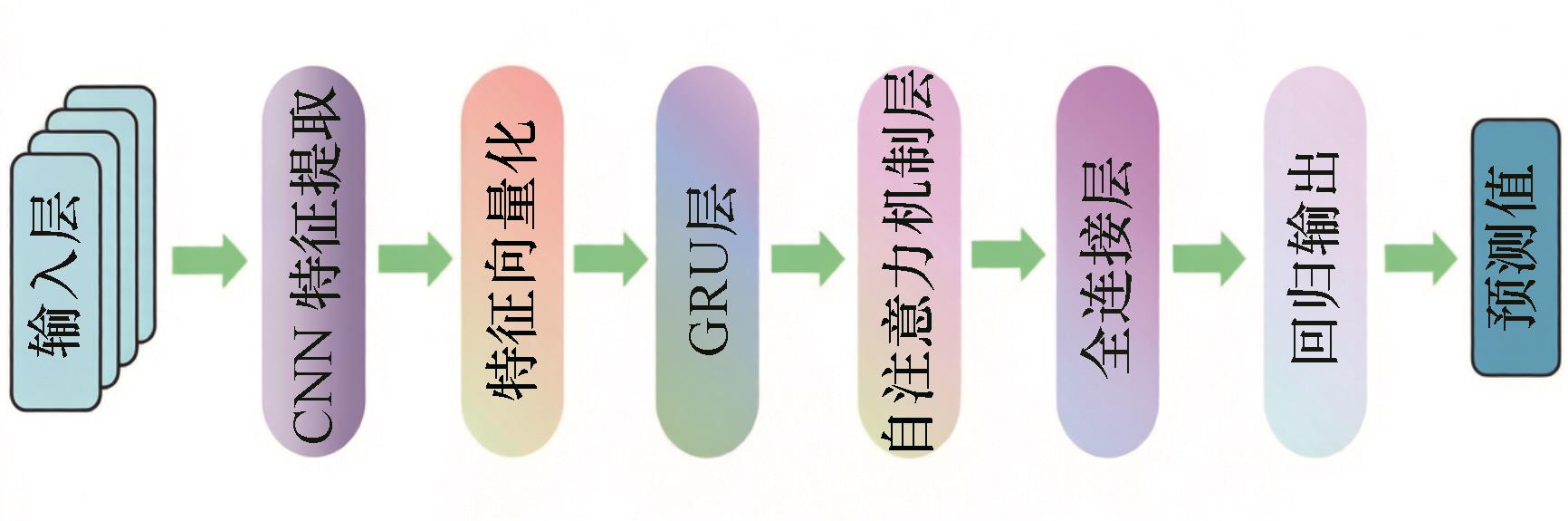
| Layer | Activation function | Output data shape |
|---|---|---|
| Input | N/A | None,1,3 |
| CNN1(Convolutional 2D) | Relu | None,1,16 |
| CNN2(Convolutional 2D) | Relu | None,1,32 |
| Pooling Layer | N/A | None,1,32 |
| Flatten Layer | N/A | None,32 |
| GRU Layer 1 | Tanh | None,1,50 |
| Self-Attention Layer 1 | N/A | None,1,50 |
| Fully Connected Layer 1 | N/A | None,1,1 |
| Dropout Layer | N/A | None,1,1 |
| GRU Layer 2 | Tanh | None,50 |
| Self-Attention Layer 2 | N/A | None,50 |
| Fully Connected Layer 2 | N/A | None,1 |
| Output | N/A | None,1 |
Tab.5 Detailed neural network architecture
| Layer | Activation function | Output data shape |
|---|---|---|
| Input | N/A | None,1,3 |
| CNN1(Convolutional 2D) | Relu | None,1,16 |
| CNN2(Convolutional 2D) | Relu | None,1,32 |
| Pooling Layer | N/A | None,1,32 |
| Flatten Layer | N/A | None,32 |
| GRU Layer 1 | Tanh | None,1,50 |
| Self-Attention Layer 1 | N/A | None,1,50 |
| Fully Connected Layer 1 | N/A | None,1,1 |
| Dropout Layer | N/A | None,1,1 |
| GRU Layer 2 | Tanh | None,50 |
| Self-Attention Layer 2 | N/A | None,50 |
| Fully Connected Layer 2 | N/A | None,1 |
| Output | N/A | None,1 |
| 模型 | RMSE/% | MSE/% | MAE/% | R2/% |
|---|---|---|---|---|
| WOA-CNN-GRU-SA | 0.809 27±0.006 48 | 0.006 549 4±0.000 105 0 | 0.554 40±0.005 94 | 99.840±0.007 |
| WOA-CNN-LSTM-SA | 0.902 70±0.007 90 | 0.008 149 1±0.000 142 7 | 0.640 10±0.007 25 | 99.802±0.010 |
| WOA-CNN-GRU | 1.388 73±0.012 81 | 0.019 286 9±0.000 355 8 | 0.878 83±0.010 41 | 99.532±0.016 |
| WOA-CNN-LSTM | 2.138 90±0.019 04 | 0.045 751 3±0.000 813 8 | 1.530 23±0.024 38 | 98.880±0.040 |
| CNN-GRU | 1.472 20±0.014 36 | 0.021 675 1±0.000 423 1 | 1.080 57±0.014 36 | 99.472±0.021 |
| CNN-LSTM | 2.764 80±0.028 75 | 0.076 446 7±0.001 588 4 | 2.014 53±0.029 21 | 98.148±0.066 |
Tab.2 Prediction results of each algorithm
| 模型 | RMSE/% | MSE/% | MAE/% | R2/% |
|---|---|---|---|---|
| WOA-CNN-GRU-SA | 0.809 27±0.006 48 | 0.006 549 4±0.000 105 0 | 0.554 40±0.005 94 | 99.840±0.007 |
| WOA-CNN-LSTM-SA | 0.902 70±0.007 90 | 0.008 149 1±0.000 142 7 | 0.640 10±0.007 25 | 99.802±0.010 |
| WOA-CNN-GRU | 1.388 73±0.012 81 | 0.019 286 9±0.000 355 8 | 0.878 83±0.010 41 | 99.532±0.016 |
| WOA-CNN-LSTM | 2.138 90±0.019 04 | 0.045 751 3±0.000 813 8 | 1.530 23±0.024 38 | 98.880±0.040 |
| CNN-GRU | 1.472 20±0.014 36 | 0.021 675 1±0.000 423 1 | 1.080 57±0.014 36 | 99.472±0.021 |
| CNN-LSTM | 2.764 80±0.028 75 | 0.076 446 7±0.001 588 4 | 2.014 53±0.029 21 | 98.148±0.066 |
| 数据集 | RMSE/% | MSE/% | MAE/% | R2/% |
|---|---|---|---|---|
| 训练集 | 0.792 30 | 0.006 277 4 | 0.543 10 | 99.852 |
| 验证集 | 0.807 90 | 0.006 527 0 | 0.552 80 | 99.842 |
| 测试集 | 0.809 27 | 0.006 549 4 | 0.554 40 | 99.840 |
Tab.7 Comparison of prediction performance on the training, validation, and test sets
| 数据集 | RMSE/% | MSE/% | MAE/% | R2/% |
|---|---|---|---|---|
| 训练集 | 0.792 30 | 0.006 277 4 | 0.543 10 | 99.852 |
| 验证集 | 0.807 90 | 0.006 527 0 | 0.552 80 | 99.842 |
| 测试集 | 0.809 27 | 0.006 549 4 | 0.554 40 | 99.840 |
| 起点 | 真实RUL | 预测RUL | AE | RE | MAPE | RMSE |
|---|---|---|---|---|---|---|
| 213 | 247 | 225 | 22 | 0.0145 | 0.0058 | 0.0065 |
| 246 | 207 | 210 | 3 | 0.0145 | 0.0060 | 0.0067 |
| 314 | 124 | 124 | 0 | 0 | 0.0065 | 0.0070 |
Tab.8 RUL prediction results and error metrics under different starting points
| 起点 | 真实RUL | 预测RUL | AE | RE | MAPE | RMSE |
|---|---|---|---|---|---|---|
| 213 | 247 | 225 | 22 | 0.0145 | 0.0058 | 0.0065 |
| 246 | 207 | 210 | 3 | 0.0145 | 0.0060 | 0.0067 |
| 314 | 124 | 124 | 0 | 0 | 0.0065 | 0.0070 |
| [1] | LI J, HE S, YANG Q, et al. A Comprehensive Review of Second Life Batteries Toward Sustainable Mechanisms: Potential, Challenges, and Future Prospects[J]. IEEE Transactions on Transportation Electrification, 2023, 9(4): 4824-4845. |
| [2] | CHEN Y, SHI P, CHANG D, et al. Selective Extraction of Valuable Metals from Spent EV Power Batteries Using Sulfation Roasting and Two Stage Leaching Process[J]. Separation and Purification Technology, 2021, 258: 118078. |
| [3] | CONTESTABILE M, PANERO S, SCROSATI B. A Laboratory-scale Lithium-ion Battery Recycling Process[J]. Journal of Power Sources, 2001, 92(1/2): 65-69. |
| [4] | HARPER G, SOMMERVILLE R, KENDRICK E, et al. Recycling Lithium-ion Batteries from Electric Vehicles[J]. Nature, 2019, 575(7781): 75-86. |
| [5] | ZHENG X, ZHU Z, LIN X, et al. A Mini-review on Metal Recycling from Spent Lithium Ion Batteries[J]. Engineering, 2018, 4(3): 361-370. |
| [6] | IQBAL H, SARWAR S, KIRLI D, et al. A Survey of Second-life Batteries Based on Techno-economic Perspective and Applications-based Analysis[J]. Carbon Neutrality, 2023, 2(1): 8. |
| [7] | NIE Y, WANG Y, LI L, et al. Literature Review on Power Battery Echelon Reuse and Recycling from a Circular Economy Perspective[J]. International Journal of Environmental Research and Public Health, 2023, 20(5): 4346. |
| [8] | MARTINEZ-LASERNA E, GANDIAGA I, SARASKETA- ZABALA E, et al. Battery Second Life: Hype, Hope or Reality? a Critical Review of the State of the Art[J]. Renewable and Sustainable Energy Reviews, 2018, 93: 701-718. |
| [9] | LIU Z, LIU X, HAO H, et al. Research on the Critical Issues for Power Battery Reusing of New Energy Vehicles in China[J]. Energies, 2020, 13(8): 1932. |
| [10] | LIU Z, ZHOU T, YANG H, et al. A Review of the Resourceful Utilization Status for Decommissioned Power Batteries[J]. Energies, 2023, 16(23): 7869. |
| [11] | GE M, LIU Y, JIANG X, et al. A Review on State of Health Estimations and Remaining Useful Life Prognostics of Lithium-ion Batteries[J]. Measurement, 2021, 174: 109057. |
| [12] | FAN G. Systematic Parameter Identification of a Control-oriented Electrochemical Battery Model and Its Application for State of Charge Estimation at Various Operating Conditions[J]. Journal of Power Sources, 2020, 470: 228153. |
| [13] | BRUCH M, MILLET L, KOWAL J, et al. Novel Method for the Parameterization of a Reliable Equivalent Circuit Model for the Precise Simulation of a Battery Cell’s Electric Behavior[J]. Journal of Power Sources, 2021, 490: 229513. |
| [14] | HAN X, WANG Z, WEI Z. A Novel Approach for Health Management Online-monitoring of Lithium-ion Batteries Based on Model-data Fusion[J]. Applied Energy, 2021, 302: 117511. |
| [15] | RICHARDSON R R, OSBORNE M A, HOWEY D A. Gaussian Process Regression for Forecasting Battery State of Health[J]. Journal of Power Sources, 2017, 357: 209-219. |
| [16] | ZHOU D, YIN H, FU P, et al. Prognostics for State of Health of Lithium-ion Batteries Based on Gaussian Process Regression[J]. Mathematical Problems in Engineering, 2018, 2018(1): 8358025. |
| [17] | ALI M U, ZAFAR A, MASOOD H, et al. A Hybrid Data-driven Approach for Multistep Ahead Prediction of State of Health and Remaining Useful Life of Lithium-ion Batteries[J]. Computational Intelligence and Neuroscience, 2022, 2022(1): 1575303. |
| [18] | ZHANG M, YIN J, CHEN W. SOH Estimation and RUL Prediction of Lithium Batteries Based on Multidomain Feature Fusion and CatBoost Model[J]. Energy Science & Engineering, 2023, 11(9): 3082-3101. |
| [19] | WU C, FU J, HUANG X, et al. Lithium-ion Battery Health State Prediction Based on VMD and DBO-SVR[J]. Energies, 2023, 16(10): 3993. |
| [20] | WANG K, GAO Q, PANG X, et al. Estimating the Health State of Lithium-ion Batteries Using an Adaptive Gated Sequence Network and Hierarchical Feature Construction[J]. Batteries, 2024, 10(8): 278. |
| [21] | SALEK F, RESALATI S, AZIZI A, et al. State of Health Prediction of Electric Vehicles’ Retired Batteries Based on First-life Historical Degradation Data Using Predictive Time-series Algorithms[J]. Mathematics, 2024, 12(7): 1051. |
| [22] | HE W, WILLIARD N, OSTERMAN M, et al. Prognostics of Lithium-ion Batteries Based on Dempste-shafer Theory and the Bayesian Monte Carlo Method[J]. Journal of Power Sources, 2011, 196(23): 10314-10321. |
| [1] | ZHANG Long, LIANG Qiyu, WEI Xiao, WAN Chuang. Springback Prediction in Plate Forming Based on Constitutive Model Embedded Deep Neural Network [J]. China Mechanical Engineering, 2026, 37(6): 1486-1496. |
| [2] | ZHAN Qingliang, CAO Zihan, WANG Zhiyong, BAI Chunjin, LIU Xin. Deep Learning Method of Flow Time History for Optimizing Position of Vortex Flowmeter Probes [J]. China Mechanical Engineering, 2026, 37(5): 1105-1110. |
| [3] | DENG Xiaoqiang, ZHAN Taoyang, XIANG Wei, LIN Wenwen, YU Junhe, ZHENG Zhipeng. Injection Molding Quality Prediction Method Based on Two-stage Feature Extraction and Multi-feature Fusion Using TCN-BiGRU-SE Model [J]. China Mechanical Engineering, 2026, 37(2): 416-427. |
| [4] | WANG Chun, SHEN Yuqin, ZENG Quanhong, TANG Tao. SAC-based Energy Management Strategy for Electric Vehicles Considering Lithium Battery Aging and Thermal Effects [J]. China Mechanical Engineering, 2026, 37(10): 2502-2510. |
| [5] | WANG Hao, LUO Haodong, SHI Yazhong, WANG Liwen, ZHANG Wei, WANG Zhong. A Topology Optimization Method Based on End-to-end Deep Learning Framework TOPO-U-Net [J]. China Mechanical Engineering, 2026, 37(1): 174-183. |
| [6] | CUI Shuo, LIU Xiuli, LI Xiangjie, WU Guoxin. Prediction of RUL and Uncertainty Quantification Evaluation Methods for High-end Rotating Machinery [J]. China Mechanical Engineering, 2026, 37(1): 209-222. |
| [7] | Zulong YAN, Qilong PANG, Jianlong XIONG. Prediction of Three-dimensional Machined Surface Topography of KDP Crystals Based on Deep Learning [J]. China Mechanical Engineering, 2025, 36(10): 2329-2334. |
| [8] | ZHAO Yunjie, HE Yansong, ZHANG Zhifei, XU Zhongming. 3D Beamforming Map Compression Method Based on Generative Model [J]. China Mechanical Engineering, 2025, 36(07): 1520-1529. |
| [9] | ZENG Hao, CAO Huajun, DONG Jianxiong. Tool Wear Prediction Method Based on ISABO-IBiLSTM Model [J]. China Mechanical Engineering, 2024, 35(11): 1995-2006. |
| [10] | LI Yue1, 2, XIE Heng1, ZHOU Gongbo1, 2, ZHOU Ping1, 2, LI Menggang1, 2. Soft Sensor Modeling and Uncertainty Analysis Approach of Tool Wear Based on Semi-supervised Bayesian Transformer [J]. China Mechanical Engineering, 2024, 35(11): 2015-2025. |
| [11] | NIE Xin, TAN Tian, SHEN Danfeng. Research on Stamping Springback of Automobile Beam Parts Based on Deep Learning [J]. China Mechanical Engineering, 2023, 34(07): 838-846. |
| [12] | TANG Donglin, YANG Zhou, CHENG Heng, LIU Mingxuan, ZHOU Li, DING Chao. Metal Defect Image Recognition Method Based on Shallow CNN Fusion Transformer [J]. China Mechanical Engineering, 2022, 33(19): 2298-2305,2316. |
| [13] | YU Hao, HUANG Huagui, ZHENG Jiali, ZHAO Tielin, ZHOU Xinliang. Non-contact On-line Inspection Method for Surface Defects of Cross-rolling Piercing Plugs for Seamless Steel Tubes [J]. China Mechanical Engineering, 2022, 33(14): 1717-1724. |
| [14] | YANG Guangyou, LIU Lang, XI Chenbo. Bearing Fault Diagnosis Based on SA-ACGAN Data Generation Model [J]. China Mechanical Engineering, 2022, 33(13): 1613-1621. |
| [15] | AI Qingbo, ZHANG Jie, CHENG Hui, LYU Youlong, ZUO Liling, HU Lan. Analysis for Roll-bending Forming Quality of Spaceflight Thin-walled Cylindrical Workpieces Based on PointCPP-LSF Method#br# [J]. China Mechanical Engineering, 2022, 33(08): 977-985. |
| Viewed | ||||||
|
Full text |
|
|||||
|
Abstract |
|
|||||