



ISSN 1004-132X
CN 42-1294/TH
CN 42-1294/TH
中国机械工程 ›› 2026, Vol. 37 ›› Issue (4): 764-779.DOI: 10.3969/j.issn.1004-132X.2026.04.001
王黎明1,2( ), 肖兴源1,2, 李方义1,2(), 汪晓光1,2,4, 李剑峰1,2,3, 聂延艳3, 刘伟彤1,2, 李柳沅1,2, 王忆同1,2, 王泊云1,2, 崔羽齐1,2
收稿日期:2025-11-03
出版日期:2026-04-25
发布日期:2026-05-11
通讯作者:
李方义
作者简介:王黎明,男,1986年生,教授、博士研究生导师。研究方向为绿色设计与制造、生命周期评价和智能优化算法。E-mail: liming_wang@sdu.edu.cn基金资助:
WANG Liming1,2(), XIAO Xingyuan1,2, LI Fangyi1,2(), WANG Xiaoguang1,2,4, LI Jianfeng1,2,3, NIE Yanyan3, LIU Weitong1,2, LI Liuyuan1,2, WANG Yitong1,2, WANG Boyun1,2, CUI Yuqi1,2
Received:2025-11-03
Online:2026-04-25
Published:2026-05-11
Contact:
LI Fangyi
摘要:
碳足迹数据是量化机电产品全生命周期碳排放、驱动制造业低碳转型的核心依据。聚焦于碳足迹数据从获取到应用的全流程,系统综述了其相关研究方法。梳理了多源异构碳足迹数据的获取技术与数据质量评估体系,解决数据“如何来”的问题。围绕“如何用”,重点阐述了数据驱动技术在低碳设计和制造中的应用,包括基于数据的碳足迹关联建模、智能预测、低碳设计方案生成与多目标决策方法,数据驱动下的制造能耗预测、低碳工艺规划与车间智能调度策略。最后分析了低碳设计和制造在数据完整性及系统集成性方面面临的挑战和未来研究方向,为机电产品绿色低碳发展提供理论参考。
中图分类号:
王黎明, 肖兴源, 李方义, 汪晓光, 李剑峰, 聂延艳, 刘伟彤, 李柳沅, 王忆同, 王泊云, 崔羽齐. 数据驱动的机电产品低碳设计与制造研究综述与展望[J]. 中国机械工程, 2026, 37(4): 764-779.
WANG Liming, XIAO Xingyuan, LI Fangyi, WANG Xiaoguang, LI Jianfeng, NIE Yanyan, LIU Weitong, LI Liuyuan, WANG Yitong, WANG Boyun, CUI Yuqi. Overview and Prospects of Data-driven Low-carbon Design and Manufacturing of Electromechanical Products[J]. China Mechanical Engineering, 2026, 37(4): 764-779.
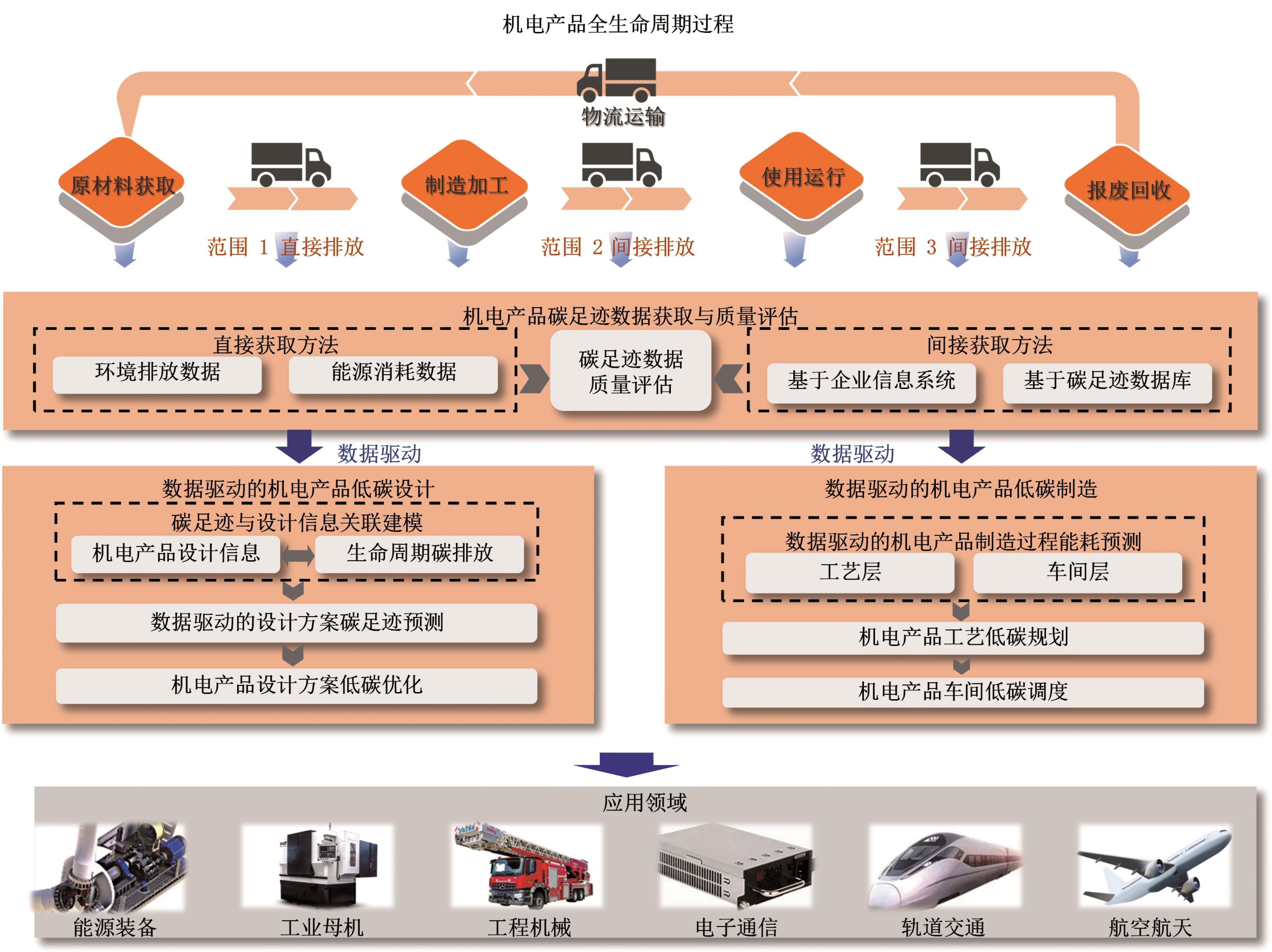
图1 碳足迹数据驱动的机电产品低碳设计与制造研究框架
Fig.1 Framework for low-carbon design and manufacturing of electromechanical products driven by carbon footprint data
| 范围 | 原材料 获取 | 制造加工 | 物流运输 | 使用 运行 | 报废 回收 |
|---|---|---|---|---|---|
| 范围1 | √ (环境排放) | √ (环境排放) | |||
| 范围2 | √ (环境排放+能源消耗) | √ (环境排放+能源消耗) | |||
| 范围3 | √ | √ | √ | √ | √ |
表1 机电产品碳足迹数据范围
Tab.1 Carbon footprint data scope of electromechanical products
| 范围 | 原材料 获取 | 制造加工 | 物流运输 | 使用 运行 | 报废 回收 |
|---|---|---|---|---|---|
| 范围1 | √ (环境排放) | √ (环境排放) | |||
| 范围2 | √ (环境排放+能源消耗) | √ (环境排放+能源消耗) | |||
| 范围3 | √ | √ | √ | √ | √ |
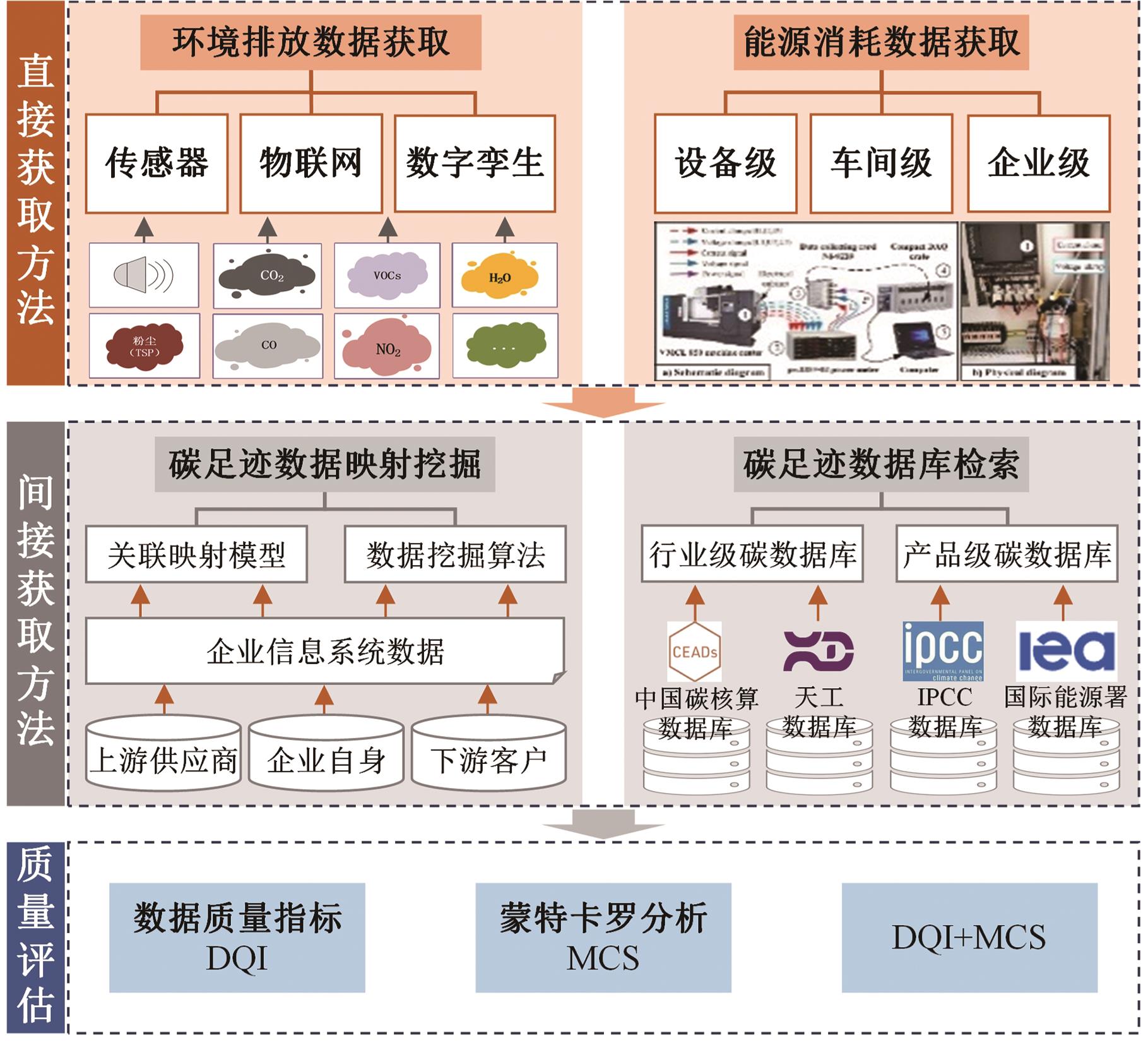
图2 机电产品碳足迹数据获取与质量评估方法
Fig.2 Carbon footprint data acquisition and quality assessment methods for electromechanical products
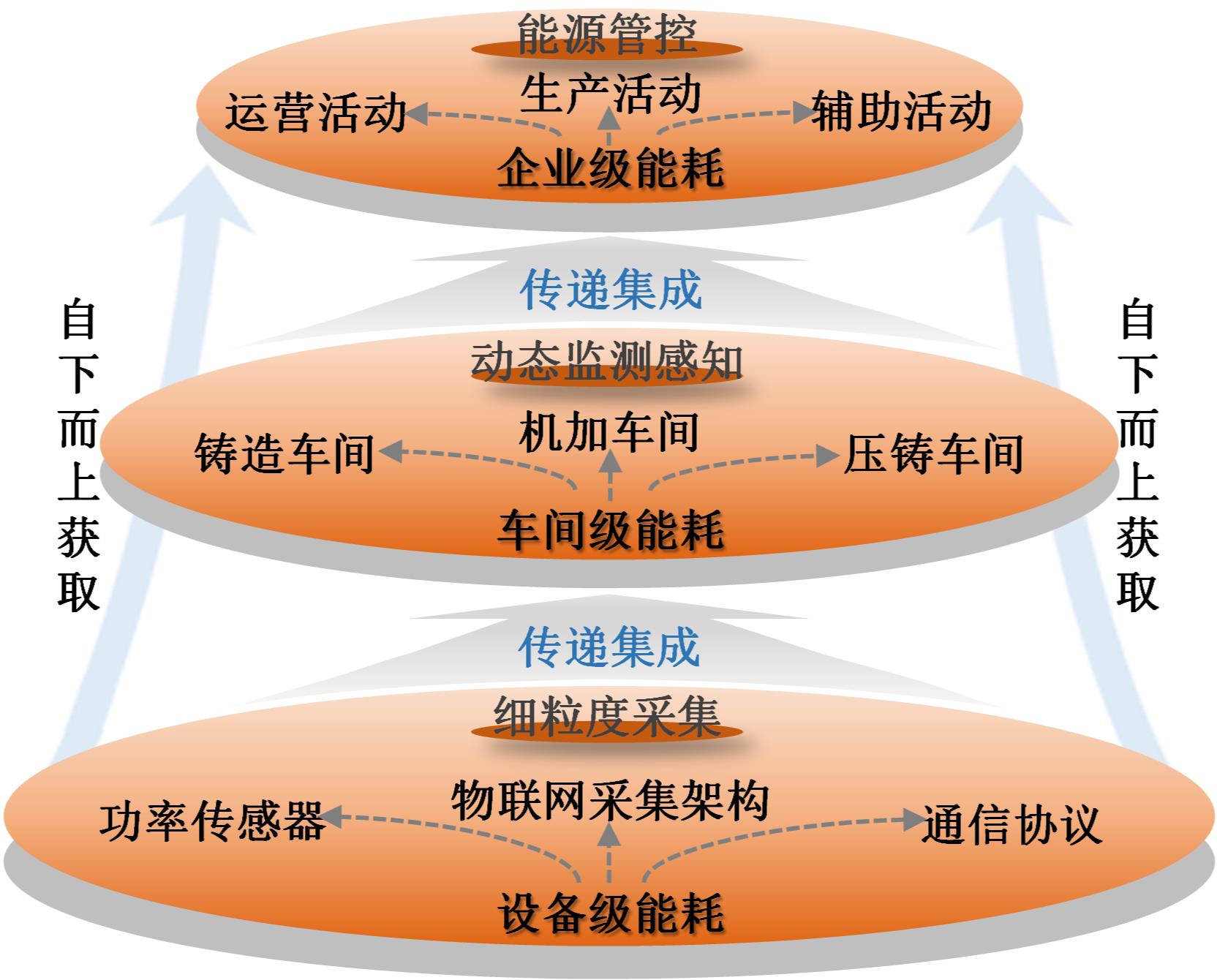
图3 能源消耗数据直接获取方法
Fig.3 Direct acquisition methods for energy consumption data
| 碳排放数据库名称 | 典型应用场景 | 局限性 | |
|---|---|---|---|
国 内 | 中国产品全生命周期 温室气体排放系数库 | 提供材料与能源排放因子,用于机电产品生命周期评价、材料选择及设计阶段碳足迹评估。 | 行业覆盖不全,部分新兴行业缺数据; 更新频率低,时效性不足。 |
中国碳核算数据库 (CEADs) | 提供行业和区域碳排放强度数据,用于估算机电产品制造阶段能源消耗与碳排放水平。 | 公开版数据截止2018年; 企业级微观数据缺失。 | |
| 天工数据库 | 支持机电产品供应链碳排数据追溯,可用于产品碳足迹核算及低碳设计决策分析。 | 数据来源依赖企业自报,精度待验; 覆盖企业数量有限。 | |
| 中国多尺度排放清单模型 | 提供区域和行业排放清单数据,可用于机电产品生产布局、区域制造碳排放分析等。 | 需结合本地数据校准; 高频动态监测能力弱。 | |
全球实时碳数据 (Carbon Monitor) | 提供能源与交通等领域的动态排放数据,用于分析机电产品制造相关能源系统的碳排放变化趋势。 | 依赖统计模型估算,实测数据少; 发展中国家数据误差大(±10%~20%)。 | |
国 外 | IPCC碳排放因子 数据库 | 提供国际通用排放因子,用于机电产品碳足迹核算和生命周期评价中的基础参数。 | 默认因子未体现区域差异; 更新周期长(5~10年)。 |
| 国际能源署(IEA) | 提供全球能源消费与碳排放数据,用于分析机电产品制造能源结构及低碳制造路径。 | 工业过程排放覆盖不足; 部分国家数据为估算值。 | |
| 世界银行(WB) | 提供国家层面碳排放与经济数据,用于机电产品产业碳排放比较及政策分析。 | 数据颗粒度粗(国家/年); 企业级核算不适用。 | |
美国环境保护署 (EPA) | 提供设施级排放监测与报告数据,可用于制造工厂碳排放管理与低碳制造评估。 | 仅限美国本土数据; 国际应用需重新校准。 | |
气候观察 (Climate Watch) | 提供全球气候政策与排放数据,可用于机电产品低碳技术发展趋势与政策环境分析。 | 部分国家数据滞后; 无法支持产品级LCA。 |
表2 全球常用碳排放数据库分析
Tab.2 Analysis of globally common carbon emission databases
| 碳排放数据库名称 | 典型应用场景 | 局限性 | |
|---|---|---|---|
国 内 | 中国产品全生命周期 温室气体排放系数库 | 提供材料与能源排放因子,用于机电产品生命周期评价、材料选择及设计阶段碳足迹评估。 | 行业覆盖不全,部分新兴行业缺数据; 更新频率低,时效性不足。 |
中国碳核算数据库 (CEADs) | 提供行业和区域碳排放强度数据,用于估算机电产品制造阶段能源消耗与碳排放水平。 | 公开版数据截止2018年; 企业级微观数据缺失。 | |
| 天工数据库 | 支持机电产品供应链碳排数据追溯,可用于产品碳足迹核算及低碳设计决策分析。 | 数据来源依赖企业自报,精度待验; 覆盖企业数量有限。 | |
| 中国多尺度排放清单模型 | 提供区域和行业排放清单数据,可用于机电产品生产布局、区域制造碳排放分析等。 | 需结合本地数据校准; 高频动态监测能力弱。 | |
全球实时碳数据 (Carbon Monitor) | 提供能源与交通等领域的动态排放数据,用于分析机电产品制造相关能源系统的碳排放变化趋势。 | 依赖统计模型估算,实测数据少; 发展中国家数据误差大(±10%~20%)。 | |
国 外 | IPCC碳排放因子 数据库 | 提供国际通用排放因子,用于机电产品碳足迹核算和生命周期评价中的基础参数。 | 默认因子未体现区域差异; 更新周期长(5~10年)。 |
| 国际能源署(IEA) | 提供全球能源消费与碳排放数据,用于分析机电产品制造能源结构及低碳制造路径。 | 工业过程排放覆盖不足; 部分国家数据为估算值。 | |
| 世界银行(WB) | 提供国家层面碳排放与经济数据,用于机电产品产业碳排放比较及政策分析。 | 数据颗粒度粗(国家/年); 企业级核算不适用。 | |
美国环境保护署 (EPA) | 提供设施级排放监测与报告数据,可用于制造工厂碳排放管理与低碳制造评估。 | 仅限美国本土数据; 国际应用需重新校准。 | |
气候观察 (Climate Watch) | 提供全球气候政策与排放数据,可用于机电产品低碳技术发展趋势与政策环境分析。 | 部分国家数据滞后; 无法支持产品级LCA。 |
| 方法 | 评估范围 | 优点 | 潜在限制 | 适用场景 |
|---|---|---|---|---|
| DQI | 数据质量 评估 | 操作简单,可直接追溯数据源,有助于识别低质量数据来源。 | 忽略模型和算法中的数据不确定性,严重依赖专家的主观判断; 缺乏数据质量等级的标准化评分,难以在不同研究之间进行标准化。 | 数据来源复杂多样,需进行初步筛选与定性评估; 受限于资源,无法进行复杂定量不确定性分析的场景。 |
| MCS | 总体评估 | 能够量化参数随机性,生成结果分布范围,适用于复杂系统或模型。 | 计算复杂,依赖于设置输入数据的概率分布,大量模拟的计算负载高; 不合理的概率分布设计和不充分的仿真运行可能会导致结果出现偏差。 | 数据基础较好,关键参数的不确定性可被合理表征(如已知概率分布); 对核算结果的概率性解释有明确需求的深度研究或高风险决策场景。 |
| DQI+MCS | 总体评估 | 结合DQI和MCS的优势,提供更全面的评估结果。 | 增加模型复杂性和计算负担; 不合理的概率分布设计和不充分的仿真运行可能会导致结果出现偏差。 | 已积累一定的数据质量评分经验,并寻求在不确定性量化中纳入数据质量维度,以提高评估全面性与准确性的合规或研究项目。 |
表3 数据质量评估方法比较
Tab.3 Comparative analysis of data quality assessment methods
| 方法 | 评估范围 | 优点 | 潜在限制 | 适用场景 |
|---|---|---|---|---|
| DQI | 数据质量 评估 | 操作简单,可直接追溯数据源,有助于识别低质量数据来源。 | 忽略模型和算法中的数据不确定性,严重依赖专家的主观判断; 缺乏数据质量等级的标准化评分,难以在不同研究之间进行标准化。 | 数据来源复杂多样,需进行初步筛选与定性评估; 受限于资源,无法进行复杂定量不确定性分析的场景。 |
| MCS | 总体评估 | 能够量化参数随机性,生成结果分布范围,适用于复杂系统或模型。 | 计算复杂,依赖于设置输入数据的概率分布,大量模拟的计算负载高; 不合理的概率分布设计和不充分的仿真运行可能会导致结果出现偏差。 | 数据基础较好,关键参数的不确定性可被合理表征(如已知概率分布); 对核算结果的概率性解释有明确需求的深度研究或高风险决策场景。 |
| DQI+MCS | 总体评估 | 结合DQI和MCS的优势,提供更全面的评估结果。 | 增加模型复杂性和计算负担; 不合理的概率分布设计和不充分的仿真运行可能会导致结果出现偏差。 | 已积累一定的数据质量评分经验,并寻求在不确定性量化中纳入数据质量维度,以提高评估全面性与准确性的合规或研究项目。 |
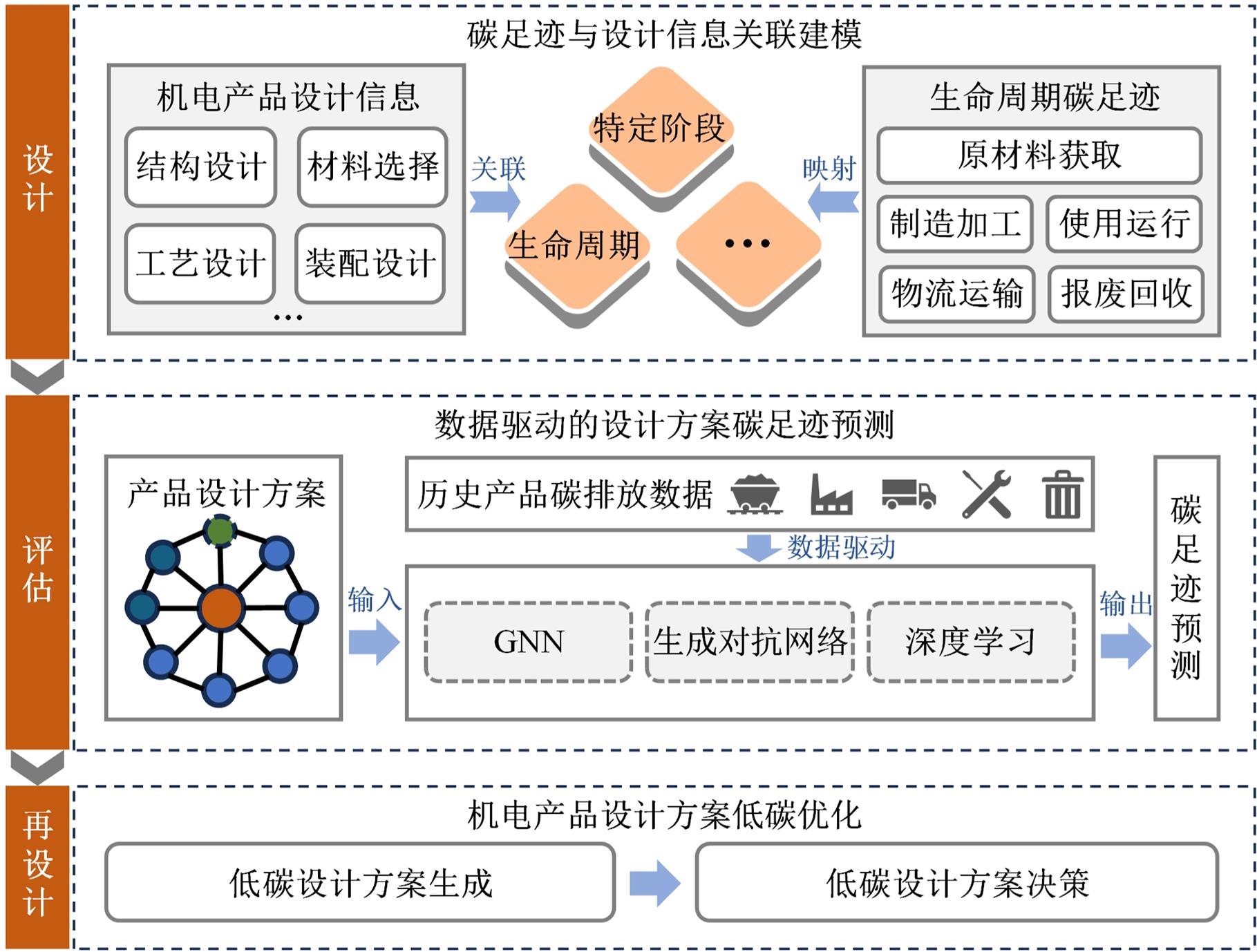
图4 数据驱动的机电产品方案低碳设计方法
Fig.4 Data-driven low-carbon design methodology for electromechanical product solutions
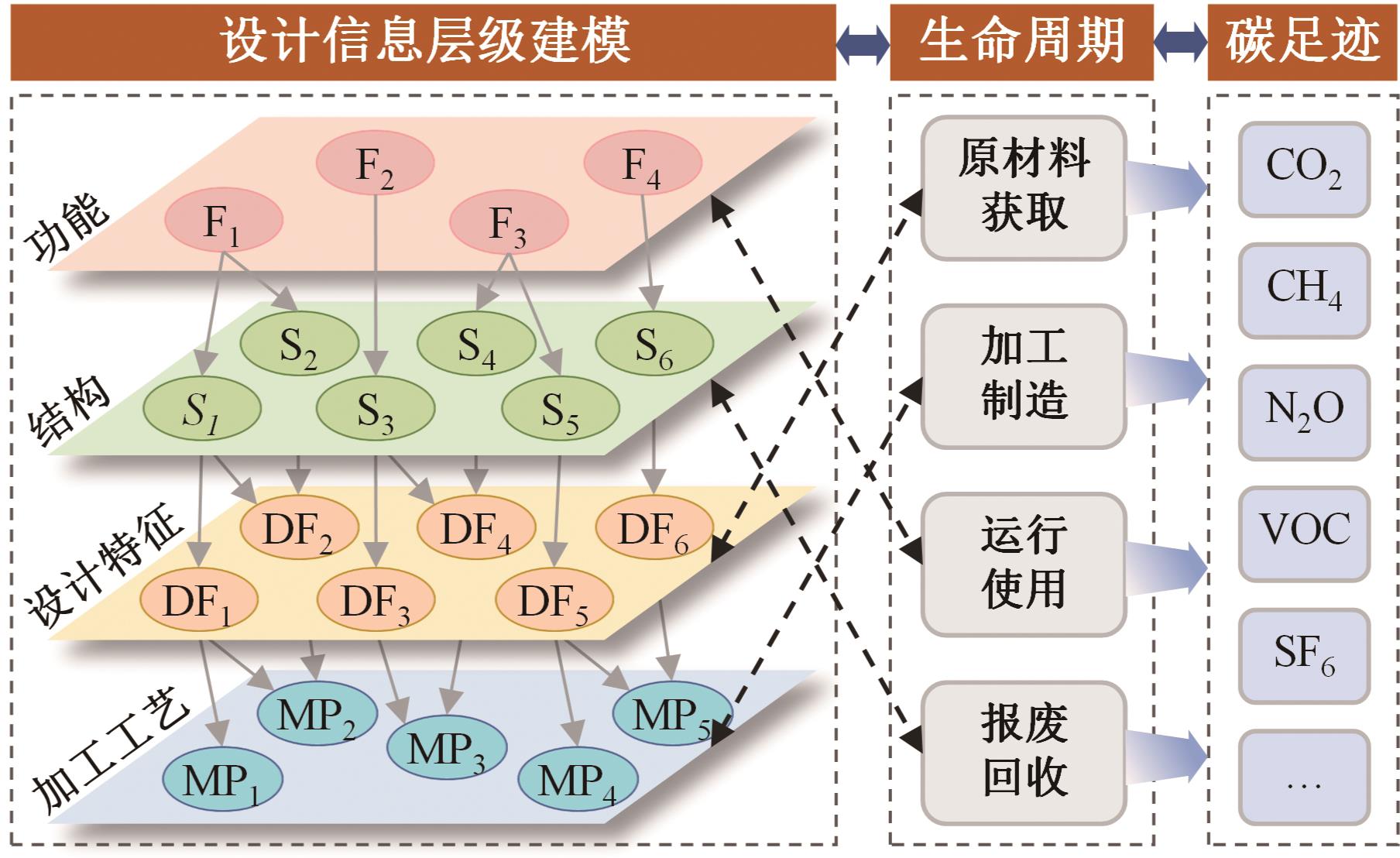
图5 层级关联建模方法[52]
Fig.5 Hierarchical correlation modeling approach[52]
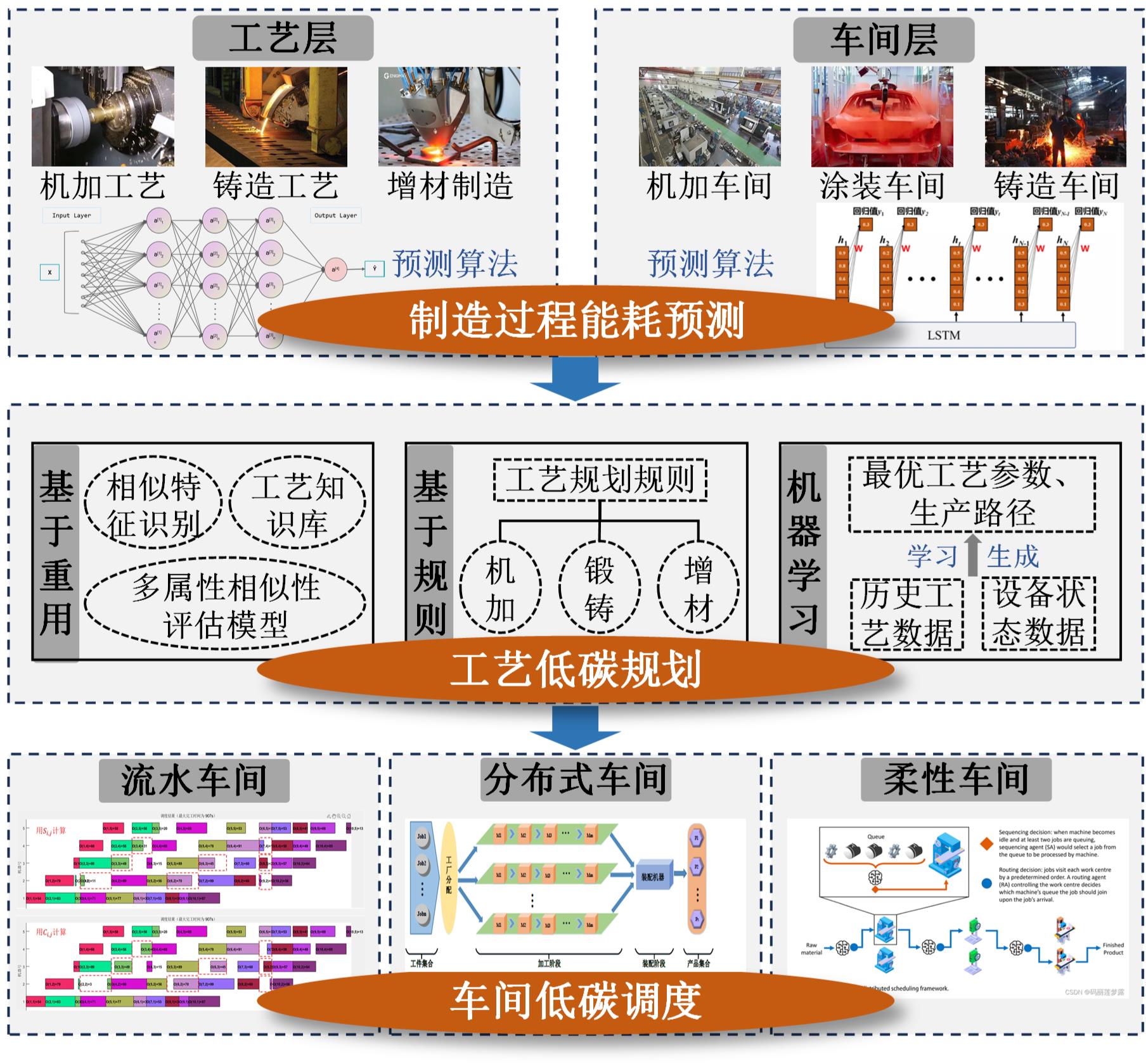
图6 数据驱动的机电产品制造低碳优化
Fig.6 Data-driven low-carbon optimization for electromechanical product manufacturing
| 方法类别 | 数据特征 | 适用场景 | 优点 | 局限性 |
|---|---|---|---|---|
| 基于重用 | 历史工艺案例数据、零件特征数据、CAD/CAM模型数据。 | 相似零件或加工特征较多的机加工、模具加工等场景。 | 能快速生成工艺方案,充分复用已有工艺知识。 | 依赖历史案例,适应新结构零件能力有限。 |
| 基于规则 | 工艺规则、加工参数、设备能力及时间/成本/碳排放约束数据。 | 工艺规则明确、知识体系成熟的制造过程。 | 可解释性强,符合工程经验。 | 规则构建复杂,难以描述复杂非线性关系。 |
| 基于机器学习 | 历史工艺数据、设备状态数据、能耗及环境数据。 | 数据基础较好的智能制造或数字化产线。 | 能挖掘复杂数据规律,优化能力强。 | 依赖数据规模与质量,可解释性较弱。 |
表4 机电产品工艺低碳规划方法对比
Tab.4 Comparison of low-carbon process planning methods for electromechanical products
| 方法类别 | 数据特征 | 适用场景 | 优点 | 局限性 |
|---|---|---|---|---|
| 基于重用 | 历史工艺案例数据、零件特征数据、CAD/CAM模型数据。 | 相似零件或加工特征较多的机加工、模具加工等场景。 | 能快速生成工艺方案,充分复用已有工艺知识。 | 依赖历史案例,适应新结构零件能力有限。 |
| 基于规则 | 工艺规则、加工参数、设备能力及时间/成本/碳排放约束数据。 | 工艺规则明确、知识体系成熟的制造过程。 | 可解释性强,符合工程经验。 | 规则构建复杂,难以描述复杂非线性关系。 |
| 基于机器学习 | 历史工艺数据、设备状态数据、能耗及环境数据。 | 数据基础较好的智能制造或数字化产线。 | 能挖掘复杂数据规律,优化能力强。 | 依赖数据规模与质量,可解释性较弱。 |
| [1] | MAGACHO G, ESPAGNE E, GODIN A. Impacts of the CBAM on EU Trade Partners: Consequences for Developing Countries[J]. Climate Policy, 2024, 24(2): 243-259. |
| [2] | CARVALHO C, SILVA C J, ABREU M J. Circular Economy: Literature Review on the Implementation of the Digital Product Passport(DPP) in the textile Industry[J]. Sustainability, 2025, 17(5): 1802. |
| [3] | ZHANG L, JIANG R, JIN Z, et al. CAD-based Identification of Product Low-carbon Design Optimization Potential: a Case Study of Low-carbon Design for Automotive in China[J]. The International Journal of Advanced Manufacturing Technology, 2019, 100(1): 751-769. |
| [4] | DOWLATSHAHI S. Product Design in a Concurrent Engineering Environment: an Optimization Approach[J]. International Journal of Production Research, 1992, 30(8): 1803-1818. |
| [5] | TRELEAVEN P C, BROWNBRIDGE D R, HOPKINS R P. Data-driven and Demand-driven Computer Architecture[J]. ACM Computing Surveys, 1982, 14(1): 93-143. |
| [6] | NICHOLSON S R, RORRER N A, CARPENTER A C, et al. Manufacturing Energy and Greenhouse Gas Emissions Associated with Plastics Consumption[J]. Joule, 2021, 5(3): 673-686. |
| [7] | DINIZ E H, YAMAGUCHI J A, RACHAEL DOS SANTOS T, et al. Greening Inventories: Blockchain to Improve the GHG Protocol Program in Scope 2[J]. Journal of Cleaner Production, 2021, 291: 125900. |
| [8] | ZHANG J, ZHONG S, WANG T, et al. Blockchain-based Systems and Applications: a Survey[J]. Journal of Internet Technology, 2020, 21(1): 1-14. |
| [9] | JÓHANNESSON S E, HEINONEN J, DAVÍÐSD-ÓTTIR B. Data Accuracy in Ecological Footprint’s Carbon Footprint[J]. Ecological Indicators, 2020, 111: 105983. |
| [10] | ZHU Y, LIU Y, SUN Y, et al. Recent Advances in Resistive Sensor Technology for Tactile Perception: a Review[J]. IEEE Sensors Journal, 2022, 22(16): 15635-15649. |
| [11] | AMOAH N A, XU G, KUMAR A R, et al. Calibration of Low-cost Particulate Matter Sensors for Coal Dust Monitoring[J]. Science of the Total Environment, 2023, 859: 160336. |
| [12] | MEAD-HUNTER R, BRADDOCK R D, KAMPA D, et al. The Relationship between Pressure Drop and Liquid Saturation in Oil-mist Filters–Predicting Filter Saturation Using a Capillary Based Model[J]. Separation and Purification Technology, 2013, 104: 121-129. |
| [13] | 杨振朋, 谢晋. 钢铁行业温室气体排放数据质量控制研究[J]. 标准生活, 2025(5): 99-102. |
| YANG Zhenpeng, XIE Jin. Research on Quality Control of Greenhouse Gas Emission Data in Iron and Steel Industry[J]. Standard Living, 2025(5): 99-102. | |
| [14] | ZHANG S, WU Y, LIU H, et al. Real-world Fuel Consumption and CO2 Emissions of Urban Public Buses in Beijing[J]. Applied Energy, 2014, 113: 1645-1655. |
| [15] | PECHOUT M, JINDRA P, HART J, et al. Regulated and Unregulated Emissions and Exhaust Flow Measurement of Four In-use High Performance Motorcycles[J]. Atmospheric Environment: X, 2022, 14: 100170. |
| [16] | LI X, DENG Q, SHI H, et al. Sustainable Manufacturing Production Process Monitoring and Economic Benefit Analysis Based on IoT Technology[J]. The International Journal of Advanced Manufacturing Technology, 2024: 1-12. |
| [17] | EYERS D. Control Architectures for Industrial Additive Manufacturing Systems[J]. Proceedings of the Institution of Mechanical Engineers, Part B: Journal of Engineering Manufacture, 2018, 232(10): 1767-1777. |
| [18] | 冯俊熙, 陈多福. 垃圾填埋场甲烷排放监测方法研究进展[J]. 环境科学与技术, 2014, 37(3): 174-179. |
| FENG Junxi, CHEN Duofu. Progress in Measurement Methods of Landfill Methane Emissions[J]. Environmental Science & Technology, 2014, 37(3): 174-179. | |
| [19] | 李全生, 刘举庆, 李军, 等. 矿山生态环境数字孪生: 内涵、架构与关键技术[J]. 煤炭学报, 2023, 48(10): 3859-3873. |
| LI Quansheng, LIU Juqing, LI Jun, et al. Digital Twin of Mine Ecological Environment: Connotation, framework and Key Technologies[J]. Journal of China Coal Society, 2023, 48(10): 3859-3873. | |
| [20] | 谢俊, 刘飞, 蔡维. 机床服役过程能量效率的可预测特性及预测方法研究[J]. 机械工程学报, 2019, 55(17): 172-184. |
| XIE Jun, LIU Fei, CAI Wei. Research on the Characteristics and Methodology for Predicting Energy Efficiency during the Service Process of Machine Tools[J]. Journal of Mechanical Engineering, 2019, 55(17): 172-184. | |
| [21] | CHEN N, YIN Y, YIN Z. Energy Consumption Monitoring System Design of Workshop Processing Equipment Based on MTConnect[C]∥2017 Second International Conference on Information Systems Engineering (ICISE). IEEE, 2017: 64-68. |
| [22] | 张华, 李曙光, 鄢威, 等. 数据与模型混合驱动的箱体零件加工能耗预测[J]. 机械工程学报, 2023, 59(12): 97-108. |
| ZHANG Hua, LI Shuguang, YAN Wei, et al. A Data and Model Hybrid Driven Method for Machining Energy Consumption Prediction of Boxy Parts[J]. Journal of Mechanical Engineering, 2023, 59(12): 97-108. | |
| [23] | LIU P, LIU F, QIU H. A Novel Approach for Acquiring the Real-time Energy Efficiency of Machine Tools[J]. Energy, 2017, 121: 524-532. |
| [24] | SELVARAJ V, XU Z, MIN S. Intelligent Operation Monitoring of an Ultra-precision CNC Machine Tool Using Energy Data[J]. International Journal of Precision Engineering and Manufacturing-Green Technology, 2023, 10(1): 59-69. |
| [25] | 鄢佳豪, 曹华军, 陈二恒, 等. 压铸单元能效在线监测方法及监测系统[J]. 中国机械工程, 2020, 31(5): 586-594. |
| YAN Jiahao, CAO Huajun, CHEN Erheng, et al. On-line Monitoring Method and System for Energy Efficiency of Die Casting Cells[J]. China Mechanical Engineering, 2020, 31(5): 586-594. | |
| [26] | QI T, FANG H, CHEN Y, et al. Research on Digital Twin Monitoring System for Large Complex Surface Machining[J]. Journal of Intelligent Manufacturing, 2024, 35(3): 977-990. |
| [27] | CHEN X, LI C, TANG Y, et al. An Internet of Things Based Energy Efficiency Monitoring and Management System for Machining Workshop[J]. Journal of Cleaner Production, 2018, 199: 957-968. |
| [28] | 李聪波, 曹宝, 吴畏, 等. 基于数字孪生的机械加工车间多级能效监测[J]. 计算机集成制造系统, 2023, 29(6): 2102-2117. |
| LI Congbo, CAO Bao, WU Wei, et al. Multi-stage Energy Efficiency Monitoring in Machining Workshop Based on Digital Twin[J]. Computer Integrated Manufacturing Systems, 2023, 29(6): 2102-2117. | |
| [29] | ZHANG H, LI L, LI L, et al. An Integrated Energy Efficiency Evaluation Method for Forging Workshop Based on IoT and Data-driven[J]. Journal of Manufacturing Systems, 2022, 65: 510-527. |
| [30] | 徐协, 何非, 周玉龙, 等. 大功率锻造设备能耗采集及分析系统[J]. 锻压技术, 2019, 44(10): 109-115. |
| XU Xie, HE Fei, ZHOU Yulong, et al. Analysis System and Energy Consumption Collection for High-power Forging Equipment[J]. Forging & Stamping Technology, 2019, 44(10): 109-115. | |
| [31] | BREVICK J R, MOUNT-CAMPBELL A F, MOUNT-CAMPBELL C A, et al. Modeling Alloy and Energy Utilization in High Volume Die Casting[J]. Clean Technologies and Environmental Policy, 2014, 16(1): 201-209. |
| [32] | CAO H, CHEN E, YI H, et al. Multi-level Energy Efficiency Evaluation for Die Casting Workshop Based on Fog-cloud Computing[J]. Energy, 2021, 226: 120397. |
| [33] | ALI M H, WU B, DOUGAL R A. An Overview of SMES Applications in Power and Energy Systems[J]. IEEE Transactions on Sustainable Energy, 2010, 1(1): 38-47. |
| [34] | CHUANG X, LI L, ZHU L, et al. The Design of a Real-time Monitoring and Intelligent Optimization Data Analysis Framework for Power Plant Production Systems by 5G Networks[J]. Energy Informatics, 2025, 8(1): 29. |
| [35] | PENG T, KELLENS K, TANG R, et al. Sustainability of Additive Manufacturing: an Overview on Its Energy Demand and Environmental Impact[J]. Additive Manufacturing, 2018, 21: 694-704. |
| [36] | MUDALIAR M D, SIVAKUMAR N. IoT Based Real Time Energy Monitoring System Using Raspberry Pi[J]. Internet of Things, 2020, 12: 100292. |
| [37] | XIANG F, HUANG Y, ZHANG Z, et al. Research on ECBOM Modeling and Energy Consumption Evaluation Based on BOM Multi-view Transformation[J]. Journal of Ambient Intelligence and Humanized Computing, 2019, 10(3): 953-967. |
| [38] | 高乐天, 顾文波. 基于RFI与PFE的光伏功率预测数据挖掘方法[J]. 太阳能学报, 2025, 46(4): 256-262. |
| GAO Letian, GU Wenbo. Data Mining Method for Photovoltaic Power Prediction Based on RFI and PFE[J]. Acta Energiae Solaris Sinica, 2025, 46(4): 256-262. | |
| [39] | 蔡泽祥, 马国龙, 孙宇嫣, 等. 基于数据挖掘的电力设备运维与决策分析方法[J]. 华南理工大学学报(自然科学版), 2019, 47(6): 57-64. |
| CAI Zexiang, MA Guolong, SUN Yuyan, et al. Decision Analysis Method for Operation and Maintenance Management of Power Equipment Based on Data Mining[J]. Journal of South China University of Technology (Natural Science Edition), 2019, 47(6): 57-64. | |
| [40] | 梁志豪, 巫江虹, 谢子立. 变频空调实际运行模式识别及数据挖掘[J]. 机械工程学报, 2019, 55(6): 194-202. |
| LIANG Zhihao, WU Jianghong, XIE Zili. Variable Frequency Room Air Conditioner Operation Pattern Recognition and Data Mining[J]. Journal of Mechanical Engineering, 2019, 55(6): 194-202. | |
| [41] | QU J, LV S, QIAN S, et al. Plant-level Emissions and Synergistic Control of Pollutants and Carbon Dioxide in China’s Cement Industry Based on Real-time Monitoring Data[J]. Earth’s Future, 2025, 13(8): e2025EF006035. |
| [42] | WU L, LI K, HUANG Y, et al. Optimization of Carbon Footprint Management Model of Electric Power Enterprises Based on Artificial Intelligence[J]. PLOS One, 2025, 20(1): e0316537. |
| [43] | 陈继平, 颜安, 王鹏, 等. 全生命周期视角下的油气化工钢质管道碳排放数据库构建与评估[J]. 山东化工, 2025, 54(4): 201-204. |
| CHEN Jiping, YAN An, WANG Peng, et al. Construction and Evaluation of a Carbon Emission Database for Steel Pipelines in Oil and Gas Chemical Industry from a Full Life Cycle Perspective[J]. Shandong Chemical Industry, 2025, 54(4): 201-204. | |
| [44] | 毛超, 袁甜, 刘贵文, 等. 预制构件生产阶段碳排放数据库系统设计[J]. 工程管理学报, 2020, 34(1): 31-36. |
| MAO Chao, YUAN Tian, LIU Guiwen, et al. System Design of Greenhouse Gas Emissions Database for Manufacturing Prefabricated Components[J]. Journal of Engineering Management, 2020, 34(1): 31-36. | |
| [45] | ZAMPORI L, PANT R. Suggestions for Updating the Product Environmental Footprint(PEF)Method [R]. Ispra:European Commission,2019. |
| [46] | MARSH E, ALLEN S, HATTAM L. Tackling Uncertainty in Life Cycle Assessments for the Built Environment: a Review[J]. Building and Environment, 2023, 231: 109941. |
| [47] | CHEN W, ZHANG J, CHI C, et al. Innovative Blockchain-based Application of Carbon Footprint of Products: a Case Study in Textile and Apparel Industry[C]∥2022 IEEE 8th International Conference on Computer and Communications (ICCC). IEEE, 2023: 1350-1355. |
| [48] | OLANREWAJU O I, ENEGBUMA W I, DONN M. Challenges in Life Cycle Assessment Implementation for Construction Environmental Product Declaration Development: a Mixed Approach and Global Perspective[J]. Sustainable Production and Consumption, 2024, 49: 502-528. |
| [49] | HUANG R, MAO S. Carbon Footprint Management in Global Supply Chains: a Data-driven Approach Utilizing Artificial Intelligence Algorithms[J]. IEEE Access, 2024, 12: 89957-89967. |
| [50] | 徐兴硕, 李方义, 周丽蓉, 等. 产品低碳设计研究现状与发展趋势[J]. 计算机集成制造系统, 2016, 22(7): 1609-1618. |
| XU Xingshuo, LI Fangyi, ZHOU Lirong, et al. Status and Future Trends Research on Low Carbon Design[J]. Computer Integrated Manufacturing Systems, 2016, 22(7): 1609-1618. | |
| [51] | HE B, ZHANG D, GU Z, et al. Skeleton Model-based Product Low Carbon Design Optimization[J]. Journal of Cleaner Production, 2020, 264: 121687. |
| [52] | KONG L, WANG L, LI F, et al. Multi-layer Integration Framework for Low Carbon Design Based on Design Features[J]. Journal of Manufacturing Systems, 2021, 61: 223-238. |
| [53] | ZHANG P, DU J, ZHOU T, et al. Sustainable Manufacturing: Re-contouring of Laser Cladding Restored Parts by Machining Method with Cutting Energy Management[J]. Archives of Civil and Mechanical Engineering, 2020, 20(2): 42. |
| [54] | ZHANG X, ZHANG S, HU Z, et al. Identification of Connection Units with High GHG Emissions for Low-carbon Product Structure Design[J]. Journal of Cleaner Production, 2012, 27: 118-125. |
| [55] | 张雷, 马军, 符永高, 等. 产品装配过程碳排放解算[J]. 机械工程学报, 2016, 52(3): 151-160. |
| ZHANG Lei, MA Jun, FU Yonggao, et al. Carbon Emission Analysis for Product Assembly Process[J]. Journal of Mechanical Engineering, 2016, 52(3): 151-160. | |
| [56] | WU T, ZHANG Z, GUO L, et al. A Hybrid Evolutionary Algorithm for the Stochastic Human-robot Collaborative Disassembly Line Balancing Problem Considering Carbon Emission Optimization[J]. Engineering Applications of Artificial Intelligence, 2024, 135: 108703. |
| [57] | 鲍宏, 胡迪, 张城, 等. 基于进化潜力分析的产品低碳创新设计[J]. 计算机集成制造系统, 2018, 24(8): 2053-2060. |
| BAO Hong, HU Di, ZHANG Cheng, et al. Innovative Design Method for Low-carbon Product Based on Evolution Potential Analysis[J]. Computer Integrated Manufacturing Systems, 2018, 24(8): 2053-2060. | |
| [58] | KONG L, WANG L, LI F, et al. A Life-cycle Integrated Model for Product Eco-design in the Conceptual Design Phase[J]. Journal of Cleaner Production, 2022, 363: 132516. |
| [59] | WANG G, LI F, ZHAO F, et al. A Product Carbon Footprint Model for Embodiment Design Based on Macro-micro Design Features[J]. The International Journal of Advanced Manufacturing Technology, 2021, 116(11): 3839-3857. |
| [60] | 易茜, 柳淳, 李聪波, 等. 数据缺失下基于改进生成对抗填补网络的碳耗预测方法[J]. 机械工程学报, 2023, 59(11): 264-275. |
| YI Qian, LIU Chun, LI Congbo, et al. Prediction Method of Hobbing Carbon Consumption Based on Improved Generative Adversarial Imputation Net with Missing Data[J]. Journal of Mechanical Engineering, 2023, 59(11): 264-275. | |
| [61] | KONG L, NIE Y, WANG L, et al. Product Carbon Emissions Estimation Method in the Early Design Stage Based on Multi-perspective Similarity Matching of Design Scenarios[J]. Advanced Engineering Informatics, 2025, 64: 103094. |
| [62] | 孔琳, 李方义, 王黎明, 等. 产品方案低碳设计研究综述与展望[J]. 机械工程学报, 2023, 59(7): 2-17. |
| KONG Lin, LI Fangyi, WANG Liming, et al. Overview and Prospects of Low Carbon Design of Products[J]. Journal of Mechanical Engineering, 2023, 59(7): 2-17. | |
| [63] | DENG Z, LV L, HUANG W, et al. Modelling of Carbon Utilisation Efficiency and Its Application in Milling Parameters Optimisation[J]. International Journal of Production Research, 2020, 58(8): 2406-2420. |
| [64] | PENG J, LI W, LI Y, et al. Innovative Product Design Method for Low-carbon Footprint Based on Multi-layer Carbon Footprint Information[J]. Journal of Cleaner Production, 2019, 228: 729-745. |
| [65] | KONG L, WANG L, LI F, et al. Toward Product Green Design of Modeling, Assessment, Optimization, and Tools: a Comprehensive Review[J]. The International Journal of Advanced Manufacturing Technology, 2022, 122(5): 2217-2234. |
| [66] | GAO Y, LIU Z, HU D, et al. Selection of Green Product Design Scheme Based on Multi-attribute Decision-making Method[J]. International Journal of Sustainable Engineering, 2010, 3(4): 277-291. |
| [67] | 孔琳, 王黎明, 吕晓腾, 等. 基于多层级约束满足问题的产品全生命周期设计方案决策研究[J]. 机械工程学报, 2023, 59(11): 276-289. |
| KONG Lin, WANG Liming, XiaotengLYU, et al. Decision-making for Product Life Cycle Design Solution Based on Multi-layer Constraints Satisfaction Problem[J]. Journal of Mechanical Engineering, 2023, 59(11): 276-289. | |
| [68] | 吴扬东, 张太华, 刘丹, 等. 复杂产品设计方案的数据驱动多属性优化决策[J]. 中国机械工程, 2020, 31(7): 865-870. |
| WU Yangdong, ZHANG Taihua, LIU Dan, et al. Data-driven Multi-attribute Optimization Decision-making for Complex Product Design Schemes[J]. China Mechanical Engineering, 2020, 31(7): 865-870. | |
| [69] | DIAZ A, SCHÖGGL J P, REYES T, et al. Sustainable Product Development in a Circular Economy: Implications for Products, Actors, Decision-making Support and Lifecycle Information Management[J]. Sustainable Production and Consumption, 2021, 26: 1031-1045. |
| [70] | FINK O, ZIO E, WEIDMANN U. Predicting Component Reliability and Level of Degradation with Complex-valued Neural Networks[J]. Reliability Engineering & System Safety, 2014, 121: 198-206. |
| [71] | VISHNU V S, VARGHESE K G, GURUMOORTHY B. Energy Prediction in Process Planning of Five-axis Machining by Data-driven Modelling[J]. Procedia CIRP, 2020, 93: 862-867. |
| [72] | CHEN Z, GUO R, LIN Z, et al. A Data-driven Health Monitoring Method Using Multiobjective Optimization and Stacked Autoencoder Based Health Indicator[J]. IEEE Transactions on Industrial Informatics, 2021, 17(9): 6379-6389. |
| [73] | FU M W, YONG M S. Simulation-enabled Casting Product Defect Prediction in Die Casting Process[J]. International Journal of Production Research, 2009, 47(18): 5203-5216. |
| [74] | ZHENG J, HUANG B, ZHOU X. A Low Carbon Process Design Method of Sand Casting Based on Process Design Parameters[J]. Journal of Cleaner Production, 2018, 197: 1408-1422. |
| [75] | GHANSIYAL S, YI L, STEINER-STARK J, et al. A Conceptual Framework for Layerwise Energy Prediction in Laser-based Powder Bed Fusion Process Using Machine Learning[J]. Procedia CIRP, 2023, 116: 7-12. |
| [76] | WANG K, YU L, XU J, et al. Energy Consumption Intelligent Modeling and Prediction for Additive Manufacturing via Multisource Fusion and Inter-layer Consistency[J]. Computers & Industrial Engineering, 2022, 173: 108720. |
| [77] | GONG X, de PESSEMIER T, JOSEPH W, et al. A Generic Method for Energy-efficient and Energy-cost-effective Production at the Unit Process Level[J]. Journal of Cleaner Production, 2016, 113: 508-522. |
| [78] | ZHUANG C, MIAO T, LIU J, et al. The Connotation of Digital Twin, and the Construction and Application Method of Shop-floor Digital Twin[J]. Robotics and Computer-Integrated Manufacturing, 2021, 68: 102075. |
| [79] | LU Y, SHENG B, FU G, et al. Prophet-EEMD-LSTM Based Method for Predicting Energy Consumption in the Paint Workshop[J]. Applied Soft Computing, 2023, 143: 110447. |
| [80] | HE F, MA X, SHEN K, et al. Study on Material and Energy Flow in Steel Forging Production Process[J]. IEEE Access, 2020, 8: 12921-12932. |
| [81] | CHEN E, LI H, CAO H, et al. An Energy Consumption Prediction Approach of Die Casting Machines Driven by Product Parameters[J]. Frontiers of Mechanical Engineering, 2021, 16(4): 868-886. |
| [82] | HAN Z, HUANG R, HUANG B, et al. Data-driven and Knowledge-guided Approach for NC Machining Process Planning[J]. Computer-Aided Design, 2023, 162: 103562. |
| [83] | MAWUSSI K B, TAPIE L. A Knowledge Base Model for Complex Forging Die Machining[J]. Computers & Industrial Engineering, 2011, 61(1): 84-97. |
| [84] | HUANG R, JIANG J, HUANG B, et al. Multilevel Structured NC Machining Process Model Based on Dynamic Machining Feature for Process Reuse[J]. The International Journal of Advanced Manufacturing Technology, 2019, 104(5): 2045-2060. |
| [85] | ASHHAB M S, BREITSPRECHER T, WARTZACK S. Neural Network Based Modeling and Optimization of Deep Drawing – Extrusion Combined Process[J]. Journal of Intelligent Manufacturing, 2014, 25(1): 77-84. |
| [86] | WANG Y, CHEN Y, WEN C, et al. The Process Planning for Additive and Subtractive Hybrid Manufacturing of Powder Bed Fusion (PBF) Process[J]. Materials & Design, 2023, 227: 111732. |
| [87] | ZHANG Y, ZHANG S, HUANG R, et al. A Deep Learning-based Approach for Machining Process Route Generation[J]. The International Journal of Advanced Manufacturing Technology, 2021, 115(11): 3493-3511. |
| [88] | 易茜, 刘益君, 卓俊康, 等. BRBP-MOSOA融合数据驱动的热处理工艺低碳优化方法[J]. 机械工程学报, 2022, 58(16): 370-383. |
| YI Qian, LIU Yijun, ZHUO Junkang, et al. BRBP-MOSOA Hybrid Data-driven Optimization Method for Low Carbon Heat Treatment Process[J]. Journal of Mechanical Engineering, 2022, 58(16): 370-383. | |
| [89] | YUAN L, PAN Z, POLDEN J, et al. Integration of a Multi-directional Wire Arc Additive Manufacturing System with an Automated Process Planning Algorithm[J]. Journal of Industrial Information Integration, 2022, 26: 100265. |
| [90] | DESTOUET C, TLAHIG H, BETTAYEB B, et al. Multi-objective Sustainable Flexible Job Shop Scheduling Problem: Balancing Economic, Ecological, and Social Criteria[J]. Computers & Industrial Engineering, 2024, 195: 110419. |
| [91] | NIKOUEI M ALI, ZANDIEH M, AMIRI M. A Two-stage Assembly Flow-shop Scheduling Problem with Bi-level Products Structure and Machines’ Availability Constraints[J]. Journal of Industrial and Production Engineering, 2022, 39(6): 494-503. |
| [92] | 胡炳涛, 钟锐锐, 冯毅雄, 等. 人-信息-物理互联环境下数字车间制造能力建模与自适应调度[J]. 机械工程学报, 2025, 61(3): 23-39. |
| HU Bingtao, ZHONG Ruirui, FENG Yixiong, et al. Digital Shop Floor Manufacturing Capability Modeling and Adaptive Scheduling in Human-cyber-physical Interconnected Environment[J]. Journal of Mechanical Engineering, 2025, 61(3): 23-39. | |
| [93] | AMIRI F, SHIRAZI B, TAJDIN A. Multi-objective Simulation Optimization for Uncertain Resource Assignment and Job Sequence in Automated Flexible Job Shop[J]. Applied Soft Computing, 2019, 75: 190-202. |
| [94] | 张帅, 王军, 张文宇. 不确定环境下再制造可重入柔性车间调度优化研究[J]. 计算机集成制造系统, 2025, 31(7): 2529-2542. |
| ZHANG Shuai, WANG Jun, ZHANG Wenyu. Uncertain Remanufacturing Re-entrant Flexible Job-shop Scheduling[J]. Computer Integrated Manufacturing Systems, 2025, 31(7): 2529-2542. | |
| [95] | HAN X, CHENG W, MENG L, et al. A Dual Population Collaborative Genetic Algorithm for Solving Flexible Job Shop Scheduling Problem with AGV[J]. Swarm and Evolutionary Computation, 2024, 86: 101538. |
| [96] | 李浚, 罗继亮, 李旭航, 等. 基于Petri网和监督学习的机器人柔性流水车间调度方法[J]. 控制理论与应用, 2025, 42(5): 1008-1016. |
| LI Jun, LUO Jiliang, LI Xuhang, et al. Scheduling Method of Robot Flexible Flow Shops Based on Petri Nets and Supervised Learning[J]. Control Theory & Applications, 2025, 42(5): 1008-1016. | |
| [97] | XIE J, LI X, GAO L, et al. A Hybrid Genetic Tabu Search Algorithm for Distributed Flexible Job Shop Scheduling Problems[J]. Journal of Manufacturing Systems, 2023, 71: 82-94. |
| [98] | ZHOU X, WANG F, WU B, et al. Deep Reinforcement Learning-based Memetic Algorithm for Solving Dynamic Distributed Green Flexible Job Shop Scheduling Problem with Finite Transportation Resources[J]. Swarm and Evolutionary Computation, 2025, 94: 101885. |
| [99] | HUANG J, PAN Q, MIAO Z, et al. Effective Constructive Heuristics and Discrete Bee Colony Optimization for Distributed Flowshop with Setup Times[J]. Engineering Applications of Artificial Intelligence, 2021, 97: 104016. |
| [1] | 张冀, 袁海博, 王智璇, 朱思华, 白振华. 物理引导的神经网络模型预测铝带冷轧轧制力[J]. 中国机械工程, 2026, 37(5): 1199-1209. |
| [2] | 陶璟, 杜思琪, 陈樱语, 张滢婕, 盛博. 产品全生命周期低碳设计跨组织协同冲突协商模型[J]. 中国机械工程, 2026, 37(4): 792-801. |
| [3] | 余昇, 何斌. 大语言模型驱动的产品低碳设计知识建模方法[J]. 中国机械工程, 2026, 37(4): 814-820. |
| [4] | 孙悦, 黄辉, 尹方辰. 高负载动态工况下工业机器人的能耗预测[J]. 中国机械工程, 2026, 37(4): 939-947. |
| [5] | 杨亮亮, 陈泓, 鲁文其. 执行器约束下基于轨迹学习的核正则化最优迭代学习控制[J]. 中国机械工程, 2025, 36(10): 2274-2283. |
| [6] | 贾晨帆, 刘怀举, 朱才朝, 陈泰民, 陈进筱. 基于CatBoost的航空齿轮本体温度预测方法与验证研究[J]. 中国机械工程, 2025, 36(08): 1658-1667. |
| [7] | 郭飞燕1, 张辉2, 宋长杰1, 张硕1. 机理与数据融合驱动的复杂航空复材部件关键装配误差元素辨识方法[J]. 中国机械工程, 2025, 36(07): 1530-1543. |
| [8] | 赵培瑞1, 邓超1, 朱波1, 闫文斌1, 梁敏2, 谌敏2. 基于多元动因驱动的中药制药车间动态调度建模与优化[J]. 中国机械工程, 2025, 36(06): 1247-1260,1299. |
| [9] | 肖刚, 顾海瑞, 董锦锦, 王琪冰, 陆佳炜. 仿真数据驱动的长期服役电梯导轨故障迁移诊断方法[J]. 中国机械工程, 2024, 35(01): 125-135. |
| [10] | 张炜, 侯亮. 云平台数据驱动的产品与供应商资源主从协同优化[J]. 中国机械工程, 2021, 32(09): 1061-1072. |
| [11] | 李聪波;尹誉先;肖溱鸽;龙云;赵希坤. 数据驱动下基于元动作的数控车削能耗预测方法[J]. 中国机械工程, 2020, 31(21): 2601-2611. |
| [12] | 姜少飞;邬天骥;彭翔;李吉泉;李治;孙涛. 基于XGBoost特征提取的数据驱动故障诊断方法[J]. 中国机械工程, 2020, 31(10): 1232-1239. |
| [13] | 吴扬东, 张太华, 刘丹, 王宜全. [数据驱动的产品设计]复杂产品设计方案的数据驱动多属性优化决策[J]. 中国机械工程, 2020, 31(07): 865-870. |
| [14] | 李浩, 王昊琪, 程颖, 陶飞, 郝兵, 王新昌, 纪杨建, 宋文燕, 杜文辽, 文笑雨, 巩晓赟, 李客, 张映锋, 罗国富, 李奇峰. [数据驱动的智能服务]数据驱动的复杂产品智能服务技术与应用[J]. 中国机械工程, 2020, 31(07): 757-772. |
| [15] | 刘银华, 孙芮, 吴欢. [质量优化]基于车身尺寸数据流潜结构建模的装配质量预测控制[J]. 中国机械工程, 2019, 30(02): 237-243. |
| 阅读次数 | ||||||
|
全文 |
|
|||||
|
摘要 |
|
|||||
