



ISSN 1004-132X
CN 42-1294/TH
CN 42-1294/TH
中国机械工程 ›› 2026, Vol. 37 ›› Issue (10): 2528-2539.DOI: 10.3969/j.issn.1004-132X.2026.10.016
刘世豪1,2( ), 邱娜1,2, 林茂1
收稿日期:2025-12-26
出版日期:2026-10-25
发布日期:2026-11-10
通讯作者:
刘世豪
作者简介:刘世豪*(通信作者),男,1981年生,教授、博士研究生导师。研究方向为机械优化设计、风电设备可靠性。获省部级科技奖2项。E-mail:liushihao1102@126.com。
基金资助:
LIU Shihao1,2(), QIU Na1,2, LIN Mao1
Received:2025-12-26
Online:2026-10-25
Published:2026-11-10
Contact:
LIU Shihao
摘要:
热带海洋风电是全球可再生能源战略核心领域,其高盐雾、高湿度、高温、强台风及强紫外的极端环境,使风电设备传动系统失效概率较陆上增加35%以上,核心部件寿命缩短近50%,成为制约工程化规模化落地的关键瓶颈。基于国内外文献、行业权威报告及热带风电场的实测故障数据,系统综述了热带海洋环境下风电设备传动系统失效机理研究进展。综述阐明的理论创新点包括:明确场域划分规范,固定式风电为四场耦合,浮式风电为五场耦合,揭示特定区域耦合强度的本土化特征;提出构建“环境场-失效模式-核心机理”多学科交叉分析框架,阐释四大核心部件失效本质;提出研究适配热带海洋环境的四场/五场耦合寿命预测模型。同时梳理当前研究短板,提出未来理论突破方向,以构建完整失效理论体系,为热带海洋风电规模化开发提供理论支撑与工程参考。
中图分类号:
刘世豪, 邱娜, 林茂. 热带海洋环境下风电设备传动系统失效机理研究现状与展望[J]. 中国机械工程, 2026, 37(10): 2528-2539.
LIU Shihao, QIU Na, LIN Mao. Research Status and Prospects on Failure Mechanisms of Wind Turbine Transmission Systems in Tropical Offshore Environments[J]. China Mechanical Engineering, 2026, 37(10): 2528-2539.
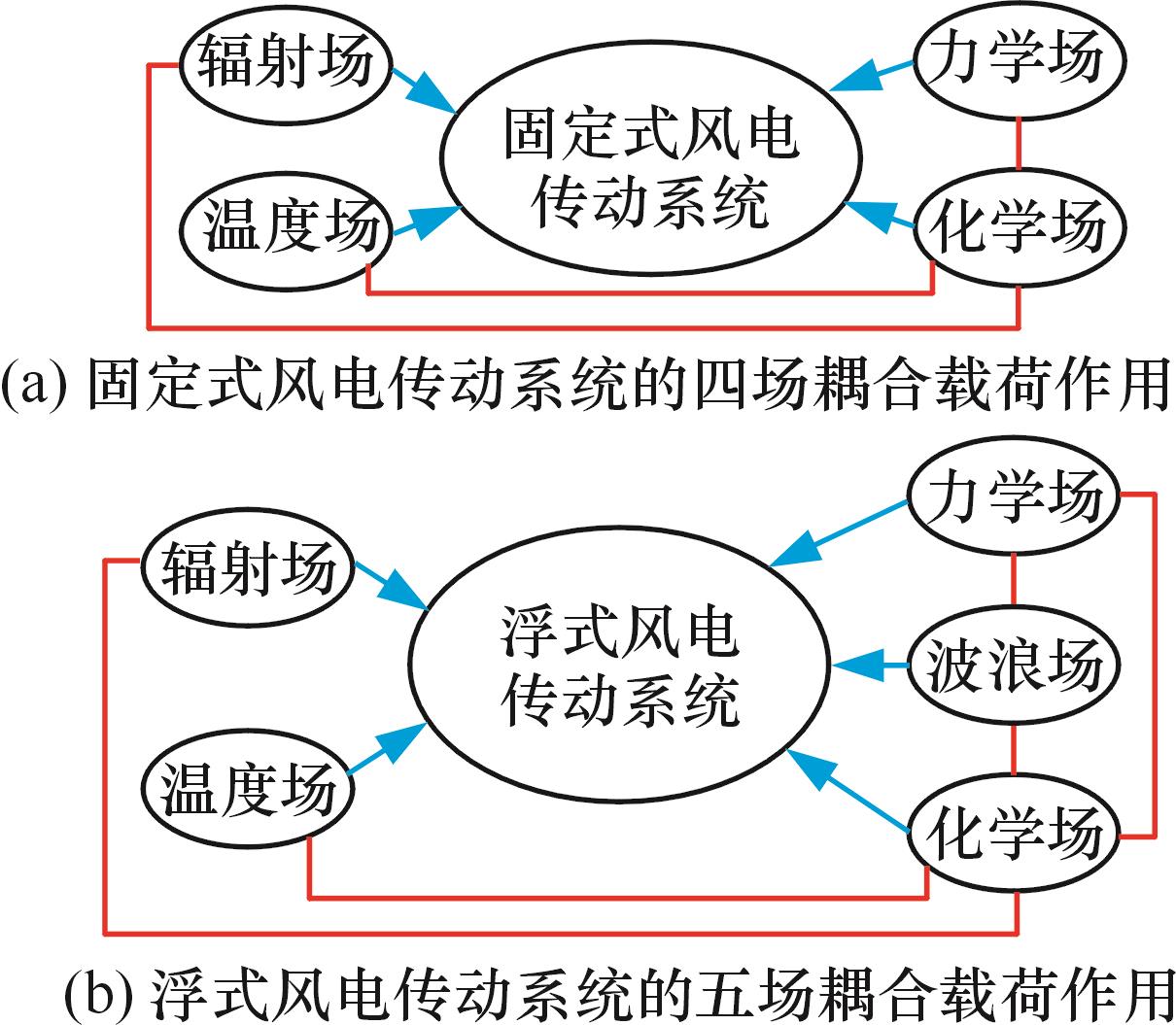
图1 南海风电传动系统的多场耦合载荷作用
Fig.1 Multi-field coupling load of wind turbine transmission system in South China Sea
| 理论方向 | 现有研究水平 | 理论瓶颈 | 核心难点 | 数据需求 |
|---|---|---|---|---|
| 力学-波浪耦合载荷建模 | 独立场载荷模型,叠加仿真误差15% | 台风-波浪非平稳耦合时频建模 | 高风速(60 m/s)与高波高(4 m)非线性叠加 | 台风-波浪同步实测(≥3年,12级以上台风) |
| 波浪-化学场耦合系数 | 定性分析波浪加速盐雾 渗透 | 波浪对盐雾分布的系数量化 | 高波高(4 m)下盐雾扩散仿真 | 不同海况盐雾浓度分布(≥2年) |
| 倾角-接触应力关联 | 仿真倾角15°应力增25%,无试验 | 倾角与轴承应力分布定量关系 | 偏载下轴承接触力学非线性(高盐雾致腐蚀) | 不同倾角轴承应力实测(≥10组工况) |
| 浮式润滑失效预测 | 固定式模型修正,误差20% | 波浪-倾角-润滑耦合 模型 | 倾角15°润滑油分布不均+波浪载荷协同 | 不同“倾角+波高”润滑性能试验(≥15组) |
表1 南海浮式风电五场耦合理论瓶颈与数据需求
Tab.1 Bottlenecks and data demands of five-field coupling theory of floating wind turbine in South China Sea
| 理论方向 | 现有研究水平 | 理论瓶颈 | 核心难点 | 数据需求 |
|---|---|---|---|---|
| 力学-波浪耦合载荷建模 | 独立场载荷模型,叠加仿真误差15% | 台风-波浪非平稳耦合时频建模 | 高风速(60 m/s)与高波高(4 m)非线性叠加 | 台风-波浪同步实测(≥3年,12级以上台风) |
| 波浪-化学场耦合系数 | 定性分析波浪加速盐雾 渗透 | 波浪对盐雾分布的系数量化 | 高波高(4 m)下盐雾扩散仿真 | 不同海况盐雾浓度分布(≥2年) |
| 倾角-接触应力关联 | 仿真倾角15°应力增25%,无试验 | 倾角与轴承应力分布定量关系 | 偏载下轴承接触力学非线性(高盐雾致腐蚀) | 不同倾角轴承应力实测(≥10组工况) |
| 浮式润滑失效预测 | 固定式模型修正,误差20% | 波浪-倾角-润滑耦合 模型 | 倾角15°润滑油分布不均+波浪载荷协同 | 不同“倾角+波高”润滑性能试验(≥15组) |
| 部件类型 | 核心失效机制 | 主导环境场 | 平均寿命/h | 故障占比/% | 关键失效参数 |
|---|---|---|---|---|---|
| 主轴系统 | 腐蚀-疲劳耦合 | 力学-化学-温度(浮式+波浪) | 固定式6.5万;浮式5.8万 | 35 | 多裂纹源:固定式2~5个、浮式3~6个;扩展速率:2.3~2.8/2.5~3.0 nm/cycle;临界裂纹尺寸:2.2/2.0 mm |
| 齿轮箱 | 润滑失效→齿面损伤→轴承失效 | 温度-化学-力学(浮式+波浪) | 固定式5.8万;浮式5.0万 | 45 | 胶合占比:固定式65%、浮式70%;点蚀深度:0.35/0.4 mm;润滑油酸值:0.32/0.35 mg/g(以KOH计) |
| 轴承系统 | 腐蚀磨损+高温卡死+疲劳剥落 | 化学-温度-力学(浮式+波浪) | 固定式4.2万;浮式3.6万 | 15 | 年磨损:0.18/0.21 mm;夏季卡死率:15%±2%/18%±2%;接触应力超设计值:29%/34% |
| 润滑密封系统 | 密封失效→润滑污染 | 辐射-化学-湿度(浮式+波浪) | 固定式3.5万;浮式3.0万 | 5 | 金属磨粒:(180±15)/(200±15) ppm;渗漏量:(6±1)/(7±1) L/天;密封件寿命:8~10/7~9个月 |
表2 南海风电传动系统四大部件失效特征
Tab.2 Failure characteristics of four components of South China Sea wind turbine transmission system
| 部件类型 | 核心失效机制 | 主导环境场 | 平均寿命/h | 故障占比/% | 关键失效参数 |
|---|---|---|---|---|---|
| 主轴系统 | 腐蚀-疲劳耦合 | 力学-化学-温度(浮式+波浪) | 固定式6.5万;浮式5.8万 | 35 | 多裂纹源:固定式2~5个、浮式3~6个;扩展速率:2.3~2.8/2.5~3.0 nm/cycle;临界裂纹尺寸:2.2/2.0 mm |
| 齿轮箱 | 润滑失效→齿面损伤→轴承失效 | 温度-化学-力学(浮式+波浪) | 固定式5.8万;浮式5.0万 | 45 | 胶合占比:固定式65%、浮式70%;点蚀深度:0.35/0.4 mm;润滑油酸值:0.32/0.35 mg/g(以KOH计) |
| 轴承系统 | 腐蚀磨损+高温卡死+疲劳剥落 | 化学-温度-力学(浮式+波浪) | 固定式4.2万;浮式3.6万 | 15 | 年磨损:0.18/0.21 mm;夏季卡死率:15%±2%/18%±2%;接触应力超设计值:29%/34% |
| 润滑密封系统 | 密封失效→润滑污染 | 辐射-化学-湿度(浮式+波浪) | 固定式3.5万;浮式3.0万 | 5 | 金属磨粒:(180±15)/(200±15) ppm;渗漏量:(6±1)/(7±1) L/天;密封件寿命:8~10/7~9个月 |
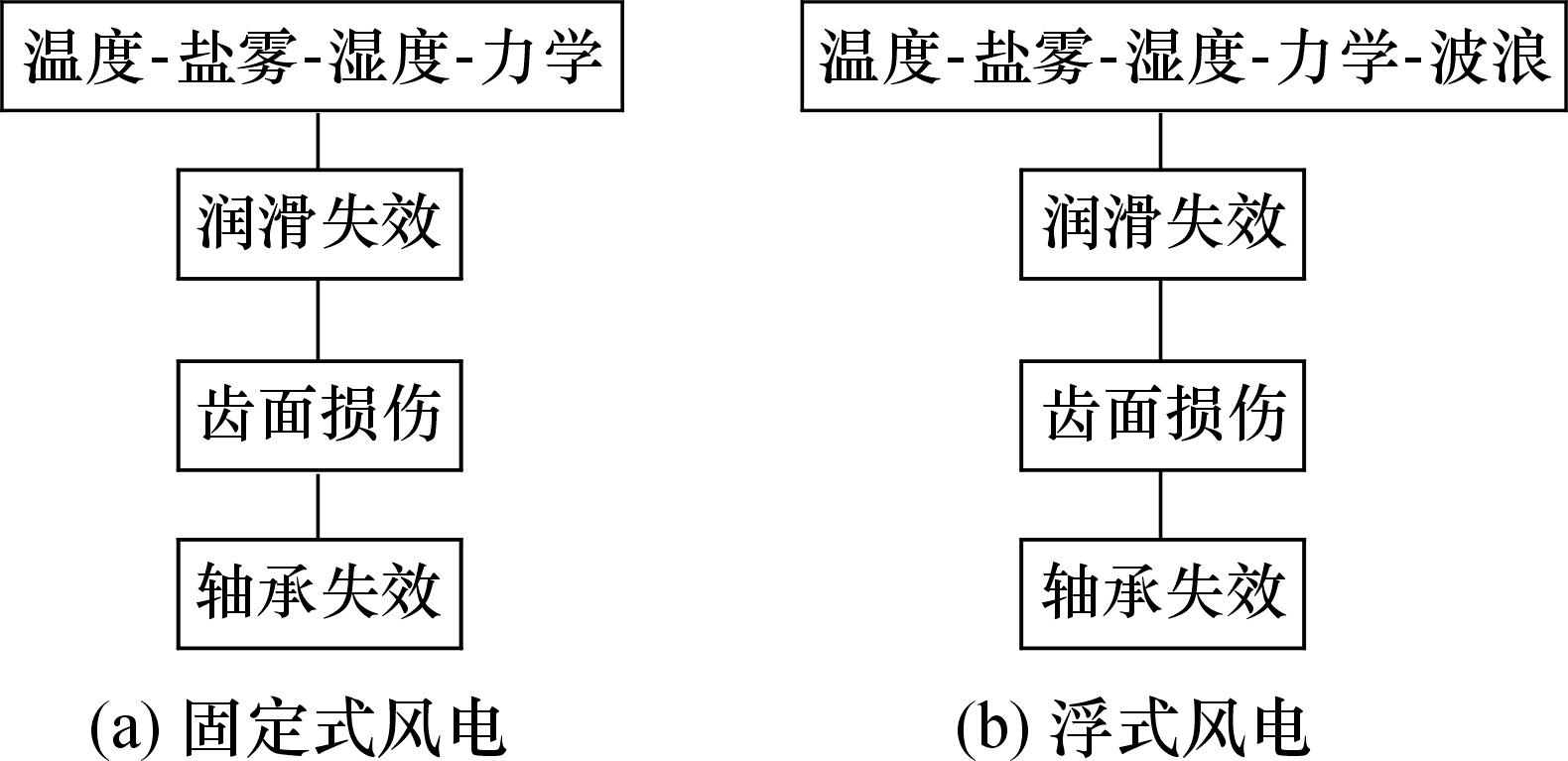
图2 失效的连锁特征
Fig.2 Interlocking characteristics of failure
| 理论空白类型 | 核心问题 | 突破方向 | 关键技术手段 | 预期目标 |
|---|---|---|---|---|
| 台风-波浪-倾角耦合建模 | 三参数耦合的定量关系未建立 | 五场耦合数学建模+试验验证 | COMSOL Multiphysics仿真+ MTS电液伺服加载试验 | 载荷预测误差<8% |
| 新型材料失效机理 | CFRP/CMC的多场耦合失效规律不明 | 新型材料长期暴露试验+多尺度仿真 | 10年户外暴露试验+分子动力学仿真 | 建立材料-环境-寿命普适模型 |
长效防护界面 理论 | 涂层界面开裂机制 未阐明 | 涂层-基体界面应力计算+协同防护设计 | 界面力学仿真+涂层优化试验 | 防护层寿命超15年 |
智能监测多源 融合 | 多维度数据关联理论 缺失 | CNN-LSTM-GRU融合算法+特征工程 | 风电场多源数据采集+算法训练 | 早期故障预警滞后<10 h |
表3 浮式风电五场耦合理论空白与未来突破方向
Tab. 3 Blank and future breakthrough direction of five-field coupling theory of floating wind power equipment
| 理论空白类型 | 核心问题 | 突破方向 | 关键技术手段 | 预期目标 |
|---|---|---|---|---|
| 台风-波浪-倾角耦合建模 | 三参数耦合的定量关系未建立 | 五场耦合数学建模+试验验证 | COMSOL Multiphysics仿真+ MTS电液伺服加载试验 | 载荷预测误差<8% |
| 新型材料失效机理 | CFRP/CMC的多场耦合失效规律不明 | 新型材料长期暴露试验+多尺度仿真 | 10年户外暴露试验+分子动力学仿真 | 建立材料-环境-寿命普适模型 |
长效防护界面 理论 | 涂层界面开裂机制 未阐明 | 涂层-基体界面应力计算+协同防护设计 | 界面力学仿真+涂层优化试验 | 防护层寿命超15年 |
智能监测多源 融合 | 多维度数据关联理论 缺失 | CNN-LSTM-GRU融合算法+特征工程 | 风电场多源数据采集+算法训练 | 早期故障预警滞后<10 h |
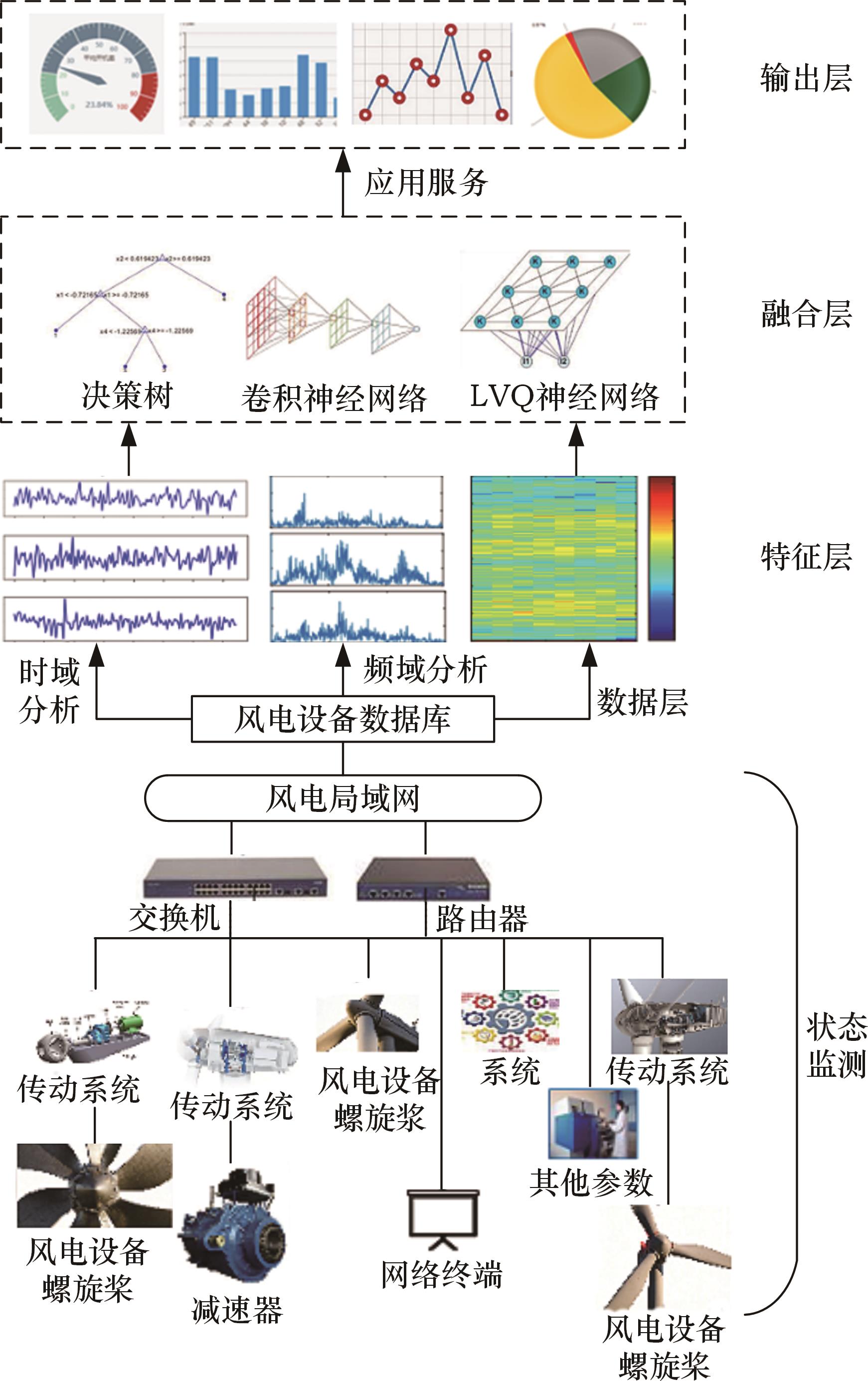
图3 智能监测多源数据融合流程
Fig.3 Intelligent monitoring multi-source data fusion process
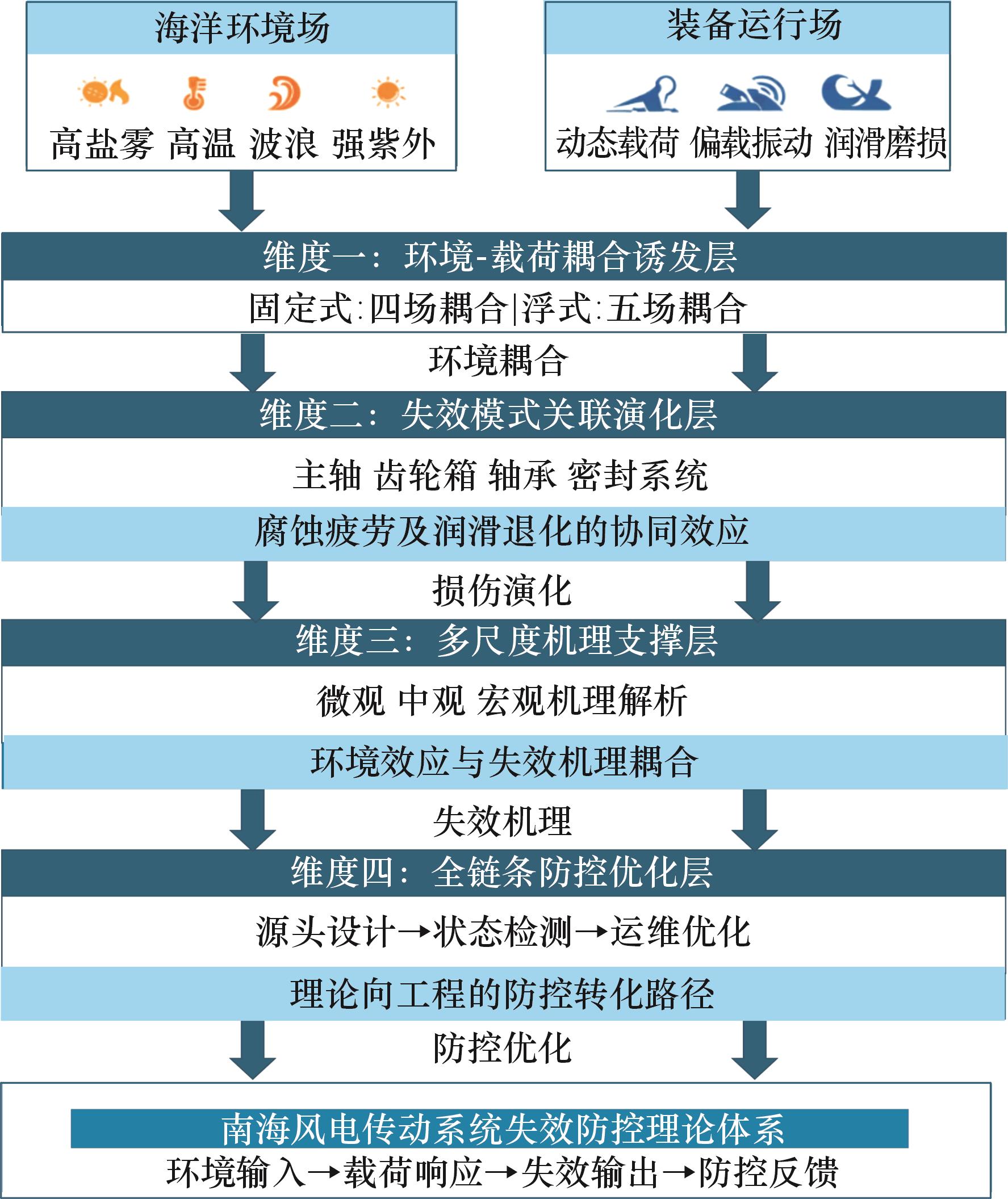
图4 失效理论体系整体框架
Fig.4 Integrated framework of failure theory system
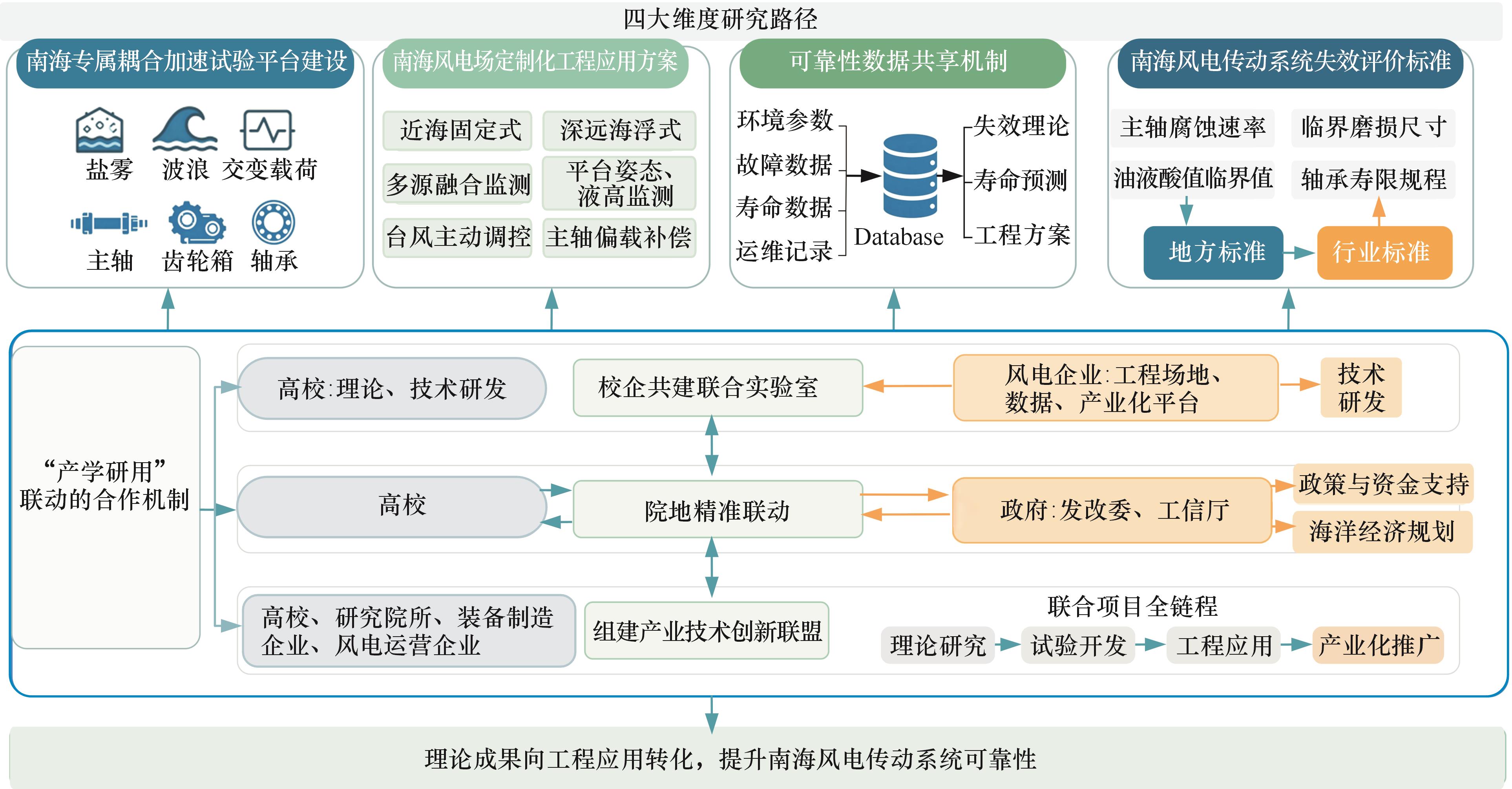
图5 总体实施路线
Fig.5 Overall Implementation Path
| [1] | 刘吉臻, 马利飞, 王庆华, 等. 海上风电支撑我国能源转型发展的思考[J]. 中国工程科学, 2021, 23(1): 149-159. |
| LIU Jizhen, MA Lifei, WANG Qinghua, et al. Offshore Wind Power Supports China’s Energy Transition[J]. Strategic Study of CAE, 2021, 23(1): 149-159. | |
| [2] | 刘洪波, 彭晓宇, 张崇, 等. 风电参与电力系统调频控制策略综述[J]. 电力自动化设备, 2021, 41(11): 81-92. |
| LIU Hongbo, PENG Xiaoyu, ZHANG Chong, et al. Overview of Wind Power Participating in Frequency Regulation Control Strategy for Power System[J]. Electric Power Automation Equipment, 2021, 41(11): 81-92. | |
| [3] | 林伯强, 杨梦琦. 碳中和背景下中国电力系统研究现状、挑战与发展方向[J]. 西安交通大学学报(社会科学版), 2022, 42(5): 1-10. |
| LIN Boqiang, YANG Mengqi. China’s Power System Research in the Context of Carbon Neutrality: Current Status, Challenges, and Development Direction[J]. Journal of Xi’an Jiaotong University (Social Sciences), 2022, 42(5): 1-10. | |
| [4] | CAO Y, MENG Y, ZHANG Z, et al. Life Cycle Environmental Analysis of Offshore Wind Power: a Case Study of the Large-scale Offshore Wind Farm in China[J]. Renewable and Sustainable Energy Reviews, 2024, 196: 114351. |
| [5] | JI L, LI J, SUN L, et al. China’s Onshore Wind Energy Potential in the Context of Climate Change[J]. Renewable and Sustainable Energy Reviews, 2024, 203: 114778. |
| [6] | 秦世耀, 齐琛, 李少林, 等. 电压源型构网风电机组研究现状及展望[J]. 中国电机工程学报, 2023, 43(4): 1314-1333. |
| QIN Shiyao, QI Chen, LI Shaolin, et al. Review of the Voltage-source Grid Forming Wind Turbine[J]. Proceedings of the CSEE, 2023, 43(4): 1314-1333. | |
| [7] | PANDIT R K, ASTOLFI D, DURAZO CARDENAS I. A Review of Predictive Techniques Used to Support Decision Making for Maintenance Operations of Wind Turbines[J]. Energies, 2023, 16(4): 1654. |
| [8] | OLABI A G, WILBERFORCE T, ELSAID K, et al. A Review on Failure Modes of Wind Turbine Components[J]. Energies, 2021, 14(17): 5241. |
| [9] | FAN Q, WANG X, YUAN J, et al. A Review of the Development of Key Technologies for Offshore Wind Power in China[J]. Journal of Marine Science and Engineering, 2022, 10(7): 929. |
| [10] | NEJAD A R, KELLER J, GUO Y, et al. Wind Turbine Drivetrains: State-of-the-art Technologies and Future Development Trends[J]. Wind Energy Science, 2022, 7(1): 387-411. |
| [11] | 李铮, 郭小江, 申旭辉, 等. 我国海上风电发展关键技术综述[J]. 发电技术, 2022, 43(2): 186-197. |
| LI Zheng, GUO Xiaojiang, SHEN Xuhui, et al. Summary of Technologies for the Development of Offshore Wind Power Industry in China[J]. Power Generation Technology, 2022, 43(2): 186-197. | |
| [12] | 周恒宇, 周建星, 温建民, 等. 风电轴承失效模式研究进展[J]. 轴承, 2023(6): 102-114. |
| ZHOU Hengyu, ZHOU Jianxing, WEN Jianmin, et al. Research Progress on Failure Modes of Wind Turbine Bearings[J]. Bearing, 2023(6): 102-114. | |
| [13] | MOURAD A I, ALMOMANI A, AHMAD SHEIKH I, et al. Failure Analysis of Gas and Wind Turbine Blades: a Review[J]. Engineering Failure Analysis, 2023, 146: 107107. |
| [14] | SUN Y, LI H, SUN L, et al. Failure Analysis of Floating Offshore Wind Turbines with Correlated Failures[J]. Reliability Engineering & System Safety, 2023, 238: 109485 |
| [15] | 孟旭铮, 于宁, 韦一可, 等. 42CrMo和Cr12MoV合金钢在NaCl溶液中的腐蚀电化学行为分析[J]. 材料保护, 2022, 55(6): 75-79. |
| MENG Xuzheng, YU Ning, WEI Yike, et al. Corrosion Electrochemical Behavior Analysis of 42CrMo and Cr12MoV Alloy Steels in NaCl Solution[J]. Materials Protection, 2022, 55(6): 75-79. | |
| [16] | LIU D, LI Y, XIE X, et al. Effect of Pre-corrosion Pits on Residual Fatigue Life for 42CrMo Steel[J]. Materials, 2019, 12(13): 2130. |
| [17] | 贾文虎, 徐群杰. 海上风电设施防腐蚀技术研究进展[J]. 发电技术, 2023, 44(5): 703-711. |
| JIA Wenhu, XU Qunjie. Research Progress of Anti-corrosion Technology for Offshore Wind Power Facilities[J]. Power Generation Technology, 2023, 44(5): 703-711. | |
| [18] | GONG J, LIU K, ZHENG Y, et al. Thermal-elastohydrodynamic Lubrication Study of Misaligned Journal Bearing in Wind Turbine Gearbox[J]. Tribology International, 2023, 188: 108887. |
| [19] | 吴重仲, 刘大勇, 闫文吉, 等. 海上风机螺栓用钢的腐蚀及疲劳行为[J]. 腐蚀与防护, 2024, 45(11): 61-68. |
| WU Chongzhong, LIU Dayong, YAN Wenji, et al. Corrosion and Fatigue Behavior of Steel for Offshore Wind Turbine Bolts[J]. Corrosion and Protection, 2024, 45(11): 61-68. | |
| [20] | DIBAJ A, GAO Z, NEJAD A R. Fault Detection of Offshore Wind Turbine Drivetrains in Different Environmental Conditions through Optimal Selection of Vibration Measurements[J]. Renewable Energy, 2023, 203: 161-176. |
| [21] | LU B, DIBAJ A, GAO Z, et al. A Class-imbalance-aware Domain Adaptation Framework for Fault Diagnosis of Wind Turbine Drivetrains under Different Environmental Conditions[J]. Ocean Engineering, 2024, 296: 116902. |
| [22] | CIVERA M, SURACE C. Non-destructive Techniques for the Condition and Structural Health Monitoring of Wind Turbines: a Literature Review of the last 20 Years[J]. Sensors, 2022, 22(4): 1627. |
| [23] | NEJAD A R, TORSVIK J. Drivetrains on Floating Offshore Wind Turbines: Lessons Learned over the Last 10 Years “,” Antriebsstränge in Schwimmenden Offshore-Windkraftanlagen: Erkenntnisse Der Letzten 10 Jahres[J]. Forschung Im Ingenieurwesen, 2021, 85(2): 335-343. |
| [24] | 王霄. 基于数据驱动的风电齿轮箱故障诊断研究[D]. 秦皇岛: 燕山大学, 2023. |
| WANG Xiao. Research on Fault Diagnosis of Wind Turbine Gearbox Based on Data Driving[D]. Qinhuangdao: Yanshan University, 2023. | |
| [25] | BHARANI R, SIVAPRAKASAM A. A Review Analysis on Performance and Classification of Wind Turbine Gearbox Technologies[J]. IETE Journal of Research, 2022, 68(5): 3341-3355. |
| [26] | BALI BASHIR M. Principle Parameters and Environmental Impacts that Affect the Performance of Wind Turbine: an Overview[J]. Arabian Journal for Science and Engineering, 2022, 47(7): 7891-7909. |
| [27] | YIN J, MENG X, CHENG S. Enhancing Wind Turbine Energy Efficiency: Tribo-dynamics Modeling and Shape Modification[J]. Renewable and Sustainable Energy Reviews, 2025, 208: 115071. |
| [28] | 董伟. 基于时间序列复杂度和模态分解的风电机组齿轮箱关键部件故障诊断方法[D]. 秦皇岛: 燕山大学, 2023. |
| DONG Wei. Fault Diagnosis Method for Key Components of Wind Turbine Gearboxes Based on Time Series Complexity and Modal Decomposition[D]. Qinhuangdao: Yanshan University, 2023. | |
| [29] | REHMAN S, ALAM M M, ALHEMS L M. A Review of Wind-turbine Structural Stability, Failure and Alleviation[J]. Wind and Structures, an International Journal, 2020, 30(5): 511-524. |
| [30] | WU M, HAN X, TAO Y, et al. Lubrication Reliability Analysis of Wind Turbine Main Bearing in Random Wind Field[J]. Tribology International, 2023, 179: 108181. |
| [31] | LÜDECKE F D, SCHMID M, REHE E, et al. Numerical Aspects of a Two-way Coupling for Electro-mechanical Interactions—a Wind Energy Perspective[J]. Energies, 2022, 15(3): 1178. |
| [32] | 张景新, 赵永生, 樊翔, 等. 海上浮式风力机支撑结构的流固耦合动力学研究[J]. 力学与实践, 2022, 44(5): 1093-1104. |
| ZHANG Jingxin, ZHAO Yongsheng, FAN Xiang, et al. Investigation of the Fluid and Structure Interaction for the Platform of Offshore Floating Wind Turbine[J]. Mechanics in Engineering, 2022, 44(5): 1093-1104. | |
| [33] | 张娇磊, 余丁浩, 李钢, 等. 考虑腐蚀与疲劳耦合损伤的海上风机支撑钢结构抗震性能分析[J/OL]. 工程力学, 2024: 1-18[2026-03-15]. . |
| ZHANG Jiaolei, YU Dinghao, LI Gang, et al. Seismic Performance Analysis of Offshore Wind Turbine Supporting Steel Structures Considering Corrosion-fatigue Coupled Damage[J/OL]. Engineering Mechanics, 2024: 1-18[2026-03-15]. . | |
| [34] | 宋增国, 刘淞仰, 何泽文, 等. 浮式风力机一体化流固耦合数值模拟方法进展[J]. 绿色能源, 2024(1): 24-33. |
| SONG Zengguo, LIU Songyang, HE Zewen, et al. Advances in Integrated Fluid-structure Interaction Numerical Simulation Methods for Floating Wind Turbines[J]. Green Energy, 2024(1): 24-33. | |
| [35] | WIEGARD B, KÖNIG M, LUND J, et al. Fluid-structure Interaction and Stress Analysis of a Floating Wind Turbine[J]. Marine Structures, 2021, 78: 102970. |
| [36] | 姜涛. 基于流固耦合方法的海上浮式风力机气动性能研究[D]. 哈尔滨: 哈尔滨工程大学, 2023. |
| JIANG Tao. Aerodynamic Performance Study of Offshore Floating Wind Turbines Based on Fluid-structure Interaction Methods. Master’s Thesis[D]. Harbin: Harbin Engineering University, 2023. | |
| [37] | SUO H, DENG K, ZHANG K, et al. Static/Fatigue Response and Degradation Behaviors of CFRP/Ti Bolted Joints under Salt-fog and Ultraviolet Synergistic Marine Environment[J]. Thin-Walled Structures, 2024, 203: 112251. |
| [38] | DENG K, LUO B, SUO H, et al. Characterization of Material Degradation Mechanism of Carbon Fiber Reinforced Epoxy Resin Composites under Ultraviolet Radiation and Salt-fog Synergistic Environment[J]. Polymer Composites, 2024, 45(1): 805-824. |
| [39] | USTINOV D A, SHAFHATOV E R. Assessment of Reliability Indicators of Combined Systems of Offshore Wind Turbines and Wave Energy Converters[J]. Energies, 2022, 15(24): 9630. |
| [40] | FANG G, GAO X, SONG Y. A Review on Ceramic Matrix Composites and Environmental Barrier Coatings for Aero-engine: Material Development and Failure Analysis[J]. Coatings, 2023, 13(2): 357. |
| [41] | HALL R, TOPHAM E, JOÃO E. Environmental Impact Assessment for the Decommissioning of Offshore Wind Farms[J]. Renewable and Sustainable Energy Reviews, 2022, 165: 112580. |
| [42] | 张攀, 张海瑞, 罗添校, 等. 漂浮式风电机组物理数值耦合模型风洞试验方法研究[J]. 工程热物理学报, 2025, 46(12): 4075-4086. |
| ZHANG Pan, ZHANG Hairui, LUO Tianxiao, et al. Research on Wind Tunnel Test Method of Physical-numerical Coupling Model for Floating Offshore Wind Turbines[J]. Journal of Engineering Thermophysics, 2025, 46(12): 4075-4086. | |
| [43] | ZHANG H, WEN B, LIU Y, et al. Equivalent Current Load Simulation for Floating Wind Turbines in Model Testing: Method and Experimental Validation[J]. Ocean Engineering, 2025, 341: 122557. |
| [44] | 严茉芯, 崔权维, 周建星, 等. 考虑失效相关的风电齿轮传动系统动态可靠性研究[J]. 太阳能学报, 2024, 45(8): 477-485. |
| YAN Moxin, CUI Quanwei, ZHOU Jianxing, et al. Research on Dynamic Reliability of Wind Power Gear Transmission System Considering Failure Correlation[J]. Acta Energiae Solaris Sinica, 2024, 45(8): 477-485. | |
| [45] | BADIHI H, ZHANG Y, JIANG B, et al. A Comprehensive Review on Signal-based and Model-based Condition Monitoring of Wind Turbines: Fault Diagnosis and Lifetime Prognosis[J]. Proceedings of the IEEE, 2022, 110(6): 754-806. |
| [46] | YIN C, HUANG H, WANG D, et al. Tropical Cyclone-induced Wave Hazard Assessment in Hainan Island, China[J]. Natural Hazards, 2022, 113(1): 103-123. |
| [1] | 朱峰, 余飞龙, 周恩涛, 万海浪, 马运五, 葛恩德, 赵亦希, 李永兵. 铆钉结构对CFRP/钛合金摩擦铆焊工艺及接头力学行为的影响[J]. 中国机械工程, 2026, 37(9): 2334-2342. |
| [2] | 张润成, 刘捷舟, 汪义伟, 刘更, 佟瑞庭. 基于数字孪生的齿轮传动系统振动性能监测方法[J]. 中国机械工程, 2026, 37(5): 1183-1192. |
| [3] | 莫帅, 李亚鑫, 吴生阳, 赵新浩, 陈素姣, 彭南江, 张伟. 非圆行星齿轮传动系统非线性动力学特性[J]. 中国机械工程, 2026, 37(2): 353-360. |
| [4] | 石致远1, 2, 孔志伟2, 陈俊臻3, 王淑营3. 风电设备情境知识图谱构建技术研究[J]. 中国机械工程, 2025, 36(06): 1206-1213. |
| [5] | 钱萍, 陈驰, 陈文华, 吴山奇, 郭明达. 电连接器用聚氨酯胶密封件贮存可靠性统计模型的加速试验验证与评估[J]. 中国机械工程, 2024, 35(05): 886-894. |
| [6] | 韩晓辉, 林森, 方喜风, 王振中, 孙兆刚, 余飞龙, 李磊, 马运五, 李永兵, . 铆钉镀层对单边摩擦铆焊接头成形及力学性能的影响[J]. 中国机械工程, 2024, 35(04): 721-730. |
| [7] | 李坤航, 张思琦, 吴玮, 胡明卓, 孙娅铃, 熊鑫, 黄宏. 三层异种不等厚钢电阻点焊多场耦合模拟与分析[J]. 中国机械工程, 2023, 34(24): 2996-3003. |
| [8] | 张丁戈, 王立勇, 李乐, 张金乐. 综合传动系统时变工况动力学建模与求解方法研究[J]. 中国机械工程, 2023, 34(22): 2665-2673. |
| [9] | 李子麟, 时振刚, 铁晓艳, 杨国军, 任文亮, 姚佳康, 王玉明, 王子羲. 重型磁悬浮转子跌落保护轴承失效机理[J]. 中国机械工程, 2023, 34(09): 1009-1018. |
| [10] | 李健, 冉琰, 张根保, 王勇勤. 机械传动系统运动精度优化分配新方法[J]. 中国机械工程, 2022, 33(09): 1034-1043. |
| [11] | 董思捷, 张新春, 汪玉林, 刘南南, 陈学晋. 不同挤压载荷下圆柱形锂离子电池的失效机理试验研究[J]. 中国机械工程, 2022, 33(08): 915-920,951. |
| [12] | 秦大同, 吕雪慧, 陈锐博, 杨战斌. 运行工况下风电传动系统机电耦合建模及其动态特性分析[J]. 中国机械工程, 2022, 33(03): 253-260. |
| [13] | 陈一凡, 张根保, 冉琰, 李宇龙, 庾辉, . 面向元动作的机械传动系统可靠性分配方法[J]. 中国机械工程, 2021, 32(17): 2032-2039. |
| [14] | 宫燃, 张真宇, 程志高, 徐宜, 张鹤. 基于MpCCI方法的密封环双向流固耦合模拟与试验研究[J]. 中国机械工程, 2021, 32(14): 1639-1646. |
| [15] | 刘辰辰1;陈亚军1;李柯1;王川2. 7075航空铝合金原位腐蚀-多轴疲劳行为分析[J]. 中国机械工程, 2019, 30(05): 615-621. |
| 阅读次数 | ||||||
|
全文 |
|
|||||
|
摘要 |
|
|||||
