



ISSN 1004-132X
CN 42-1294/TH
CN 42-1294/TH
中国机械工程 ›› 2026, Vol. 37 ›› Issue (7): 1572-1579.DOI: 10.3969/j.issn.1004-132X.2026.07.005
• 机械基础工程 • 上一篇
娄明1( ), 杨训旺1, 郝开元1, 徐凯1, 于兴胜2, 沈海春3, 张国田2, 常可可1()
收稿日期:2025-06-22
出版日期:2026-07-25
发布日期:2026-08-18
通讯作者:
常可可
作者简介:娄明,男,1988年生,副研究员、硕士研究生导师。研究方向为钻探金属陶瓷复合材料。发表论文50余篇。E-mail: louming@nimte.ac.cn基金资助:
LOU Ming1(), YANG Xunwang1, HAO Kaiyuan1, XU Kai1, YU Xingsheng2, SHEN Haichun3, ZHANG Guotian2, CHANG Keke1()
Received:2025-06-22
Online:2026-07-25
Published:2026-08-18
Contact:
CHANG Keke
摘要:
采用ANSYS仿真分析了深地钻具径向轴承在温度、载荷协同作用下的应力/应变分布状态。仿真结果表明,最大等效应力/应变出现在硬质合金/焊料界面(焊接界面)和硬质合金/硬质合金界面(摩擦界面)附近;温度显著提升应力/应变水平,300 ℃下的最大等效应力/应变较100 ℃下的最大等效应力/应变增大约2.5倍;轴承两端的摩擦应力高于中间区域,且更易发生黏着磨损。上述仿真结果与实地服役轴承的损伤分布特征高度吻合,可为径向轴承的优化设计提供理论参考。
中图分类号:
娄明, 杨训旺, 郝开元, 徐凯, 于兴胜, 沈海春, 张国田, 常可可. 温度与载荷协同作用下深地钻具径向轴承的表面损伤行为[J]. 中国机械工程, 2026, 37(7): 1572-1579.
LOU Ming, YANG Xunwang, HAO Kaiyuan, XU Kai, YU Xingsheng, SHEN Haichun, ZHANG Guotian, CHANG Keke. Surface Damage Behaviors of the Radial Bearings for Deep Drilling Tools under the Synergistic Effect of Temperature and Load[J]. China Mechanical Engineering, 2026, 37(7): 1572-1579.
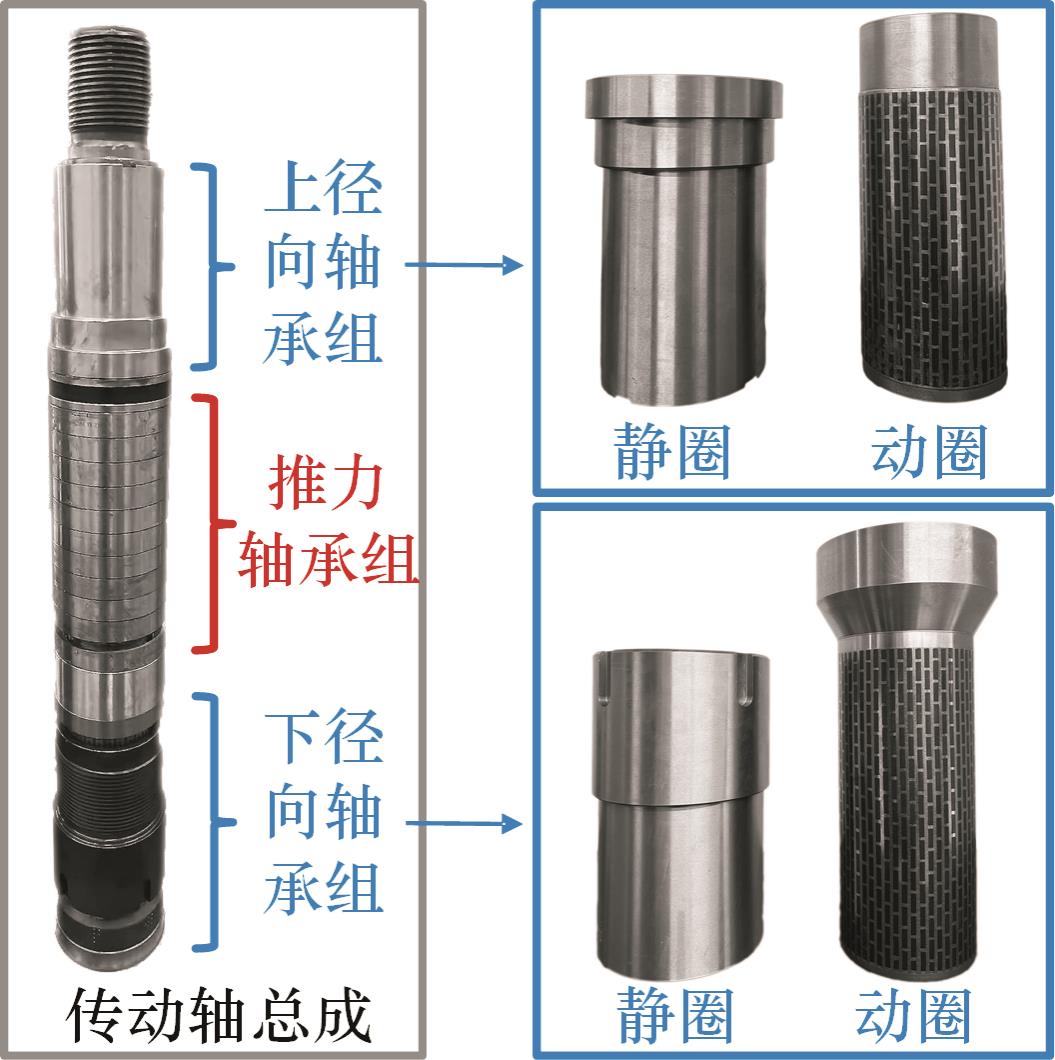
图1 钻探机具传动轴及径向轴承组结构
Fig.1 Typical structures of the drive shaft assembly and the radial bearing set of drilling tools
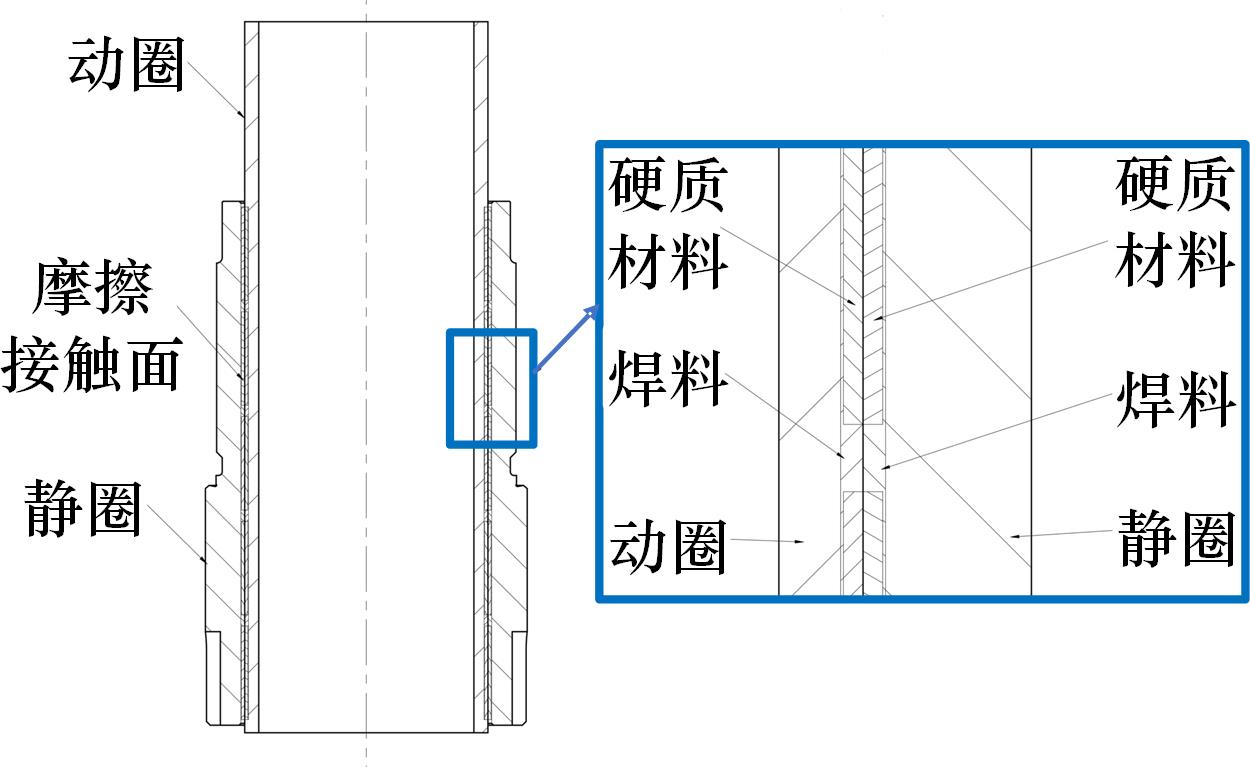
图2 径向轴承动/静圈摩擦接触面示意图
Fig.2 Schematic diagram of sliding contact surfaces between the moving rings and stationary rings of radial bearings
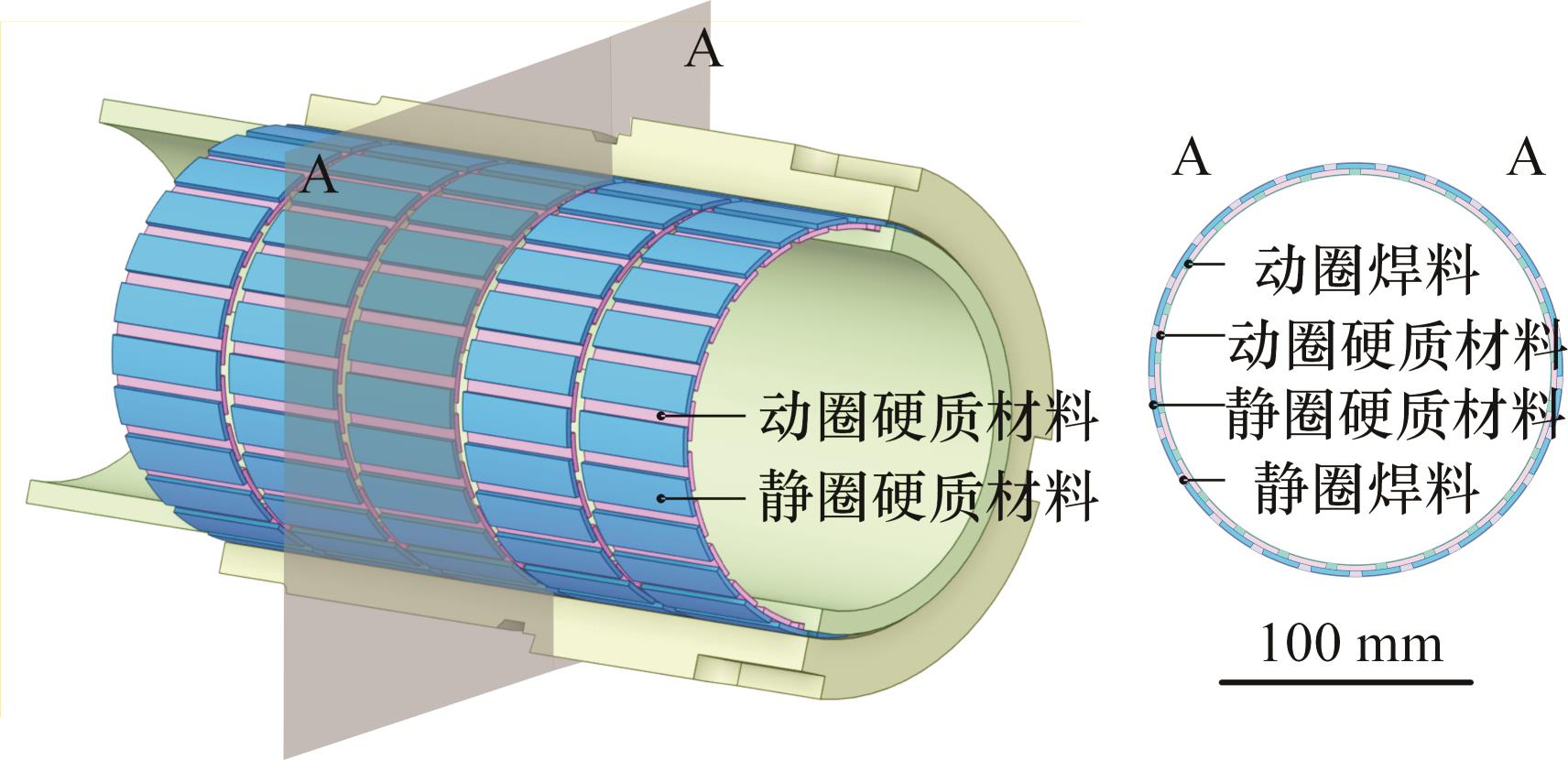
图3 径向轴承动/静圈有限元模拟模型
Fig.3 Simulation model of the moving rings and stationary rings of radial bearings
| 序号 | 硬质材料和焊料区域的网格尺寸/mm | 基体区域的网格尺寸/mm | 网格 数量 | 最大等效应力/MPa |
|---|---|---|---|---|
| 1 | 1.0 | 10.0 | 537 233 | 382 |
| 2 | 1.5 | 10.0 | 339 793 | 380 |
| 3 | 2.0 | 10.0 | 294 712 | 383 |
| 4 | 2.0 | 8.0 | 337 581 | 385 |
| 5 | 2.5 | 10.0 | 258 271 | 387 |
| 6 | 3.0 | 10.0 | 248 091 | 391 |
表1 网格独立性验证
Tab.1 Validation of mesh independence
| 序号 | 硬质材料和焊料区域的网格尺寸/mm | 基体区域的网格尺寸/mm | 网格 数量 | 最大等效应力/MPa |
|---|---|---|---|---|
| 1 | 1.0 | 10.0 | 537 233 | 382 |
| 2 | 1.5 | 10.0 | 339 793 | 380 |
| 3 | 2.0 | 10.0 | 294 712 | 383 |
| 4 | 2.0 | 8.0 | 337 581 | 385 |
| 5 | 2.5 | 10.0 | 258 271 | 387 |
| 6 | 3.0 | 10.0 | 248 091 | 391 |
| 材料 | 密度 ρ/(kg∙m-3) | 热膨胀系数 α/K-1 | 热导率 K/(W∙m-1∙K-1) | 比热容 C/(J∙kg-1∙K-1) | 弹性模量 E/GPa | 泊松比ν | 硬度HV | 屈服强度 MPa |
|---|---|---|---|---|---|---|---|---|
| YG8合金片 | 14600 | 5.8×10⁻⁶ | 134 | 200 | 577 | 0.23 | 1270 | - |
| Ti(C,N)片 | 6400 | 9.4×10⁻⁶ | 17 | 466 | 484 | 0.19 | 1300 | - |
| AgCuZn焊料 | 9500 | 1.9×10⁻⁵ | 150 | 300 | 80 | 0.34 | 130 | 400 |
| CuNiZn焊料 | 8400 | 1.6×10⁻⁵ | 40 | 380 | 120 | 0.33 | 200 | 557 |
| 42CrMo基体 | 7850 | 1.2×10⁻⁵ | 40 | 460 | 210 | 0.28 | 260 | 550 |
表2 材料属性定义[10-16]
Tab.2 Definition of materials properties[10-16]
| 材料 | 密度 ρ/(kg∙m-3) | 热膨胀系数 α/K-1 | 热导率 K/(W∙m-1∙K-1) | 比热容 C/(J∙kg-1∙K-1) | 弹性模量 E/GPa | 泊松比ν | 硬度HV | 屈服强度 MPa |
|---|---|---|---|---|---|---|---|---|
| YG8合金片 | 14600 | 5.8×10⁻⁶ | 134 | 200 | 577 | 0.23 | 1270 | - |
| Ti(C,N)片 | 6400 | 9.4×10⁻⁶ | 17 | 466 | 484 | 0.19 | 1300 | - |
| AgCuZn焊料 | 9500 | 1.9×10⁻⁵ | 150 | 300 | 80 | 0.34 | 130 | 400 |
| CuNiZn焊料 | 8400 | 1.6×10⁻⁵ | 40 | 380 | 120 | 0.33 | 200 | 557 |
| 42CrMo基体 | 7850 | 1.2×10⁻⁵ | 40 | 460 | 210 | 0.28 | 260 | 550 |
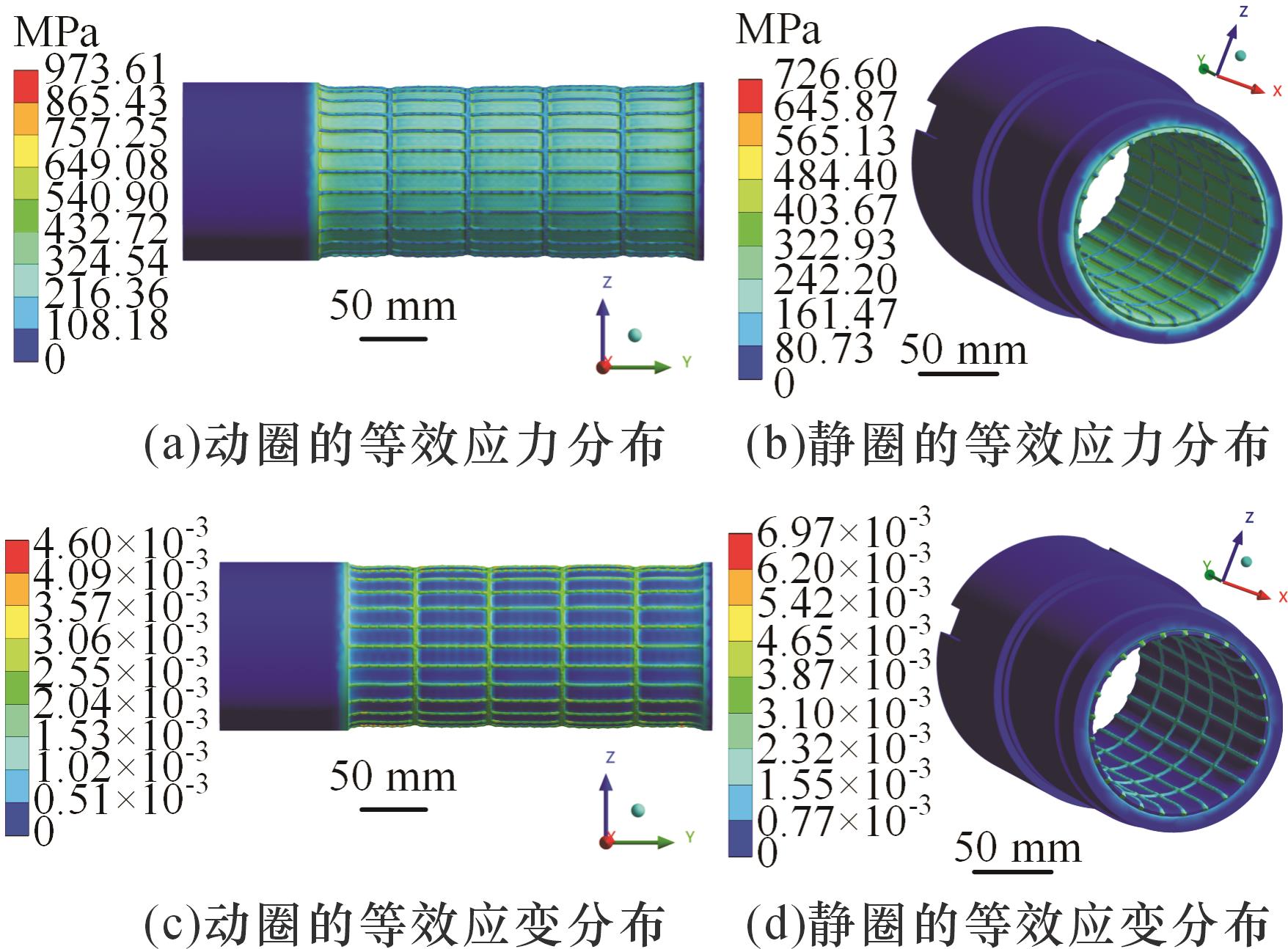
图4 径向轴承在温度100 ℃和动态轴承载荷0~10 kN下的仿真结果
Fig.4 Simulation results of the radial bearings at a temperature of 100 ℃ and dynamic bearing loads of 0~10 kN
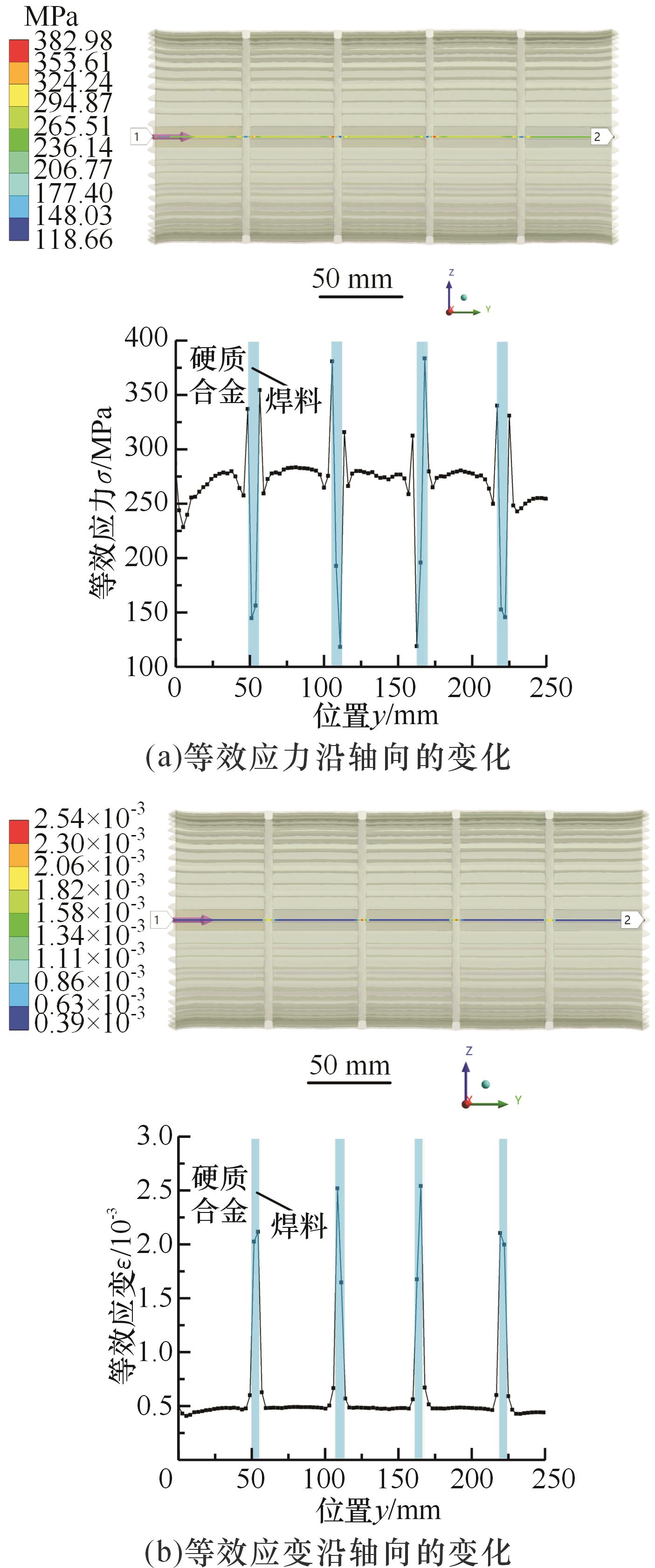
图5 轴承摩擦界面的仿真结果(100 ℃,动态载荷0~10 kN)
Fig.5 Simulation results of the sliding interfaces for bearing (100 ℃, dynamic loads of 0~10 kN)
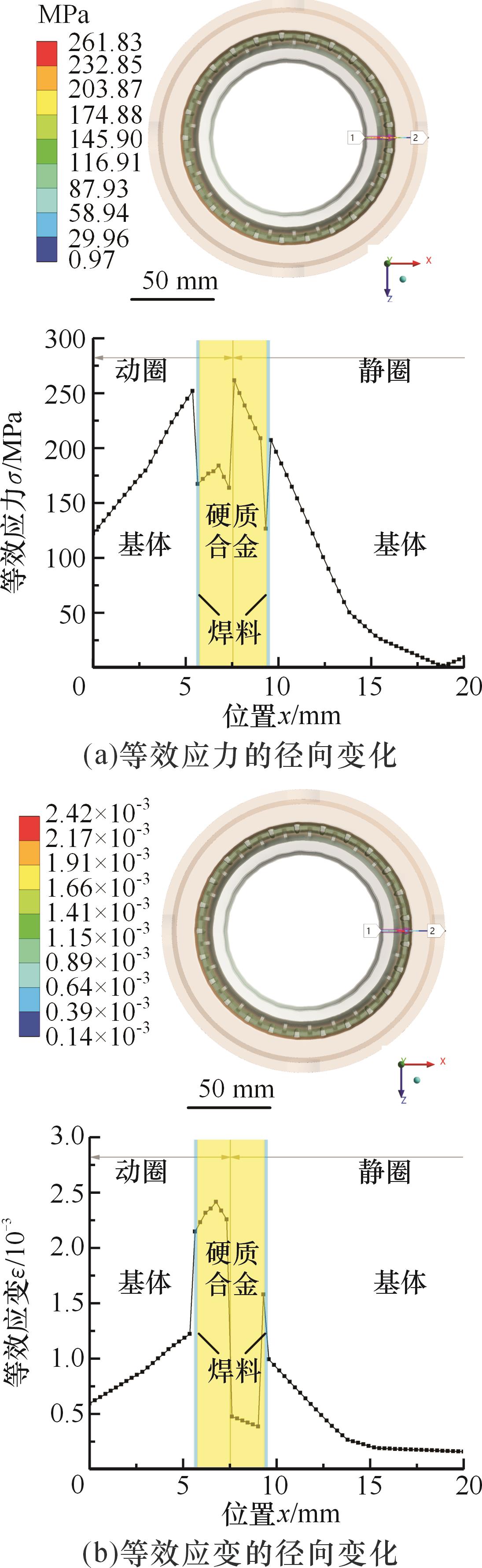
图6 径向轴承在温度100 ℃和动态轴承载荷0~10 kN下的仿真结果
Fig.6 Simulation results of the radial bearings at a temperature of 100 ℃ and dynamic bearing loads of 0~10 kN
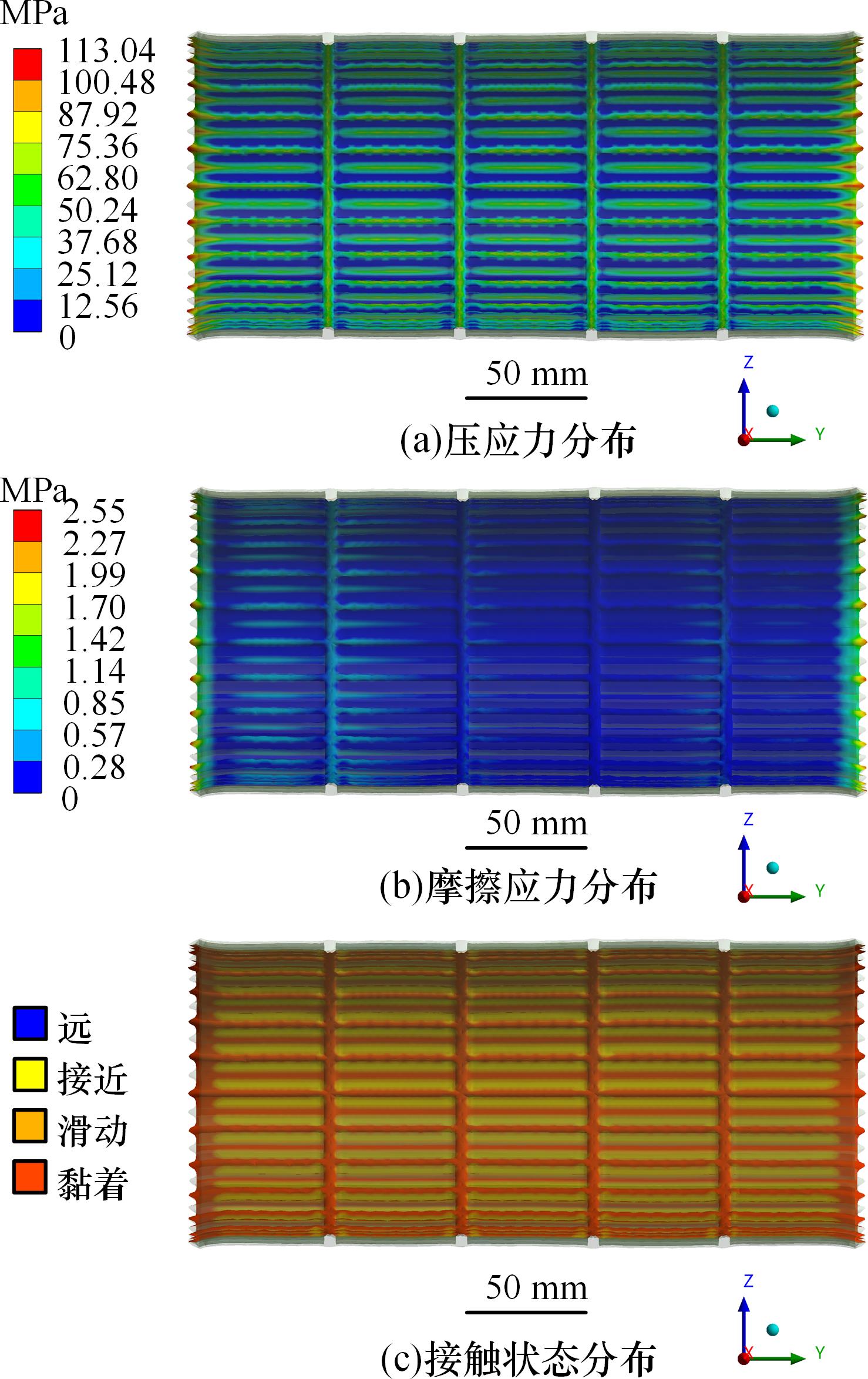
图7 摩擦界面在温度100 ℃和动态轴承载荷0~10 kN下的仿真结果:
Fig.7 Simulation results of the sliding interfaces at a temperature of 100 ℃ and dynamic bearing loads of 0~10 kN
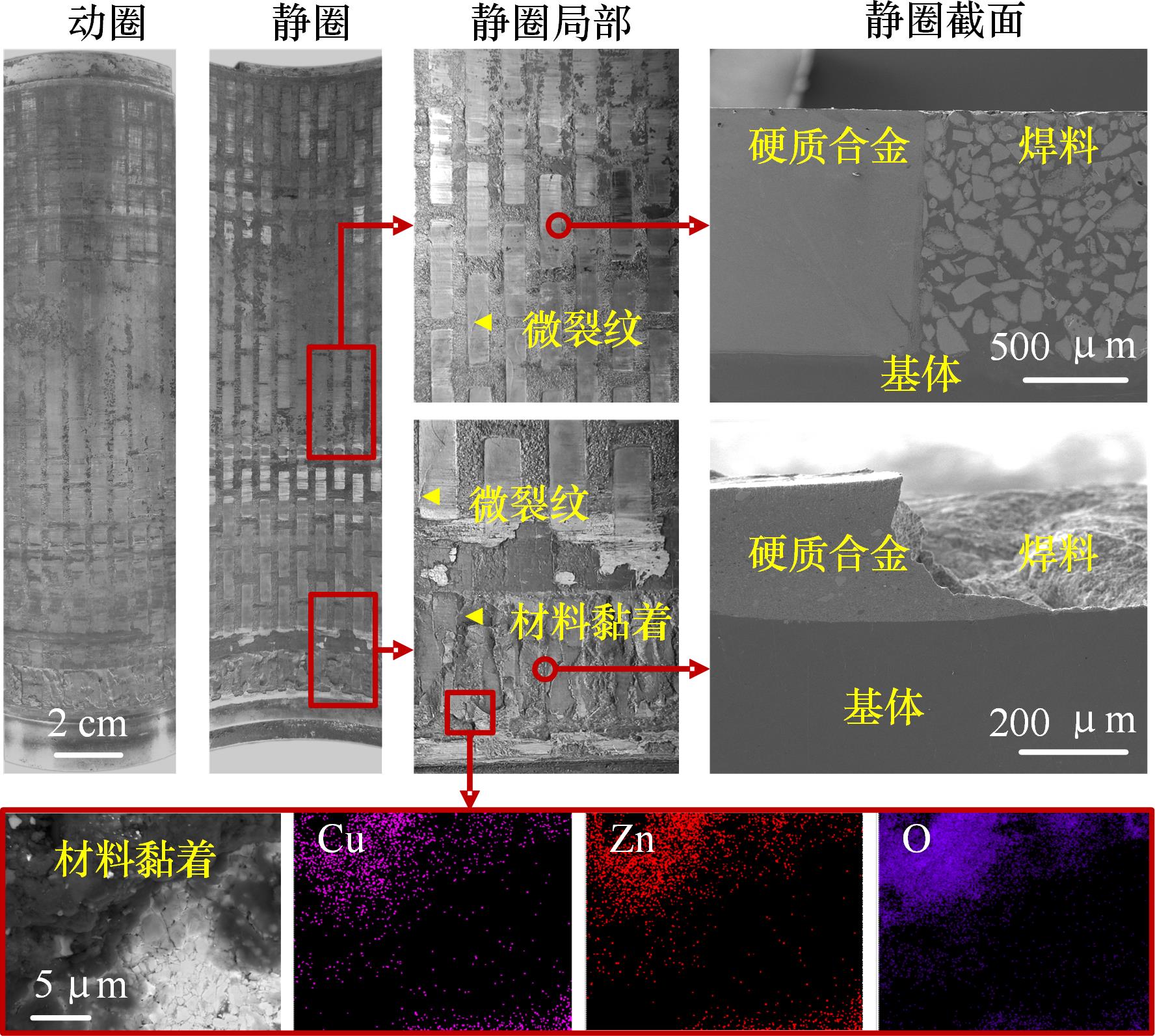
图8 深地钻具径向轴承动/静圈表界面损伤形貌分析
Fig.8 Morphological analyses on the damaged surfaces and interfaces of the moving ring and stationary ring of radial bearings dismantled from deep drilling tools
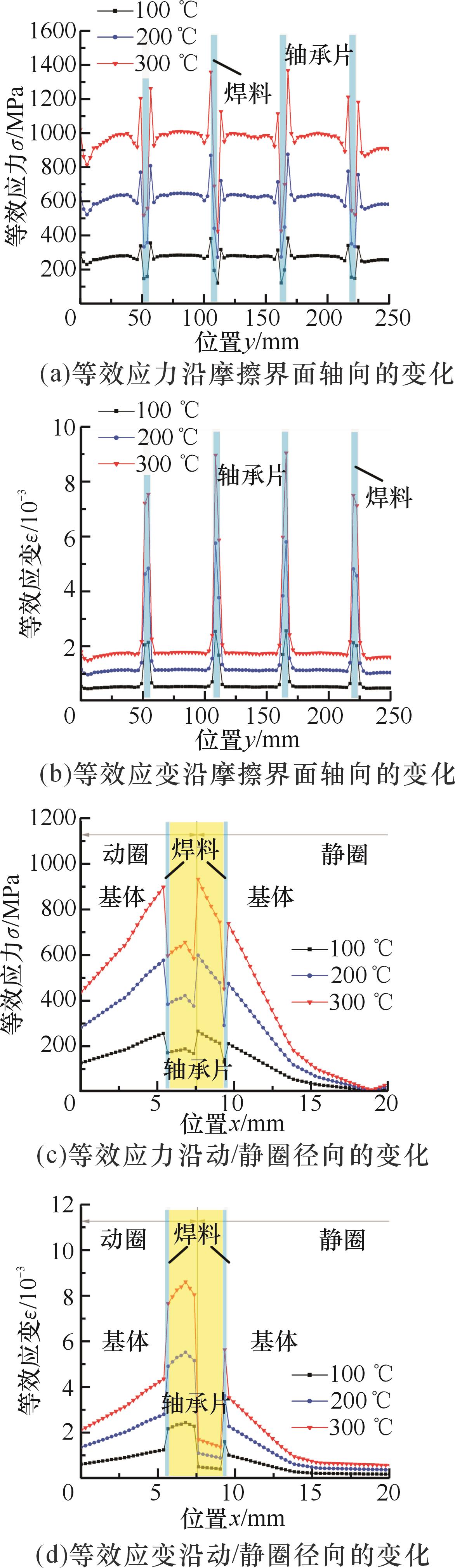
图9 不同温度和动态轴承载荷0~10 kN下的仿真结果
Fig.9 Simulation results at different temperatures and dynamic bearing loads of 0~10 kN
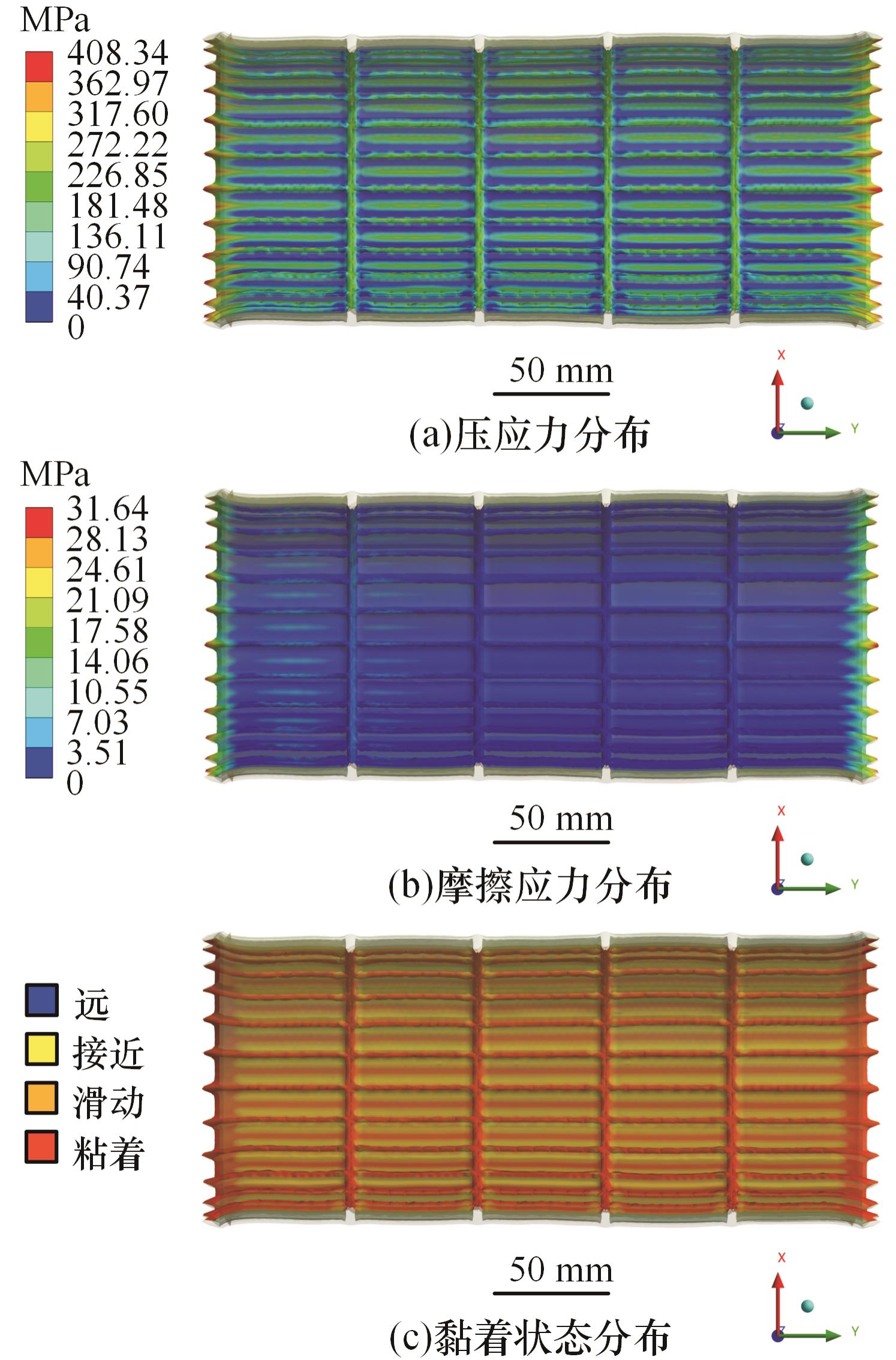
图10 摩擦界面在温度300 ℃和动态轴承载荷0~10 kN下的仿真结果
Fig.10 Simulation results of the sliding interfaces at a temperature of 300 ℃ and dynamic bearing loads of 0~10 kN
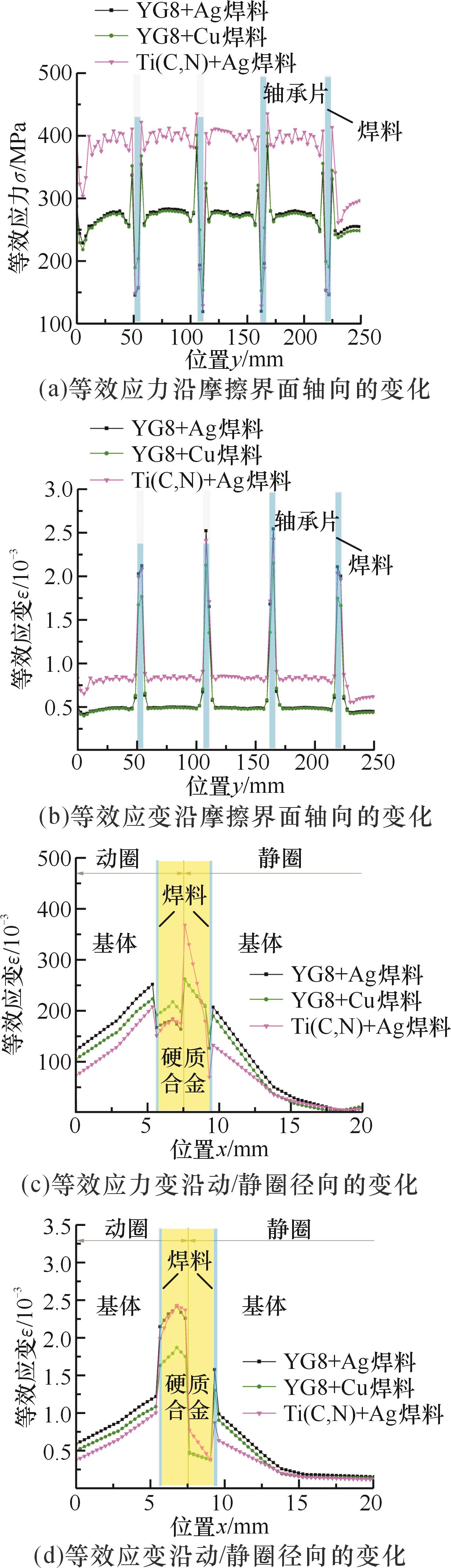
图11 不同材料组合在温度100 ℃和动态轴承载荷0~10 kN下的仿真结果
Fig.11 Simulation results of different materials combinations at a temperature of 100 ℃ and dynamic bearing loads of 0~10 kN
| [1] | 常可可, 陈雷雷, 周若男, 等. 极端环境表面工程及其共性科学问题研究进展[J]. 中国机械工程, 2022, 33(12): 1388-1417. |
| CHANG Keke, CHEN Leilei, ZHOU Ruonan, et al. Progresses of Surface Engineering in Extreme Environments and Its Common Scientific Problems[J]. China Mechanical Engineering, 2022, 33(12): 1388-1417. | |
| [2] | 常可可, 王立平, 薛群基. 极端工况下机械表面界面损伤与防护研究进展[J]. 中国机械工程, 2020, 31(2): 206-220. |
| CHANG Keke, WANG Liping, XUE Qunji. Progresses of Damage and Protection for Surfaces and Interfaces in Machinery under Extreme Operating Conditions[J]. China Mechanical Engineering, 2020, 31(2): 206-220. | |
| [3] | 尹浩, 梁健, 李宽, 等. 万米科学钻探关键机具优化措施研究[J]. 钻探工程, 2023, 50(4): 16-24. |
| YIN Hao, LIANG Jian, LI Kuan, et al. Research on Optimization Measures of Key Instrument for Myriametric Scientific Drilling[J]. Drilling Engineering, 2023, 50(4): 16-24. | |
| [4] | 杨胶溪, 胡星, 王艳芳. TC轴承激光增材制造工艺及组织性能研究[J]. 材料工程, 2016, 44(7): 61-66. |
| YANG Jiaoxi, HU Xing, WANG Yanfang. Microstructure and Properties of Laser Additive Manufacturing TC Bearing[J]. Journal of Materials Engineering, 2016, 44(7): 61-66. | |
| [5] | LIU Qiancheng, CUI Mei, HE Qingkun, et al. Failure Analysis of Tungsten Carbide Bearing on Screw Drill[J]. Engineering Failure Analysis, 2018, 89: 37-45. |
| [6] | 汪文斋, 岳林, 杨荡, 等. 铜基焊料对浸渍烧结TC轴承中硬质合金性能的影响[J]. 硬质合金, 2016, 33(4): 230-237. |
| WANG Wenzhai, YUE Lin, YANG Dang, et al. Influence of Copper Based Solder on Properties of Cemented Carbide for Impregnated Sintered TC Bearing[J]. Cemented Carbide, 2016, 33(4): 230-237. | |
| [7] | 许爱荣, 柳梅梅, 薛佳男, 等. 旋转导向工具多列块式滑动轴承载荷研究[J]. 石油机械, 2022, 50(12): 32-39. |
| XU Airong, LIU Meimei, XUE Jianan, et al. Load Characteristics of Multi-row Block Sliding Bearing for Rotary Steerable System[J]. China Petroleum Machinery, 2022, 50(12): 32-39. | |
| [8] | 沈彬, 杨皓, 薛哲婧, 等. 钻压与推靠力对推靠式旋转导向轴承应力变化规律研究[J]. 测井技术, 2024, 48(5): 653-660. |
| SHEN Bin, YANG Hao, XUE Zhejing, et al. Investigation of Stress Variation in Push-the-bit Rotary Steering Bearings under Weight on Bit and Push Forces[J]. Well Logging Technology, 2024, 48(5): 653-660. | |
| [9] | 赵雯婕, 张宇欣, 谭松成, 等. 基于SolidWorks的螺杆钻具PDC推力轴承失效仿真分析[J]. 钻探工程, 2023, 50(): 175-182. |
| ZHAO Wenjie, ZHANG Yuxin, TAN Songcheng, et al. Failure Simulation Analysis of PDC Thrust Bearing of Screw Drill Based on SolidWorks[J]. Drilling Engineering, 2023, 50(S1): 175-182. | |
| [10] | WANG Hongtao, WEBB T, BITLER J W. Study of Thermal Expansion and Thermal Conductivity of Cemented WC–Co Composite[J]. International Journal of Refractory Metals and Hard Materials, 2015, 49: 170-177. |
| [11] | KAZYMYROVYCH V, KRYZHANIVSKYY V. Thermal Properties of Cemented Carbides Used for Metal Cutting[J]. International Journal of Refractory Metals and Hard Materials, 2023, 111: 106097. |
| [12] | OKAMOTO S, NAKAZONO Y, OTSUKA K, et al. Mechanical Properties of WC/Co Cemented Carbide with Larger WC Grain Size[J]. Materials Characterization, 2005, 55(4/5): 281-287. |
| [13] | CHO S, LEE J, SHIN S, et al. Enhancing High-temperature Properties of Stainless Steel Composite with Titanium Carbide Reinforcement: a Study on Coefficient of Thermal Expansion, Thermal Conductivity, and Strength[J]. Journal of Materials Research and Technology, 2023, 25: 7241-7253. |
| [14] | YI Shanjie, YIN Haiqing, ZHENG J, et al. The First-principles Study on the Mechanical and Electronic Properties about Rim Phase and Hard Phase of Ti(C, N) Based Cermets[J]. Computational Materials Science, 2013, 79: 417-423. |
| [15] | LONG W M, ZHANG G X, ZHANG Q K. In Situ Synthesis of High Strength Ag Brazing Filler Metals during Induction Brazing Process[J]. Scripta Materialia, 2016, 110: 41-43. |
| [16] | ANSUINI F J, BADIA F A. High Strength Microduplex Cu-NI-Zn Alloys[J]. Metallurgical Transactions, 1973, 4(1): 15-20. |
| [17] | LOU Ming, CHANG Keke, XU Kai, et al. Achieving Exceptional Wear Resistance in Cemented Carbides Using B2 Intermetallic Binders[J]. Composites Part B: Engineering, 2023, 249: 110400. |
| [18] | KLÜNSNER T, MARSONER S, EBNER R, et al. Effect of Microstructure on Fatigue Properties of WC-Co Hard Metals[J]. Procedia Engineering, 2010, 2(1): 2001-2010. |
| [19] | 张开源, 尹延国, 张国涛, 等. 高能球磨-粉末冶金法制备硫化亚铁/铁基轴承材料的摩擦学性能[J]. 中国机械工程, 2019, 30(18): 2172-2178. |
| ZHANG Kaiyuan, YIN Yanguo, ZHANG Guotao, et al. Tribological Properties of FeS/Iron-based Bearing Materials by High Energy Ball Milling-powder Metallurgy Method[J]. China Mechanical Engineering, 2019, 30(18): 2172-2178. | |
| [20] | LI Weiguo, KOU Haibo, ZHANG Xuyao, et al. Temperature-dependent Elastic Modulus Model for Metallic Bulk Materials[J]. Mechanics of Materials, 2019, 139: 103194. |
| [21] | MILMAN Y V, CHUGUNOVA S, GONCHARUCK V, et al. Low and High Temperature Hardness of WC-6 wt%Co Alloys[J]. International Journal of Refractory Metals and Hard Materials, 1997, 15(1/3): 97-101. |
| [22] | DENG Jianxin, ZHANG Hui, WU Ze, et al. Friction and Wear Behaviors of WC/Co Cemented Carbide Tool Materials with Different WC Grain Sizes at Temperatures up to 600℃[J]. International Journal of Refractory Metals and Hard Materials, 2012, 31: 196-204. |
| [1] | 吴怀超, 吴白羽, 张秀华. 石蜡感温阀传热性能的数字仿真研究 [J]. J4, 201016, 21(16): 1921-1926. |
| [2] | 曾凯, 张文韬, 张洪申, 邢保英, 黄俊智, 李银波. 镁/铝异质材料实心自冲铆接有限元建模及试验研究[J]. 中国机械工程, 2026, 37(6): 1531-1539. |
| [3] | 沈明学, 陈思扬, 吴海红, 肖丽, 王能慧, 季德惠. 服役环境影响下的材料载流摩擦学行为研究进展[J]. 中国机械工程, 2026, 37(1): 2-13. |
| [4] | 余植敏, 陈磊, 范雪. 温度电场耦合下纳米结构碳膜的摩擦学特性及机理[J]. 中国机械工程, 2026, 37(1): 30-39. |
| [5] | 刘秀梅, 罗云龙, 李贝贝, 刘申, 刘启航, 李永涛, 赵巧. 考虑气体溶解和温度的油气悬架输出特性研究[J]. 中国机械工程, 2025, 36(11): 2492-2500. |
| [6] | 姚凌云, 杨植顺, 李丽, 林勇杰. 基于最优伪维格纳-维尔分布方法的载荷谱编辑研究[J]. 中国机械工程, 2025, 36(11): 2501-2508. |
| [7] | 李云峰, 李金成, 仲志丹. 基于热网络法的风电机组主轴承温度场分析[J]. 中国机械工程, 2025, 36(11): 2624-2632. |
| [8] | 许雷, 胡俊山, 凡志磊, 葛恩德, 张胜平, 田威. 大型民用飞机机身对接区双面均衡夹紧装置设计[J]. 中国机械工程, 2025, 36(10): 2444-2452. |
| [9] | 张申廷, 雷金, 贾文兴, 张昕煜, 金鹏, 秦新燕. 移动载荷作用下输电线路的动力响应分析[J]. 中国机械工程, 2025, 36(09): 2126-2139. |
| [10] | 邱冰静, 贾慕华, 励音骐, 吉刘斌. 基于试验测试的超重力离心模拟环境下加载缸稳压方案研究[J]. 中国机械工程, 2025, 36(08): 1651-1657. |
| [11] | 贾晨帆, 刘怀举, 朱才朝, 陈泰民, 陈进筱. 基于CatBoost的航空齿轮本体温度预测方法与验证研究[J]. 中国机械工程, 2025, 36(08): 1658-1667. |
| [12] | 崔熙颖1, 王文奇1, 徐世浩1, 刘阔1, Sahal Ahmed ELMI1, 白振华1, 2, 3. 20辊轧机非对称冷却的板形预报模型及影响因素分析[J]. 中国机械工程, 2025, 36(07): 1592-1599,1610. |
| [13] | 刘伟1, 2, 常佳起1, 2, 李博鑫1, 2, 严灿1, 2, 邓朝晖3, 万林林1, 2. 中间相炭微球对多层钎焊金刚石砂轮电解修整磨削性能的影响[J]. 中国机械工程, 2025, 36(06): 1151-1158. |
| [14] | 杨雨1, 2, 李晓雷2, 陶友瑞1, 2, 郭祺雨1, 2, 叶楠1, 2. RV减速器服役工况加速载荷谱编制方法[J]. 中国机械工程, 2025, 36(06): 1170-1177. |
| [15] | 侯雨雷1, 李希萌1, 索槐2, 李岳1, 曾达幸3 . 正压防护服用供气背包设计及其数值模拟与实验[J]. 中国机械工程, 2025, 36(06): 1352-1362,1370. |
| 阅读次数 | ||||||
|
全文 |
|
|||||
|
摘要 |
|
|||||
