



ISSN 1004-132X
CN 42-1294/TH
CN 42-1294/TH
中国机械工程 ›› 2026, Vol. 37 ›› Issue (10): 2652-2666.DOI: 10.3969/j.issn.1004-132X.2026.10.028
王映尧1( ), 叶显爵1, 张文强1, 陈爽1, 张跃飞1,2()
收稿日期:2025-04-17
出版日期:2026-10-25
发布日期:2026-11-10
通讯作者:
张跃飞
作者简介:王映尧,男,1999年生,硕士研究生。研究方向为高温金属材料使役条件与结构性能数值仿真。E-mail:22226018@zju.edu.cn基金资助:
WANG Yingyao1(), YE Xianjue1, ZHANG Wenqiang1, CHEN Shuang1, ZHANG Yuefei1,2()
Received:2025-04-17
Online:2026-10-25
Published:2026-11-10
Contact:
ZHANG Yuefei
摘要:
通过流-热-结构顺序耦合仿真流程,结合晶体塑性有限元方法(CPFEM),探究热障涂层(TBC)与单晶次级取向对航空发动机叶片热-机械行为及微观塑性滑移的具体影响。结果表明:TBC可显著降低叶片温度,使热点冷却效率提高约30%,但在强对流区隔热效果减弱并伴随热应力重分布加剧局部应力集中;结构干涉会诱发主导滑移系(DSS)转变,尤其在气膜孔区域表现为滑移系竞争行为增强;TBC可使孔周区域滑移混合分布收缩,缓解材料剪切作用并增强统一分布特征;将通过解析弹性应力结果得到的DSS和对应最大分切应力(MRSS)用于衡量取向匹配度与塑性变形风险,发现气膜孔区域晶体取向导致MRSS差异可达32%;通过提出的“S₁-S₂-S₃”指标,结合晶体塑性分析可定量评估多轴应力下的滑移系优先级;低应力三轴度区域应力张量与晶格接近满足空间对称关系时易形成多滑移系竞争现象,而高应力三轴度促进单一滑移系主导。
中图分类号:
王映尧, 叶显爵, 张文强, 陈爽, 张跃飞. 镍基单晶涡轮叶片热应力分布与局部塑性行为多尺度模拟分析[J]. 中国机械工程, 2026, 37(10): 2652-2666.
WANG Yingyao, YE Xianjue, ZHANG Wenqiang, CHEN Shuang, ZHANG Yuefei. Thermal Stress Distribution and Local Plasticity Analysis of Nickel-based Single Crystal Turbine Blades via Multiscale Simulation[J]. China Mechanical Engineering, 2026, 37(10): 2652-2666.
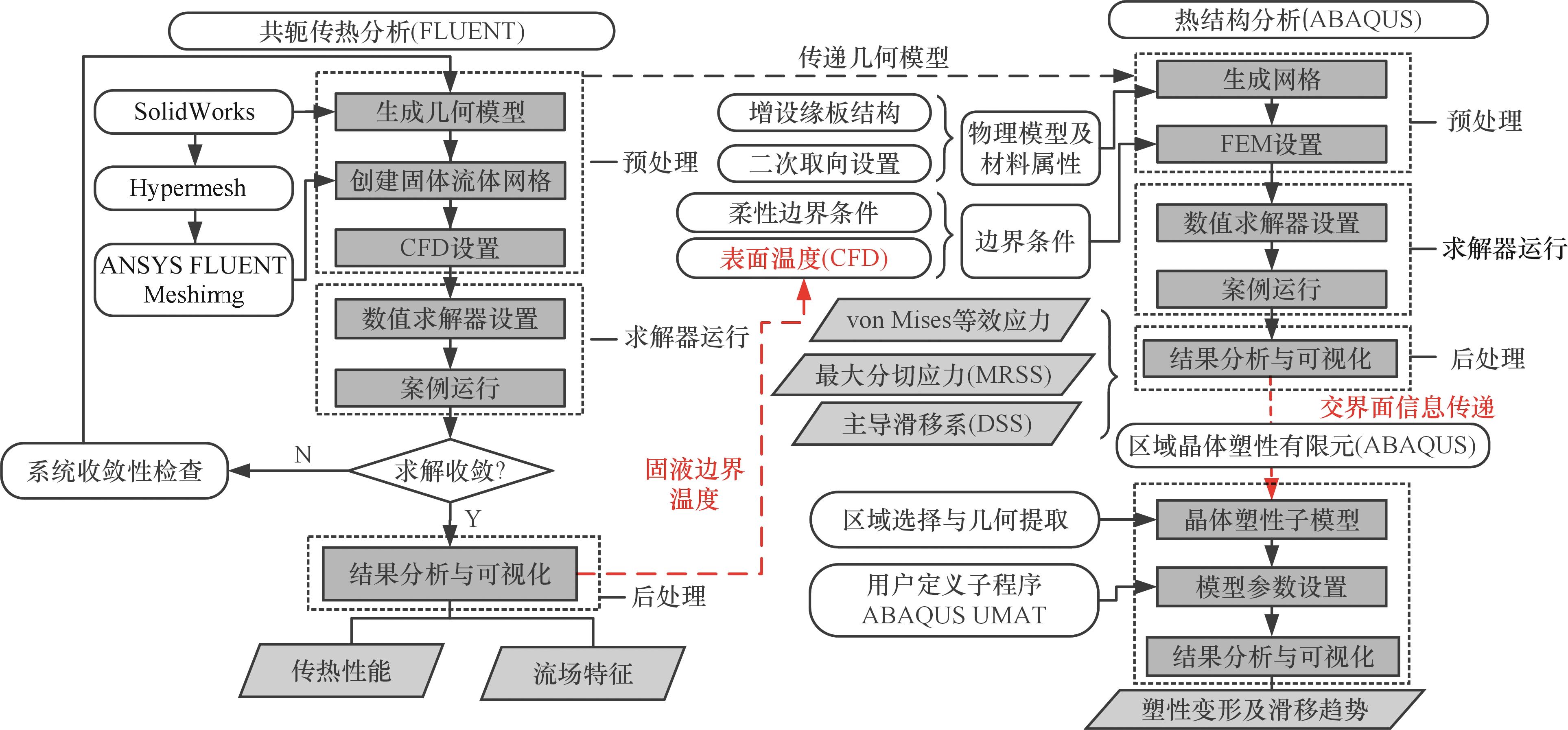
图1 数值仿真框架示意
Fig.1 Numerical schematic
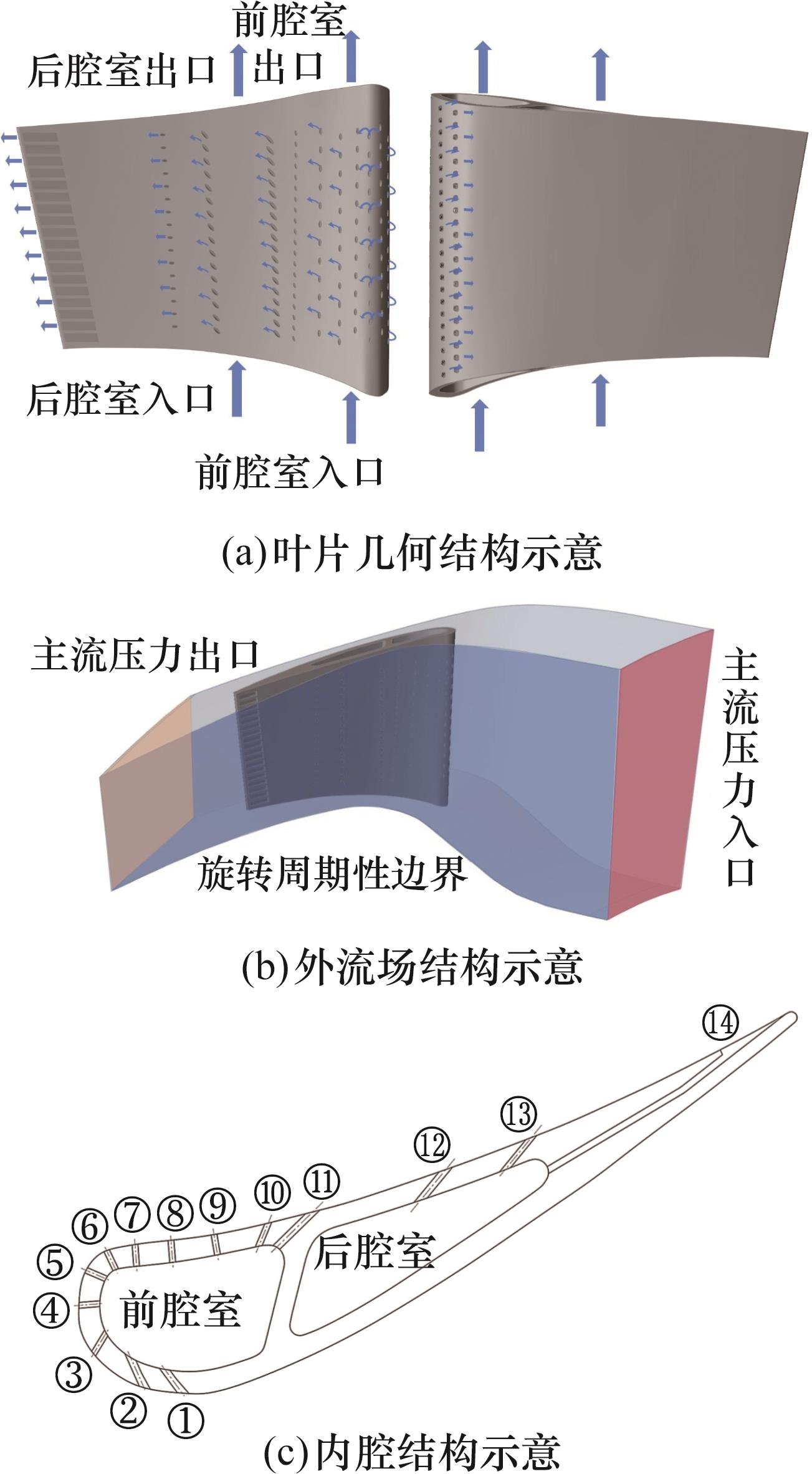
图2 物理模型建模
Fig.2 Physical modeling
| 序号 | 孔数目 | 孔半径/cm | 孔结构类型 |
|---|---|---|---|
| 1 | 22 | 0.061 | 轴向,扩散型孔 |
| 2 | 23 | 0.061 | 轴向,扩散型孔 |
| 3 | 12 | 0.048 | 倾斜圆孔(复合角默认25°) |
| 4 | 12 | 0.048 | 倾斜圆孔 |
| 5 | 12 | 0.048 | 倾斜圆孔 |
| 6 | 12 | 0.048 | 倾斜圆孔 |
| 7 | 12 | 0.048 | 倾斜圆孔 |
| 8 | 12 | 0.048 | 倾斜圆孔 |
| 9 | 12 | 0.048 | 倾斜圆孔 |
| 10 | 20 | 0.036 | 倾斜圆孔 |
| 11 | 19 | 0.061 | 倾斜圆孔,45° |
| 12 | 16 | 0.061 | 倾斜圆孔,45° |
| 13 | 16 | 0.048 | 轴向圆孔 |
| 14 | 18 | 0.055×0.155 | 劈缝(Slots) |
表1 孔形参数
Tab.1 Holes parameter
| 序号 | 孔数目 | 孔半径/cm | 孔结构类型 |
|---|---|---|---|
| 1 | 22 | 0.061 | 轴向,扩散型孔 |
| 2 | 23 | 0.061 | 轴向,扩散型孔 |
| 3 | 12 | 0.048 | 倾斜圆孔(复合角默认25°) |
| 4 | 12 | 0.048 | 倾斜圆孔 |
| 5 | 12 | 0.048 | 倾斜圆孔 |
| 6 | 12 | 0.048 | 倾斜圆孔 |
| 7 | 12 | 0.048 | 倾斜圆孔 |
| 8 | 12 | 0.048 | 倾斜圆孔 |
| 9 | 12 | 0.048 | 倾斜圆孔 |
| 10 | 20 | 0.036 | 倾斜圆孔 |
| 11 | 19 | 0.061 | 倾斜圆孔,45° |
| 12 | 16 | 0.061 | 倾斜圆孔,45° |
| 13 | 16 | 0.048 | 轴向圆孔 |
| 14 | 18 | 0.055×0.155 | 劈缝(Slots) |
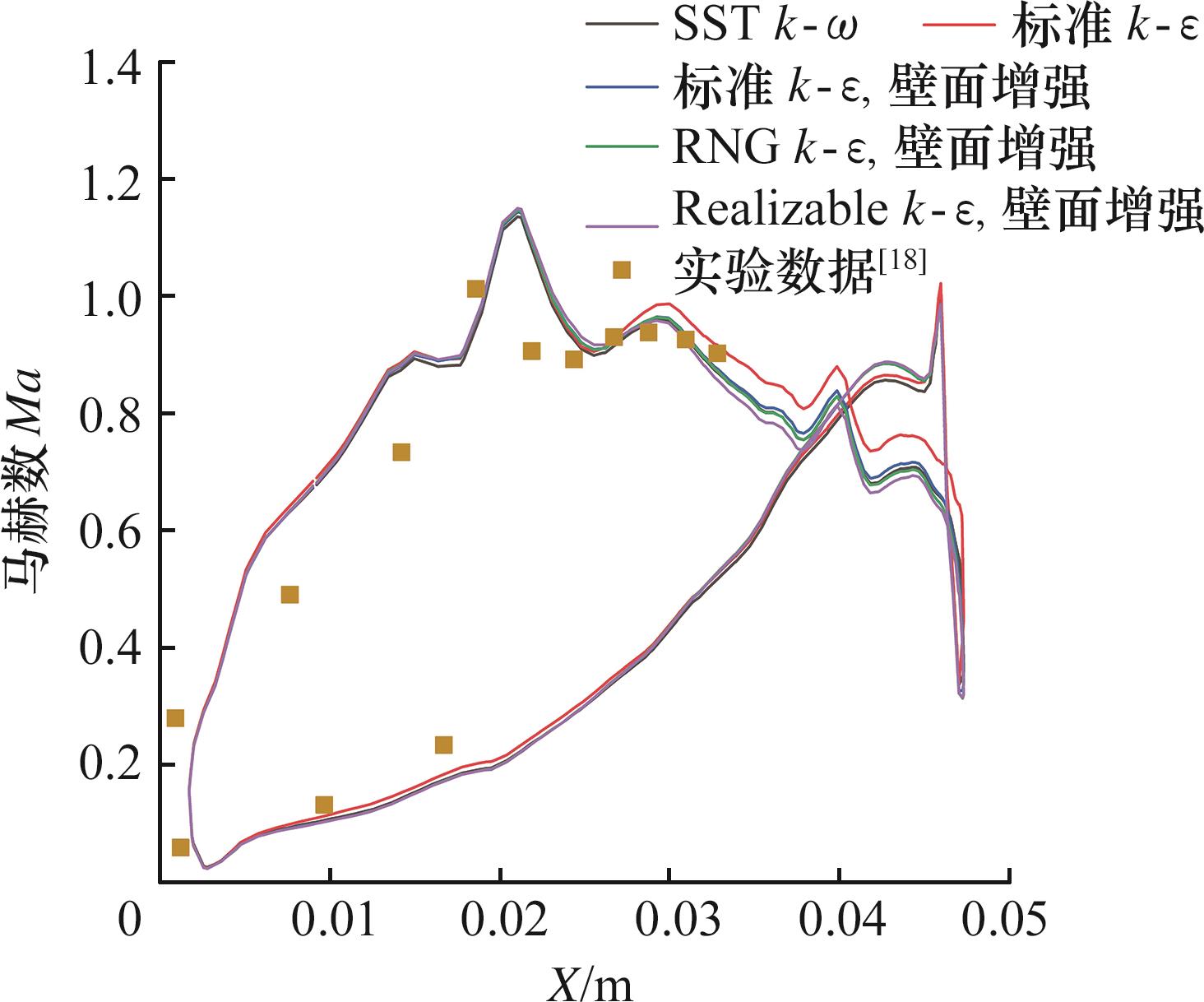
图3 不同湍流模型设置效果验证及实验数据对比
Fig.3 Validation of different turbulence model settings and comparison of experimental data
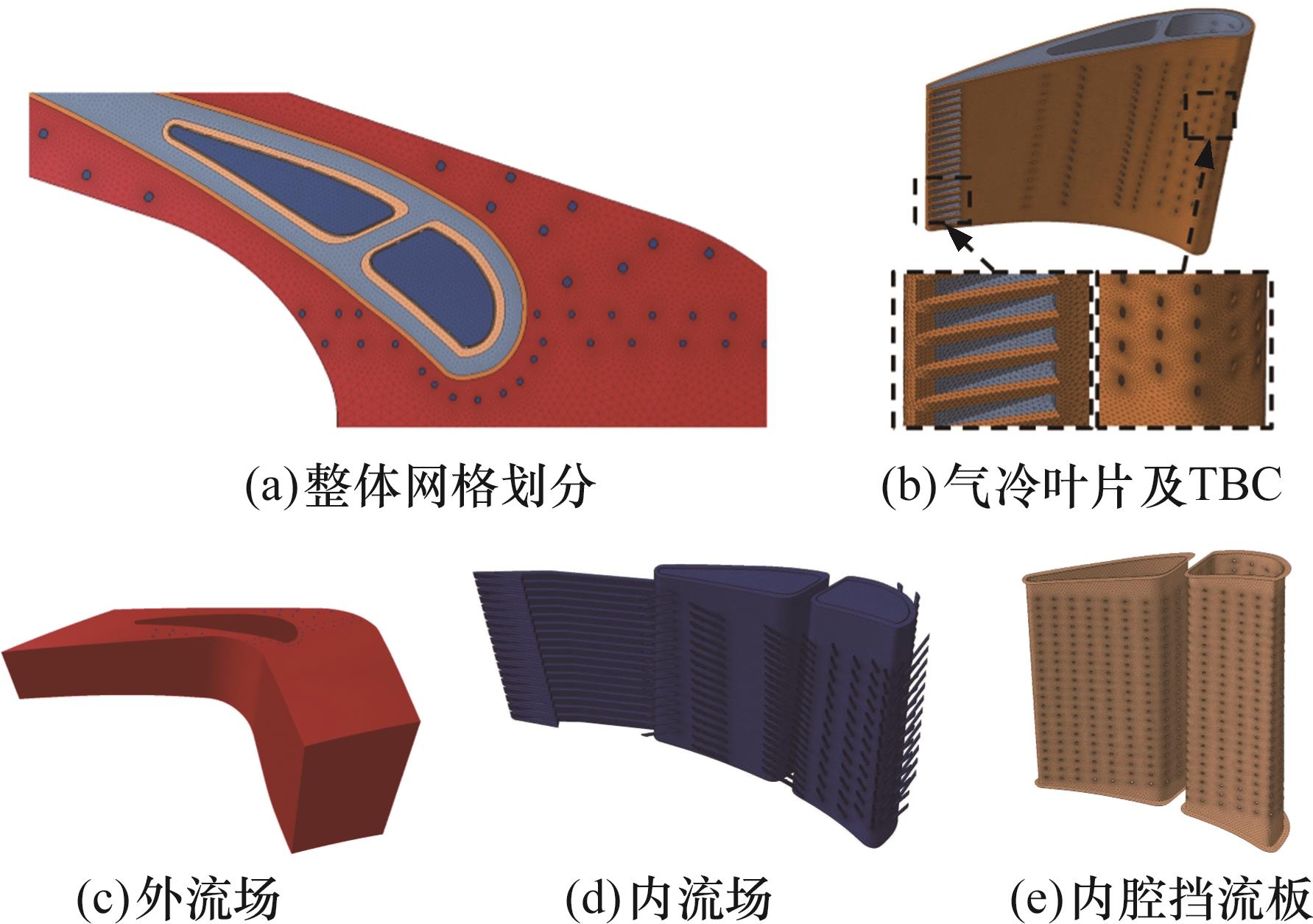
图4 网格离散模型
Fig.4 Mesh discretization model
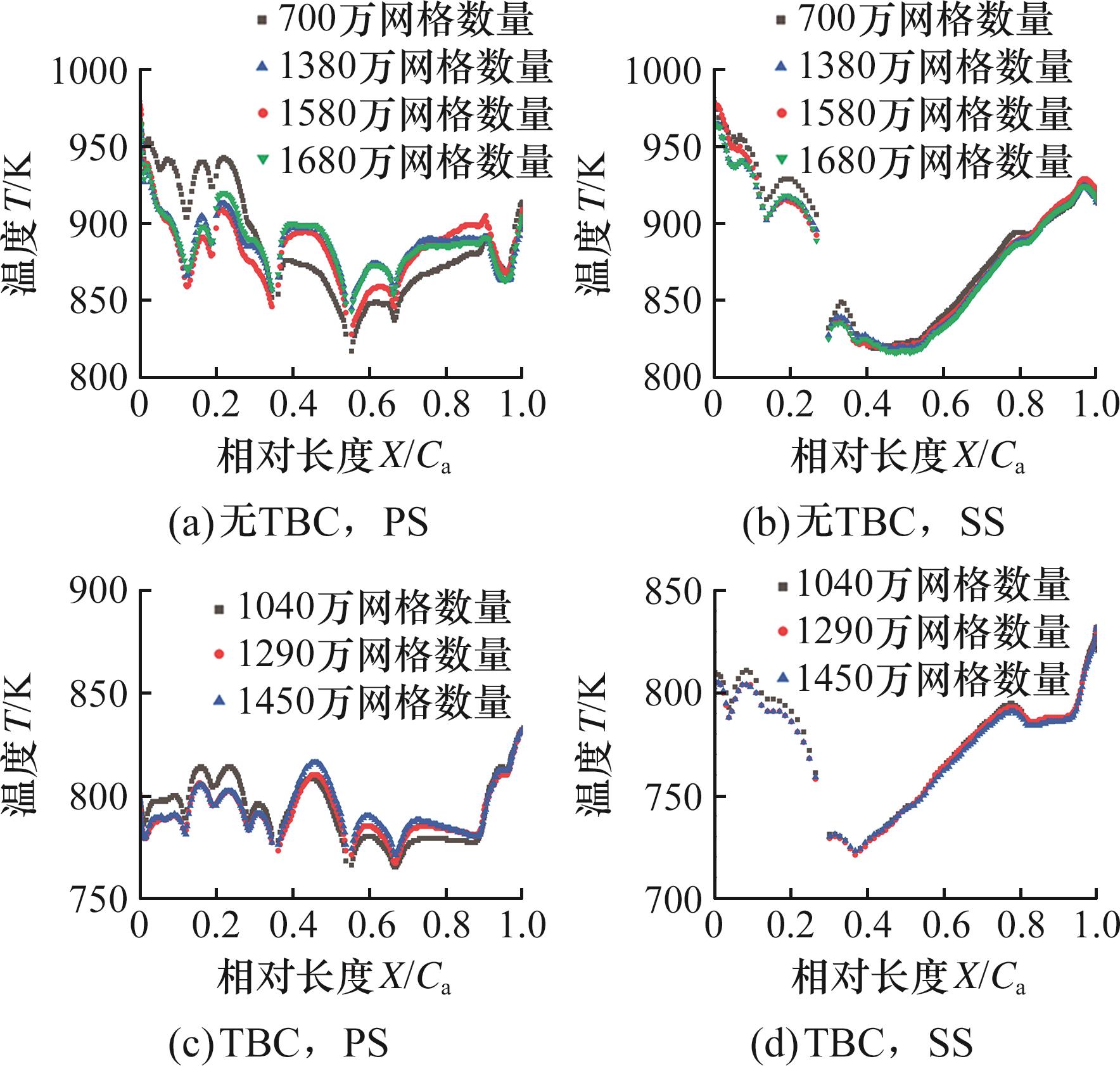
图5 网格无关性验证
Fig.5 Grid independence verification
| 工况 | 网格 数量/ | 最高 温度/ K | 最大温度误差/% | 平均 温度/ K | 平均温度误差/% | 平均 误差/ % |
|---|---|---|---|---|---|---|
| 无TBC | 16.8 | 961 | 869.5 | |||
| 7.0 | 977 | 1.66 | 876.1 | 0.76 | 0.82 | |
| 13.8 | 975 | 1.47 | 873.5 | 0.46 | 0.51 | |
| 15.8 | 960 | 0.10 | 870.5 | 0.12 | 0.16 | |
| 含TBC | 14.5 | 832 | 793.3 | |||
| 10.4 | 832 | 792.8 | 0.06 | 0.79 | ||
| 12.9 | 832 | 791.6 | 0.21 | 0.25 |
表2 网格敏感性分析
Tab.2 Mesh sensitivity analysis
| 工况 | 网格 数量/ | 最高 温度/ K | 最大温度误差/% | 平均 温度/ K | 平均温度误差/% | 平均 误差/ % |
|---|---|---|---|---|---|---|
| 无TBC | 16.8 | 961 | 869.5 | |||
| 7.0 | 977 | 1.66 | 876.1 | 0.76 | 0.82 | |
| 13.8 | 975 | 1.47 | 873.5 | 0.46 | 0.51 | |
| 15.8 | 960 | 0.10 | 870.5 | 0.12 | 0.16 | |
| 含TBC | 14.5 | 832 | 793.3 | |||
| 10.4 | 832 | 792.8 | 0.06 | 0.79 | ||
| 12.9 | 832 | 791.6 | 0.21 | 0.25 |
| 材料 | 物理量 | 拟合式 | 来源文献 |
|---|---|---|---|
理想 气体 | 6.00×10 | [ | |
| cₚ | 3.00×10 | [ | |
| CMSX-4 | 2.94×10 | [ | |
| cₚ | 9.36×10 | [ | |
| 8YSZ | 3.71×10 | [ | |
| cₚ | [ |
表3 温度相关材料物理属性参数(流热耦合部分)
Tab.3 Temperature-dependent thermophysical properties of materials(fluid-thermal coupling part)
| 材料 | 物理量 | 拟合式 | 来源文献 |
|---|---|---|---|
理想 气体 | 6.00×10 | [ | |
| cₚ | 3.00×10 | [ | |
| CMSX-4 | 2.94×10 | [ | |
| cₚ | 9.36×10 | [ | |
| 8YSZ | 3.71×10 | [ | |
| cₚ | [ |
| 位置 | 压力/质流速率 | 总温/K | 湍流度 |
|---|---|---|---|
| 主流入口 | pm,total=1.5 MPa | 1400 | 5% |
| 主流出口 | pm,static=0.9 MPa | 5% | |
| 冷却通道入口A | pc1,in=1.58 MPa | 700 | 5% |
| 冷却通道入口B | pc2,in=1.56 MPa | 700 | 5% |
| 冷却通道出口A | pc1,out=1.57 MPa | 5% | |
| 冷却通道出口B | pc2,out=1.55 MPa | 5% | |
| 内环、外环喷嘴 | Mc,in=1×10 | 700 | 5% |
表4 边界条件
Tab.4 Boundary condition specifications
| 位置 | 压力/质流速率 | 总温/K | 湍流度 |
|---|---|---|---|
| 主流入口 | pm,total=1.5 MPa | 1400 | 5% |
| 主流出口 | pm,static=0.9 MPa | 5% | |
| 冷却通道入口A | pc1,in=1.58 MPa | 700 | 5% |
| 冷却通道入口B | pc2,in=1.56 MPa | 700 | 5% |
| 冷却通道出口A | pc1,out=1.57 MPa | 5% | |
| 冷却通道出口B | pc2,out=1.55 MPa | 5% | |
| 内环、外环喷嘴 | Mc,in=1×10 | 700 | 5% |
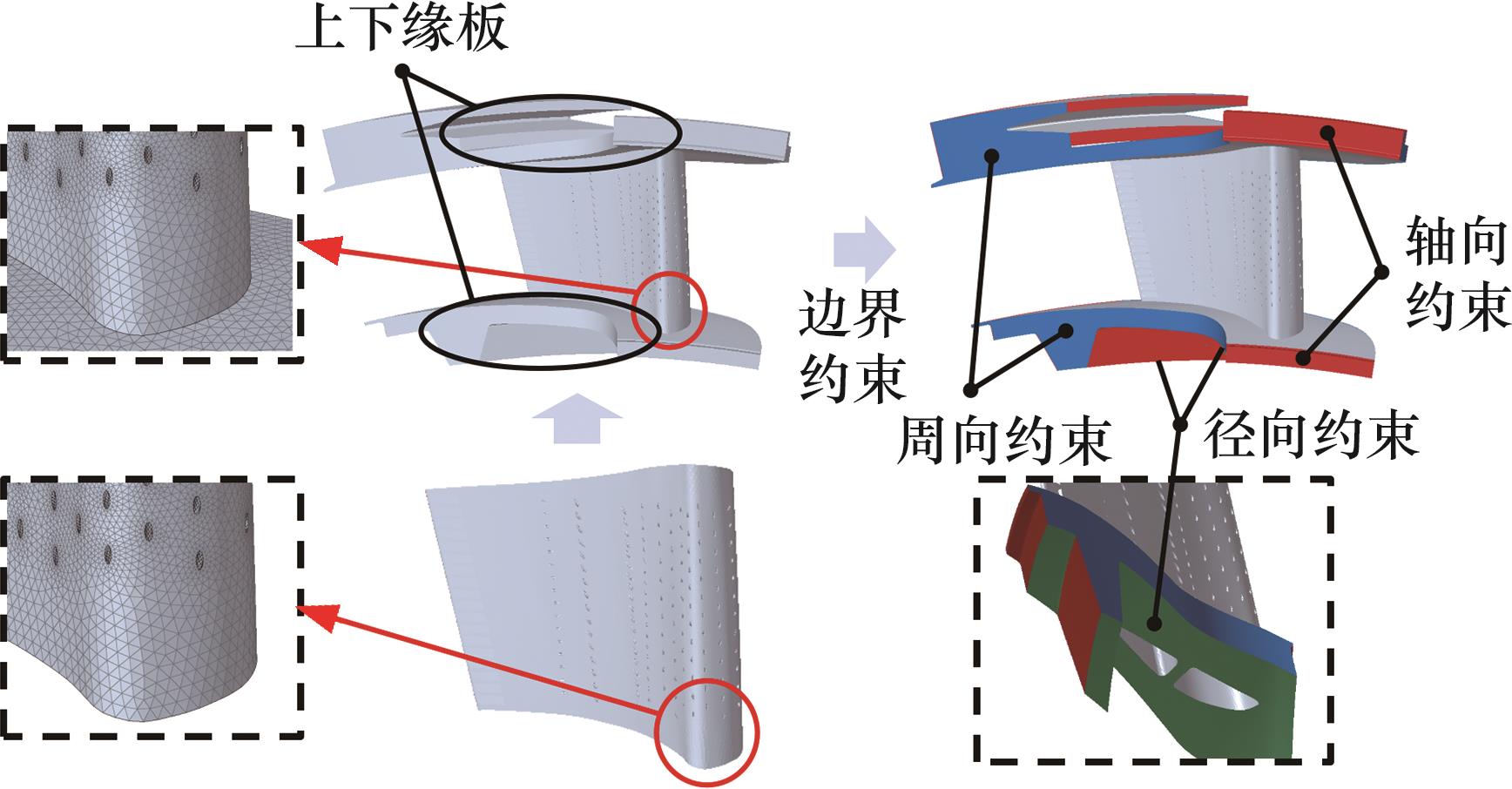
图6 热结构离散模型及约束条件
Fig.6 Discrete thermal structure model and constraint conditions
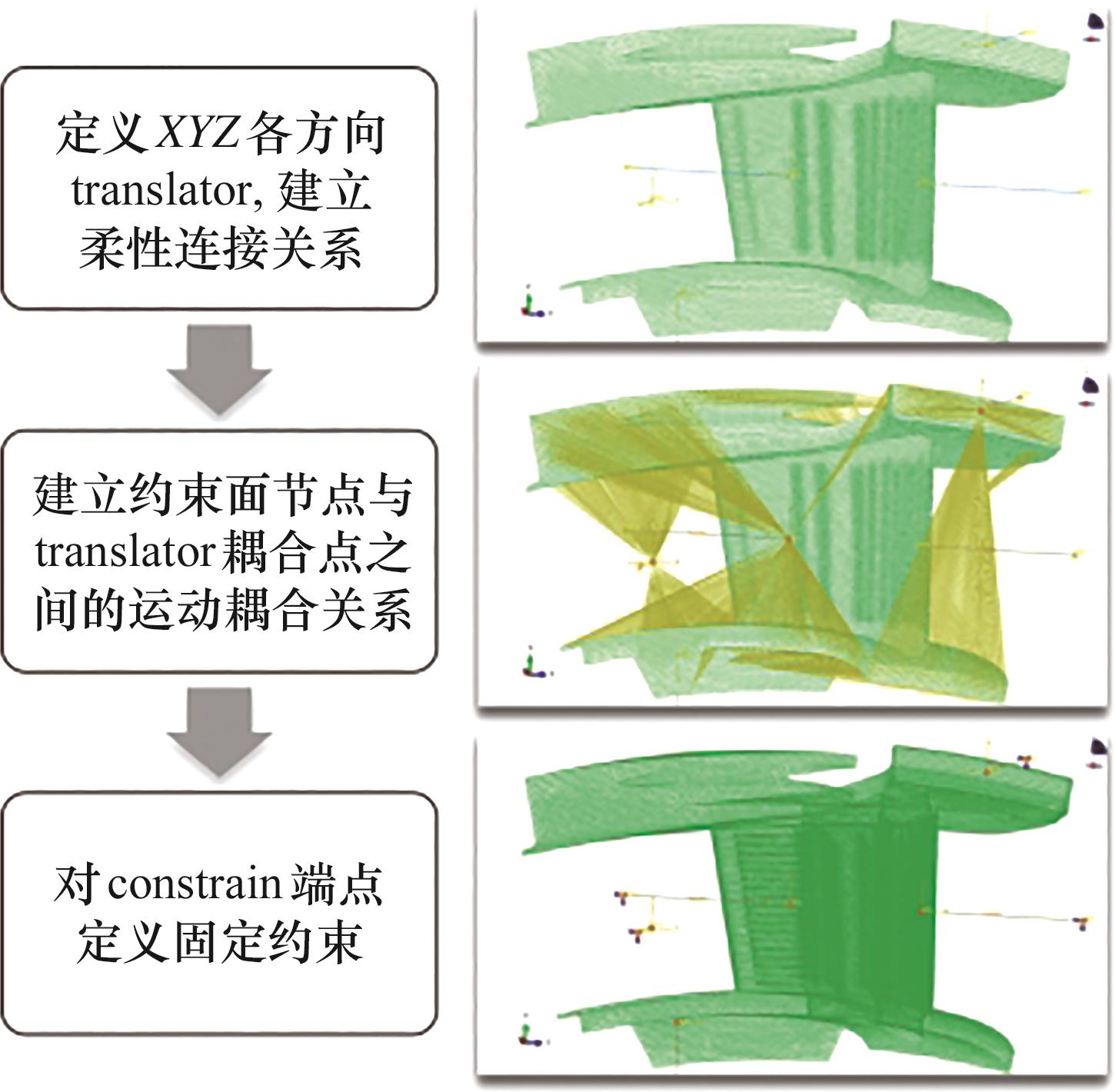
图7 柔性约束定义流程示意
Fig. 7 Schematic diagram of flexible constraint definition process
| 温度/℃ | 弹性常数C11/GPa | 弹性常数C12/GPa | 弹性常数C44/GPa | 热膨胀系数/(10-6K-1) |
|---|---|---|---|---|
| 20 | 184.6 | 87.8 | 126.0 | 14.8 |
| 100 | 190.0 | 95.6 | 123.0 | — |
| 200 | 182.0 | 90.4 | 120.0 | 15.2 |
| 300 | 179.0 | 89.8 | 117.0 | — |
| 400 | 176.0 | 89.2 | 114.0 | 15.6 |
| 500 | 166.0 | 81.1 | 111.0 | — |
| 600 | 167.1 | 85.7 | 108.0 | 16.2 |
| 700 | 165.8 | 87.8 | 105.0 | — |
| 800 | 153.7 | 79.5 | 101.0 | 16.9 |
| 900 | 145.2 | 75.8 | 96.8 | — |
| 1000 | 133.9 | 70.3 | 92.0 | 17.5 |
| 1100 | 117.0 | 60.2 | 86.5 | 17.6 |
表5 第二代单晶高温合金的温度依赖性弹性常数[26]和热膨胀系数[27]
Tab.5 Temperature-dependent elastic constants[26] and thermal expansion coefficient[27] of second-generation single crystal superalloys
| 温度/℃ | 弹性常数C11/GPa | 弹性常数C12/GPa | 弹性常数C44/GPa | 热膨胀系数/(10-6K-1) |
|---|---|---|---|---|
| 20 | 184.6 | 87.8 | 126.0 | 14.8 |
| 100 | 190.0 | 95.6 | 123.0 | — |
| 200 | 182.0 | 90.4 | 120.0 | 15.2 |
| 300 | 179.0 | 89.8 | 117.0 | — |
| 400 | 176.0 | 89.2 | 114.0 | 15.6 |
| 500 | 166.0 | 81.1 | 111.0 | — |
| 600 | 167.1 | 85.7 | 108.0 | 16.2 |
| 700 | 165.8 | 87.8 | 105.0 | — |
| 800 | 153.7 | 79.5 | 101.0 | 16.9 |
| 900 | 145.2 | 75.8 | 96.8 | — |
| 1000 | 133.9 | 70.3 | 92.0 | 17.5 |
| 1100 | 117.0 | 60.2 | 86.5 | 17.6 |
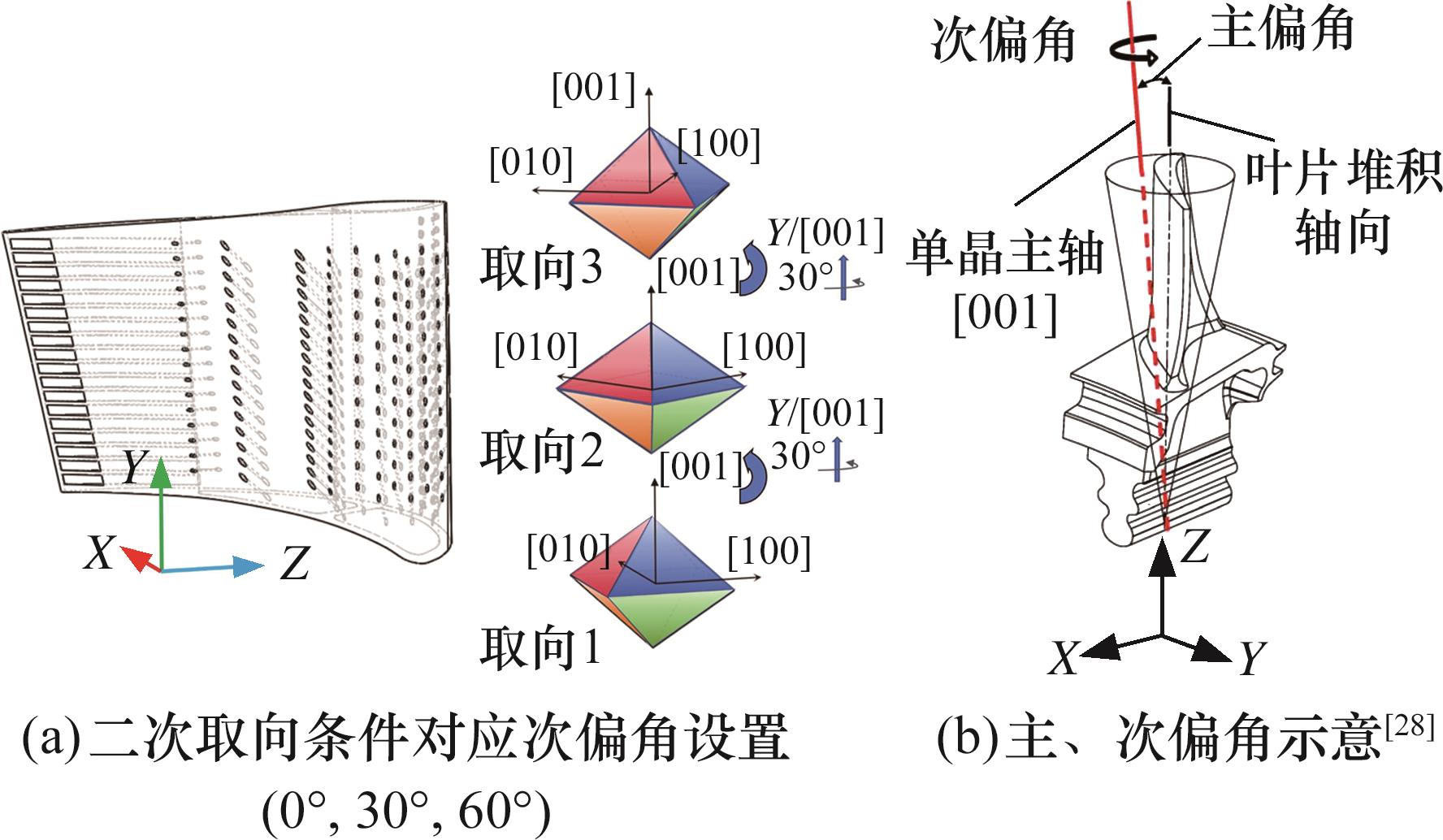
图8 二次取向设置
Fig.8 Secondary orientation settings
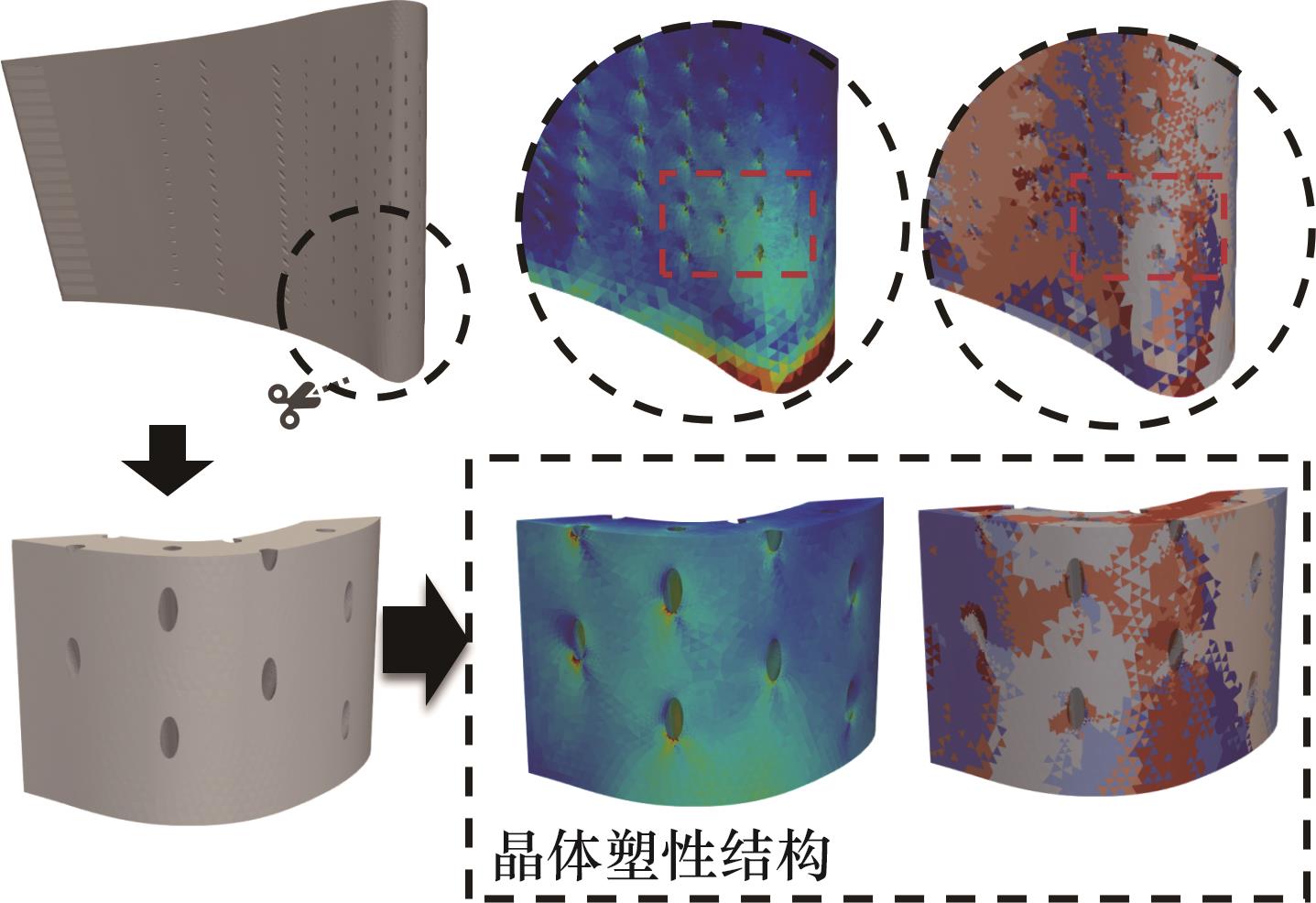
图9 子模型抽取
Fig.9 Sub-model extraction
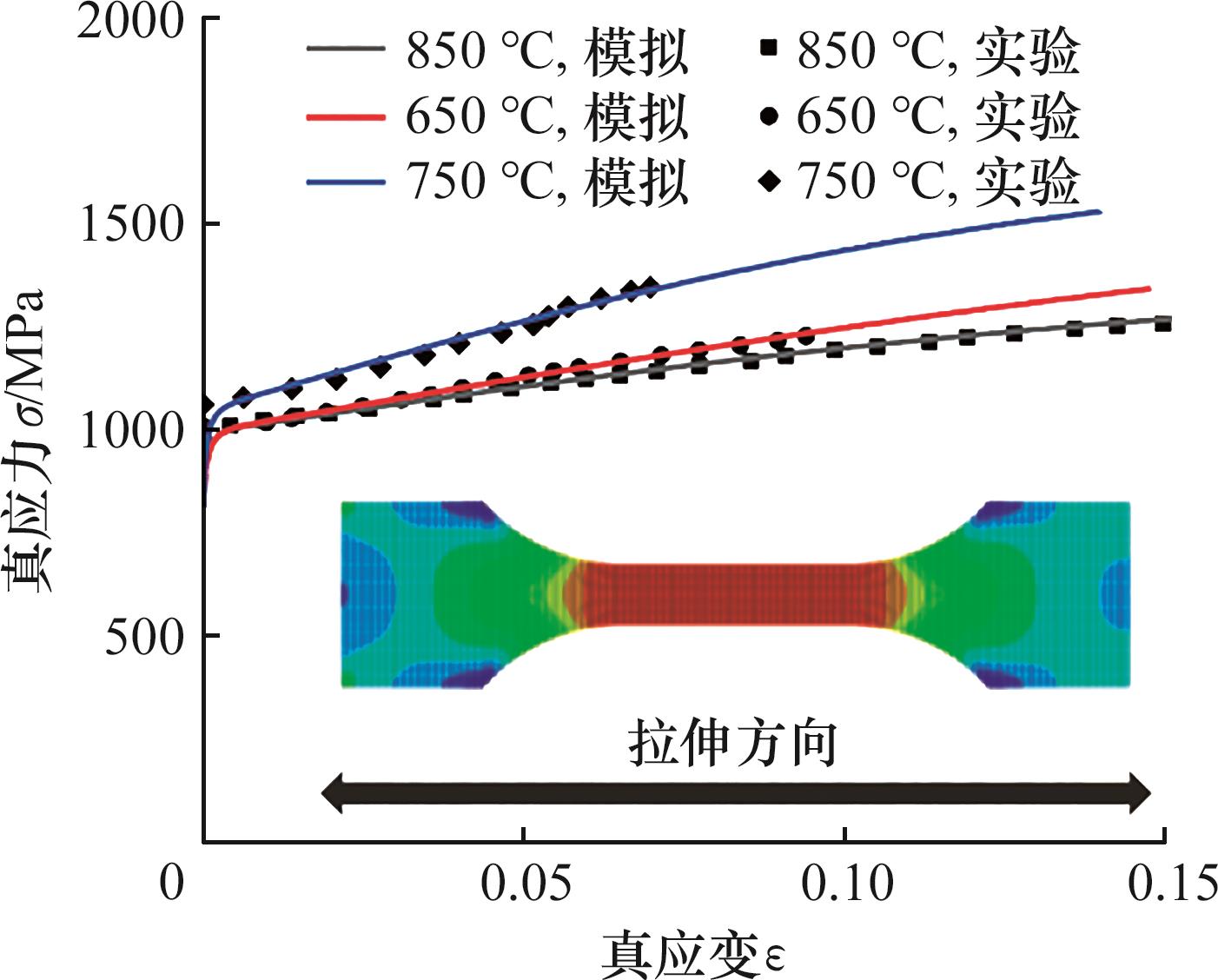
图10 在不同温度下的应力-应变曲线拟合
Fig.10 Stress-strain curve fitting at different temperature
| θ/℃ | |||||||
|---|---|---|---|---|---|---|---|
| 650 | 300 | 480 | 360 | 0.0001 | 1× | 1.9 | 1.9 |
| 750 | 450 | 490 | 370 | 0.0001 | 1× | 1.9 | 1.9 |
| 850 | 250 | 440 | 360 | 0.0001 | 1× | 1.9 | 1.9 |
表 6 塑性流变及潜硬化行为拟合参数
Tab. 6 Fitting parameters for plastic flow and latent hardening behavior
| θ/℃ | |||||||
|---|---|---|---|---|---|---|---|
| 650 | 300 | 480 | 360 | 0.0001 | 1× | 1.9 | 1.9 |
| 750 | 450 | 490 | 370 | 0.0001 | 1× | 1.9 | 1.9 |
| 850 | 250 | 440 | 360 | 0.0001 | 1× | 1.9 | 1.9 |
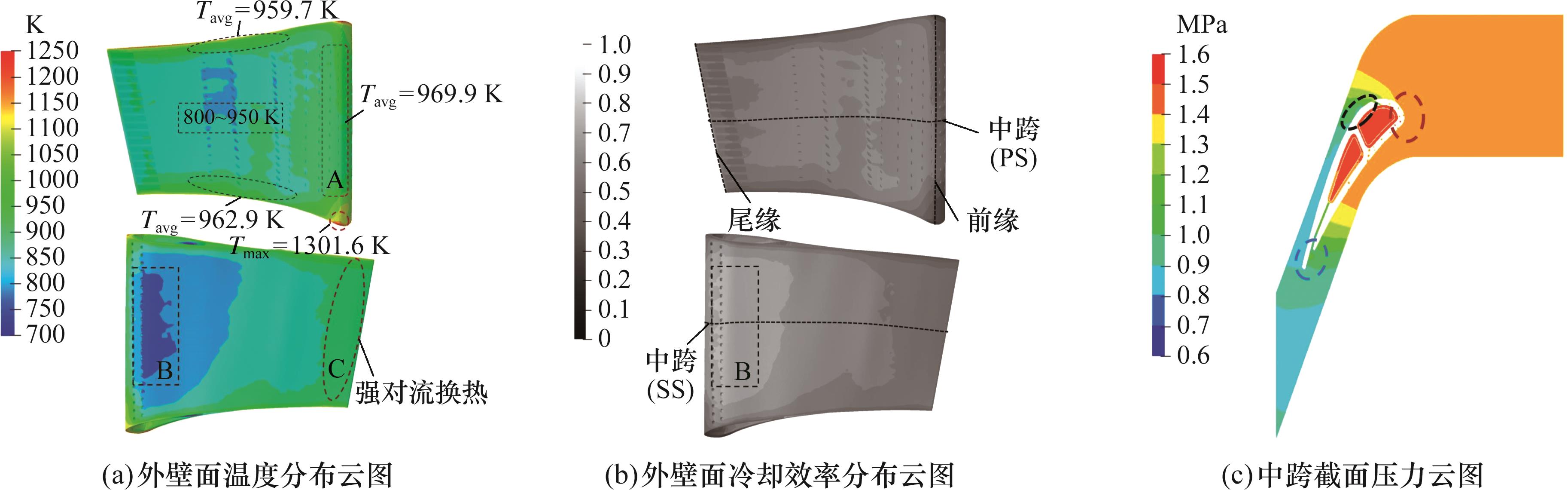
图11 无TBC工况条件流热耦合求解结果
Fig.11 Numerical results for TBC-free operating conditions
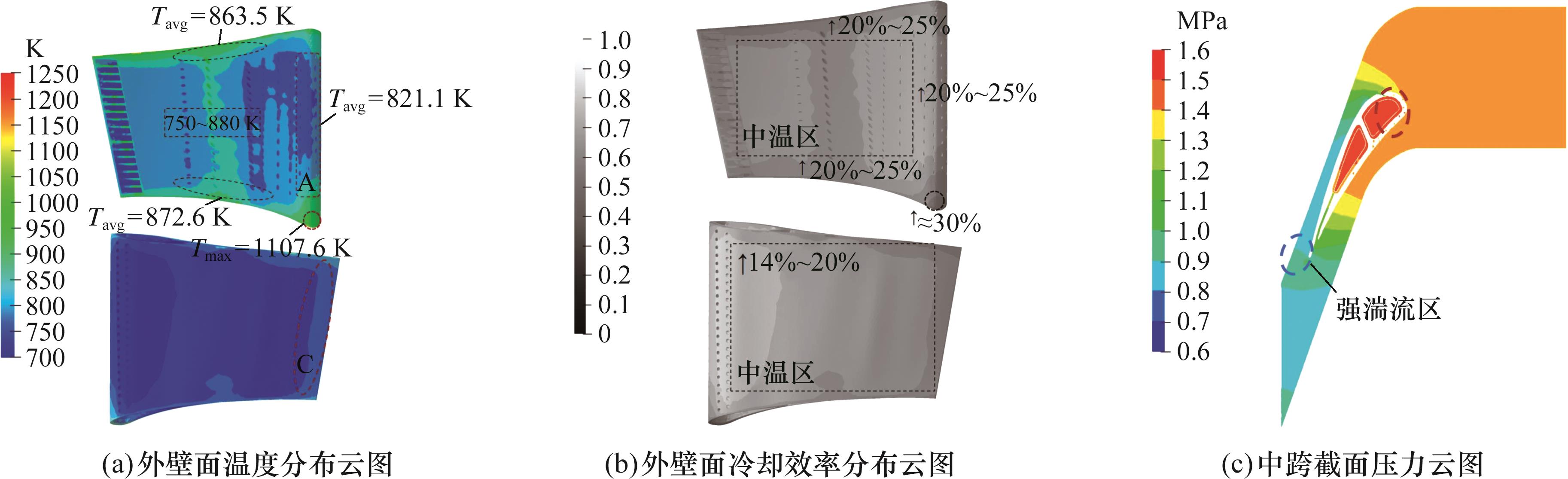
图12 含TBC工况条件流热耦合求解结果
Fig.12 Numerical results for TBC-coated operating conditions
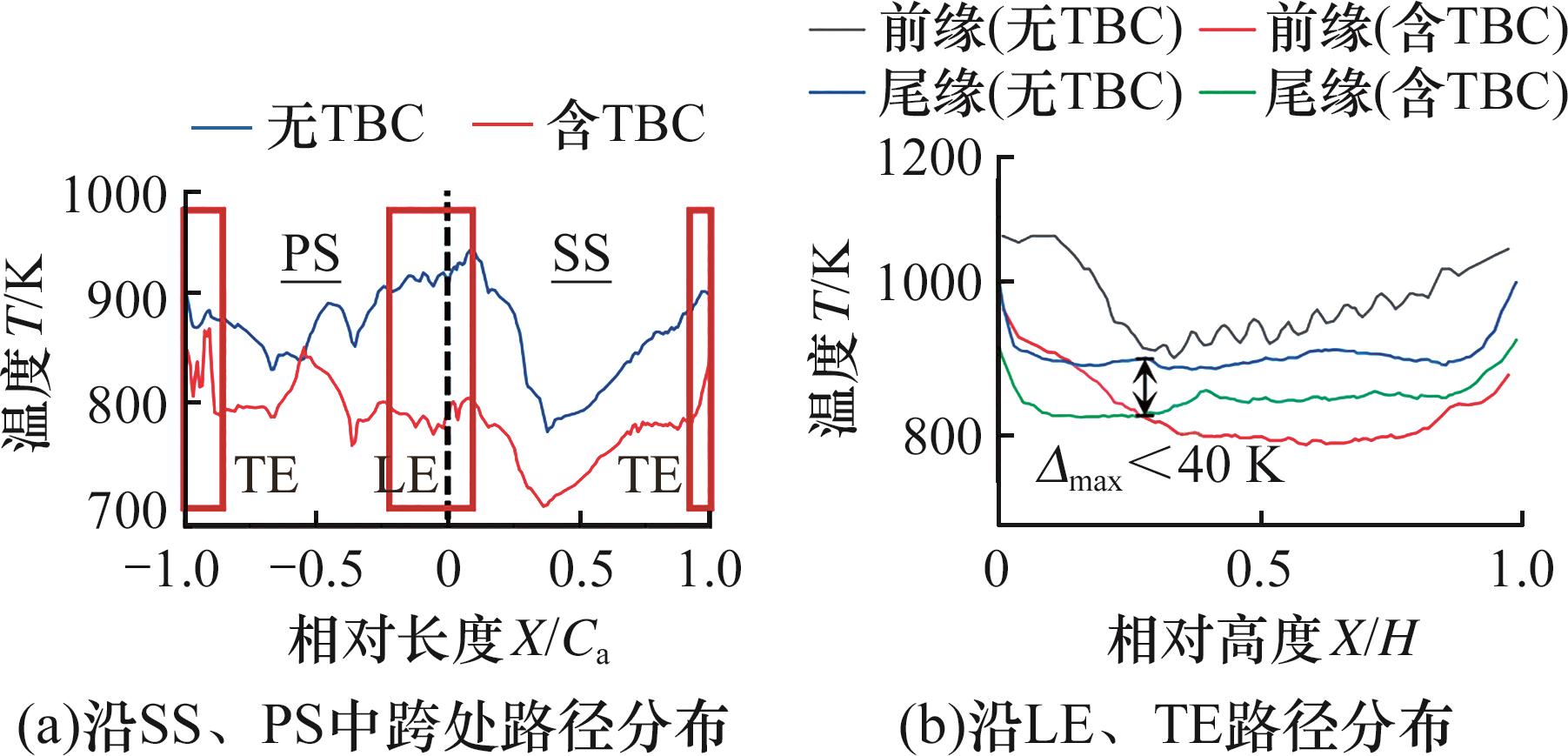
图13 不同TBC设置条件下温度分布曲线
Fig.13 Temperature distribution profiles under varying TBC configurations
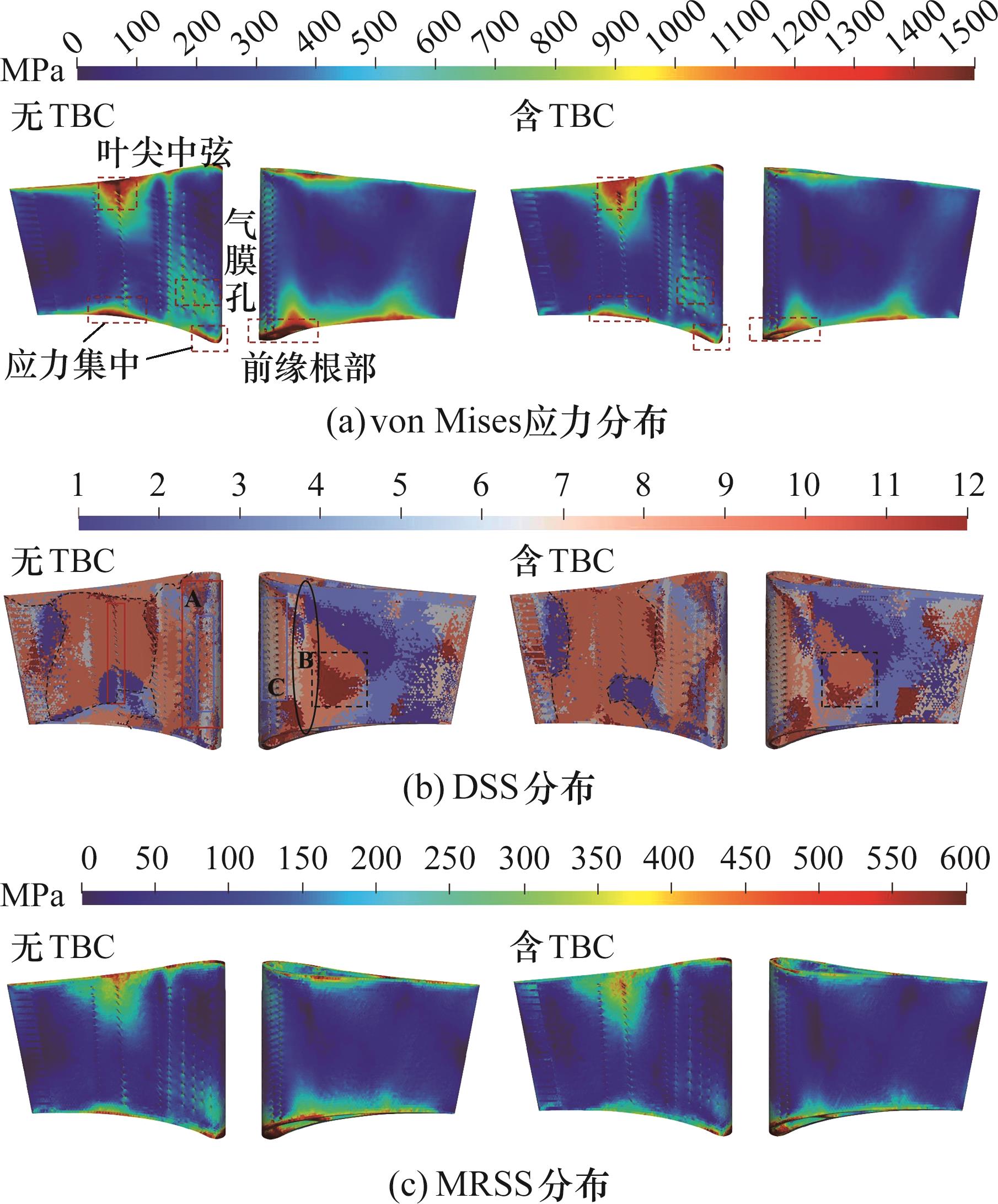
图14 不同TBC设置条件下力学指标云图
Fig.14 Contour plots of mechanical parameters under different TBC configurations
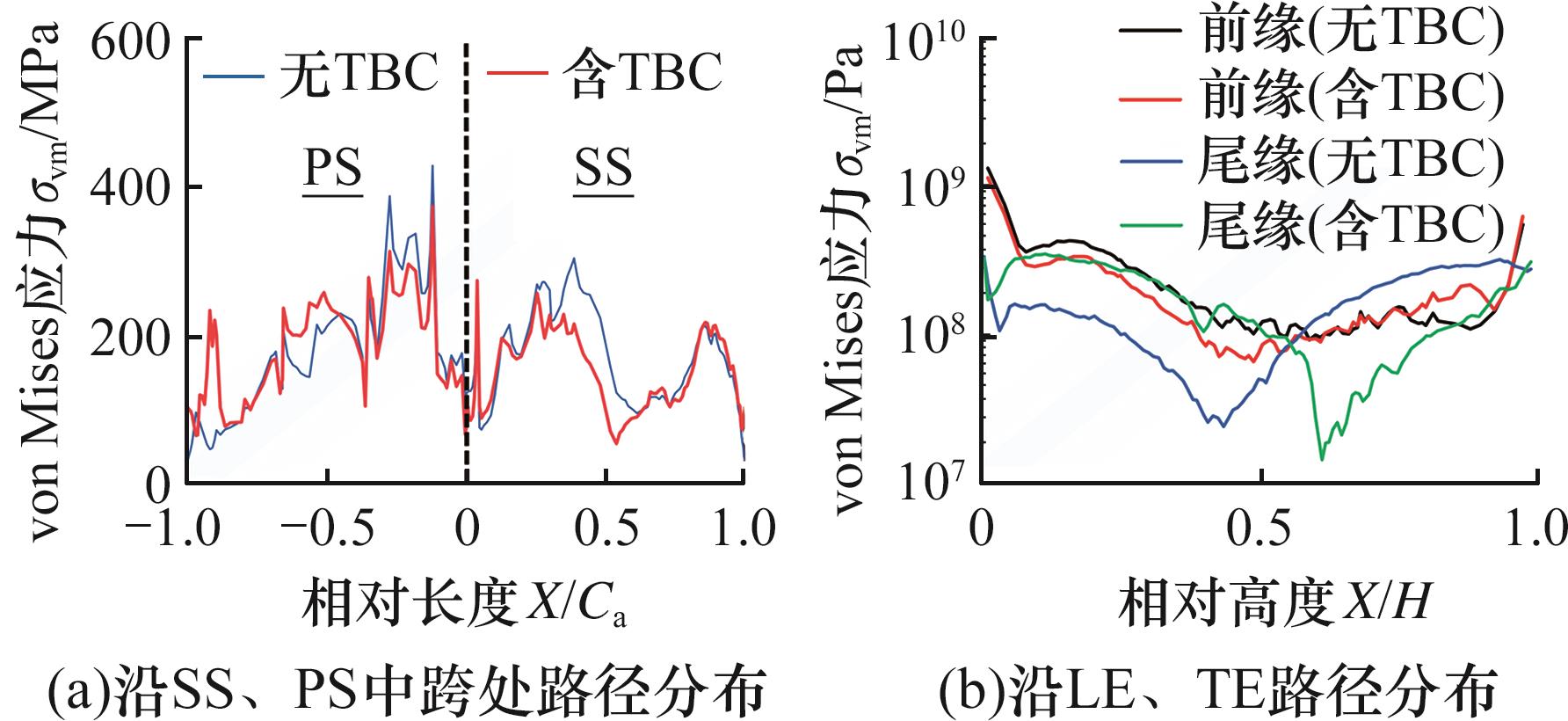
图15 von Mises应力分布曲线
Fig.15 von Mises stress distribution profiles
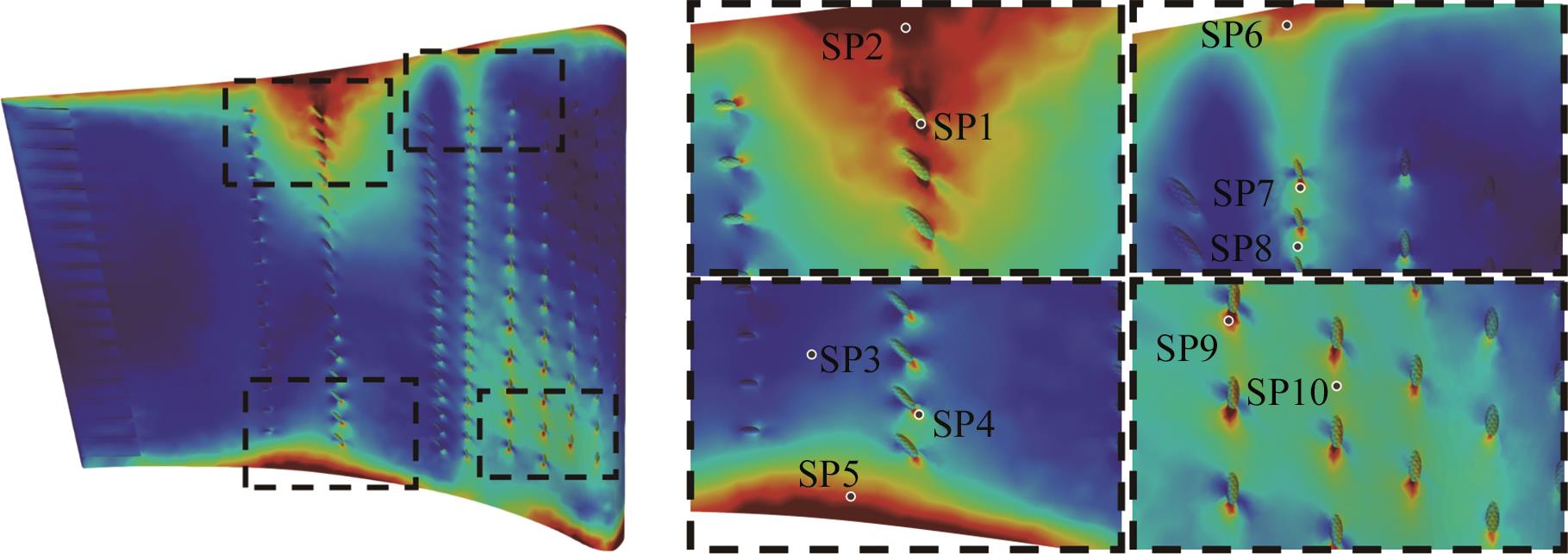
图16 热结构应力采样位置
Fig.16 Thermal-structural stress sampling locations
| 采样点(SP) | 采样位置 | 应力类型 | 应力集中 因子Kt | MRSS/MPa | DSS | 潜在滑移系统及 MRSS/CRSS | ||||
|---|---|---|---|---|---|---|---|---|---|---|
| 无TBC | TBC | 无TBC | TBC | 无TBC | TBC | 无TBC | TBC | |||
| 1 | 气膜孔/叶尖中弦 | 热载荷/结构应力集中 | 4.5 | 6.1 | 516.0 | 537.0 | 9 | 5 | 9(1.290) 12(1.090) | 9(1.342) 12(1.339) |
| 2 | 叶尖中弦 | 热载荷主导 | 3.9 | 4.0 | 420.0 | 338.0 | 9 | 10 | 9(1.049) | |
| 3 | 中温区 | 压缩应力主导 | 0.6 | 0.6 | 84.2 | 80.3 | 1 | 10 | ||
| 4 | 气膜孔/轮毂中弦 | 压缩/结构应力集中 | 3.6 | 2.5 | 398.0 | 227.0 | 9 | 1 | ||
| 5 | 轮毂中弦 | 压缩应力主导 | 3.8 | 3.4 | 346.0 | 258.0 | 9 | 12 | ||
| 6 | 叶尖 | 压缩应力主导 | 2.8 | 2.6 | 519.0 | 408.0 | 9 | 9 | 9(1.298) | 9(1.021) |
| 7 | 气膜孔/内部圆角 | 压缩/结构应力集中 | 3.9 | 3.6 | 932.0 | 732.0 | 4 | 4 | 4(2.331) 6(1.788) 9(1.734) | 4(1.832) 6(1.469) |
| 8 | 孔间/内部圆角 | 压缩/结构应力干涉 | 1.8 | 1.5 | 172.0 | 148.0 | 4 | 4 | ||
| 9 | 气膜孔/前缘 | 压缩/结构应力集中 | 3.2 | 2.9 | 227.0 | 175.0 | 10 | 9 | ||
| 10 | 孔间/前缘 | 压缩/结构应力干涉 | 2.1 | 1.9 | 193.0 | 142.0 | 2 | 3 | ||
表7 不同TBC条件下热结构应力分布和材料响应数据采样统计
Tab.7 Statistical data of thermal-structural stress distribution and material response under different TBC conditions
| 采样点(SP) | 采样位置 | 应力类型 | 应力集中 因子Kt | MRSS/MPa | DSS | 潜在滑移系统及 MRSS/CRSS | ||||
|---|---|---|---|---|---|---|---|---|---|---|
| 无TBC | TBC | 无TBC | TBC | 无TBC | TBC | 无TBC | TBC | |||
| 1 | 气膜孔/叶尖中弦 | 热载荷/结构应力集中 | 4.5 | 6.1 | 516.0 | 537.0 | 9 | 5 | 9(1.290) 12(1.090) | 9(1.342) 12(1.339) |
| 2 | 叶尖中弦 | 热载荷主导 | 3.9 | 4.0 | 420.0 | 338.0 | 9 | 10 | 9(1.049) | |
| 3 | 中温区 | 压缩应力主导 | 0.6 | 0.6 | 84.2 | 80.3 | 1 | 10 | ||
| 4 | 气膜孔/轮毂中弦 | 压缩/结构应力集中 | 3.6 | 2.5 | 398.0 | 227.0 | 9 | 1 | ||
| 5 | 轮毂中弦 | 压缩应力主导 | 3.8 | 3.4 | 346.0 | 258.0 | 9 | 12 | ||
| 6 | 叶尖 | 压缩应力主导 | 2.8 | 2.6 | 519.0 | 408.0 | 9 | 9 | 9(1.298) | 9(1.021) |
| 7 | 气膜孔/内部圆角 | 压缩/结构应力集中 | 3.9 | 3.6 | 932.0 | 732.0 | 4 | 4 | 4(2.331) 6(1.788) 9(1.734) | 4(1.832) 6(1.469) |
| 8 | 孔间/内部圆角 | 压缩/结构应力干涉 | 1.8 | 1.5 | 172.0 | 148.0 | 4 | 4 | ||
| 9 | 气膜孔/前缘 | 压缩/结构应力集中 | 3.2 | 2.9 | 227.0 | 175.0 | 10 | 9 | ||
| 10 | 孔间/前缘 | 压缩/结构应力干涉 | 2.1 | 1.9 | 193.0 | 142.0 | 2 | 3 | ||
无TBC +ORI1 | 无TBC +ORI2 | 无TBC +ORI3 | 含TBC +ORI1 | 含TBC +ORI2 | 含TBC +ORI3 |
|---|---|---|---|---|---|
| 389.7 | 419.6 | 388.3 | 333.2 | 361.4 | 333.9 |
表 8 不同配置下叶身体积平均等效应力 (MPa)
Tab. 8 Volume-averaged equivalent stress in the blade body under different configurations
无TBC +ORI1 | 无TBC +ORI2 | 无TBC +ORI3 | 含TBC +ORI1 | 含TBC +ORI2 | 含TBC +ORI3 |
|---|---|---|---|---|---|
| 389.7 | 419.6 | 388.3 | 333.2 | 361.4 | 333.9 |
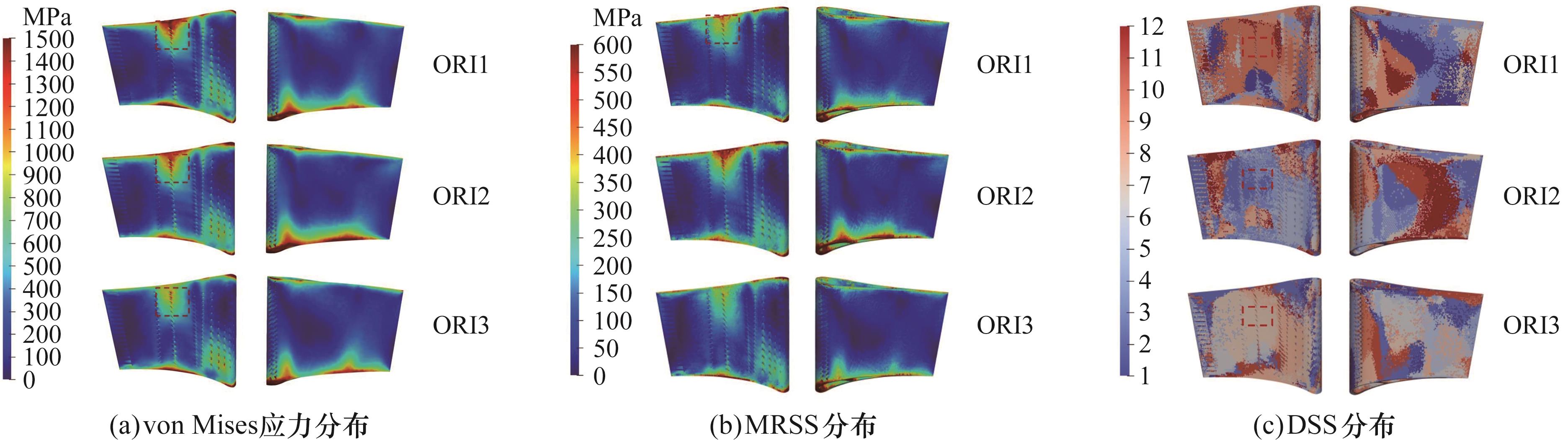
图17 不同取向条件下力学指标
Fig.17 Mechanical parameters under varying material orientations
| 采样点 | 采样位置 | 应力集中因子Kt | MRSS/MPa | DSS | 潜在激活滑移系 | ||||||||
|---|---|---|---|---|---|---|---|---|---|---|---|---|---|
| ORI1 | ORI2 | ORI3 | ORI1 | ORI2 | ORI3 | ORI1 | ORI2 | ORI3 | ORI1 | ORI2 | ORI3 | ||
| 1 | 气膜孔/叶尖中弦 | 4.5 | 3.9 | 3.4 | 516.0 | 709.0 | 506.0 | 9 | 5 | 8 | 9(1.290) 12(1.090) | 5(1.503) 3(1.291) | 8(1.264) 3(1.028) |
| 2 | 叶尖中弦 | 3.9 | 3.1 | 2.3 | 420.0 | 541.0 | 315.0 | 9 | 5 | 8 | 9(1.049) | 5(1.352) 3(1.325) | |
| 3 | 中温区 | 0.6 | 0.7 | 0.7 | 84.2 | 138.0 | 111.0 | 1 | 8 | 6 | |||
| 4 | 气膜孔/轮毂中弦 | 3.6 | 3.5 | 2.9 | 398.0 | 553.0 | 442.0 | 9 | 5 | 2 | 5(1.381) 12(1.357) 6(1.204) | 2(1.104) | |
| 5 | 轮毂中弦 | 3.8 | 3 | 3.5 | 346.0 | 446.0 | 406.0 | 9 | 3 | 8 | 3(1.115) 5(1.066) | 8(1.014) | |
| 6 | 叶尖 | 2.8 | 2.5 | 2 | 519.0 | 519.0 | 485.0 | 9 | 10 | 2 | 9(1.298) | 10(1.299) 6(1.002) | 2(1.214) |
| 7 | 气膜孔/内部圆角 | 3.9 | 3.7 | 2.7 | 932.0 | 1370.0 | 691.0 | 4 | 8 | 5 | 4(2.331) 6(1.788) 9(1.734) | 8(3.426) 12(3.039) 3(2.206) | 5(1.727) 2(1.702) 12(1.408) |
| 8 | 孔间/内部圆角 | 1.8 | 1.4 | 1.2 | 172.0 | 294.0 | 179.0 | 4 | 8 | 11 | |||
| 9 | 气膜孔/前缘 | 3.2 | 2.8 | 3.2 | 227.0 | 376.0 | 364.0 | 10 | 5 | 8 | |||
| 10 | 孔间/前缘 | 2.1 | 2 | 2.4 | 193.0 | 252.0 | 266.0 | 2 | 5 | 8 | |||
表9 不同材料取向条件下热结构应力分布和材料响应数据采样统计
Tab.9 Statistical sampling of thermo-structural stress distribution and material response data under different material orientation conditions
| 采样点 | 采样位置 | 应力集中因子Kt | MRSS/MPa | DSS | 潜在激活滑移系 | ||||||||
|---|---|---|---|---|---|---|---|---|---|---|---|---|---|
| ORI1 | ORI2 | ORI3 | ORI1 | ORI2 | ORI3 | ORI1 | ORI2 | ORI3 | ORI1 | ORI2 | ORI3 | ||
| 1 | 气膜孔/叶尖中弦 | 4.5 | 3.9 | 3.4 | 516.0 | 709.0 | 506.0 | 9 | 5 | 8 | 9(1.290) 12(1.090) | 5(1.503) 3(1.291) | 8(1.264) 3(1.028) |
| 2 | 叶尖中弦 | 3.9 | 3.1 | 2.3 | 420.0 | 541.0 | 315.0 | 9 | 5 | 8 | 9(1.049) | 5(1.352) 3(1.325) | |
| 3 | 中温区 | 0.6 | 0.7 | 0.7 | 84.2 | 138.0 | 111.0 | 1 | 8 | 6 | |||
| 4 | 气膜孔/轮毂中弦 | 3.6 | 3.5 | 2.9 | 398.0 | 553.0 | 442.0 | 9 | 5 | 2 | 5(1.381) 12(1.357) 6(1.204) | 2(1.104) | |
| 5 | 轮毂中弦 | 3.8 | 3 | 3.5 | 346.0 | 446.0 | 406.0 | 9 | 3 | 8 | 3(1.115) 5(1.066) | 8(1.014) | |
| 6 | 叶尖 | 2.8 | 2.5 | 2 | 519.0 | 519.0 | 485.0 | 9 | 10 | 2 | 9(1.298) | 10(1.299) 6(1.002) | 2(1.214) |
| 7 | 气膜孔/内部圆角 | 3.9 | 3.7 | 2.7 | 932.0 | 1370.0 | 691.0 | 4 | 8 | 5 | 4(2.331) 6(1.788) 9(1.734) | 8(3.426) 12(3.039) 3(2.206) | 5(1.727) 2(1.702) 12(1.408) |
| 8 | 孔间/内部圆角 | 1.8 | 1.4 | 1.2 | 172.0 | 294.0 | 179.0 | 4 | 8 | 11 | |||
| 9 | 气膜孔/前缘 | 3.2 | 2.8 | 3.2 | 227.0 | 376.0 | 364.0 | 10 | 5 | 8 | |||
| 10 | 孔间/前缘 | 2.1 | 2 | 2.4 | 193.0 | 252.0 | 266.0 | 2 | 5 | 8 | |||
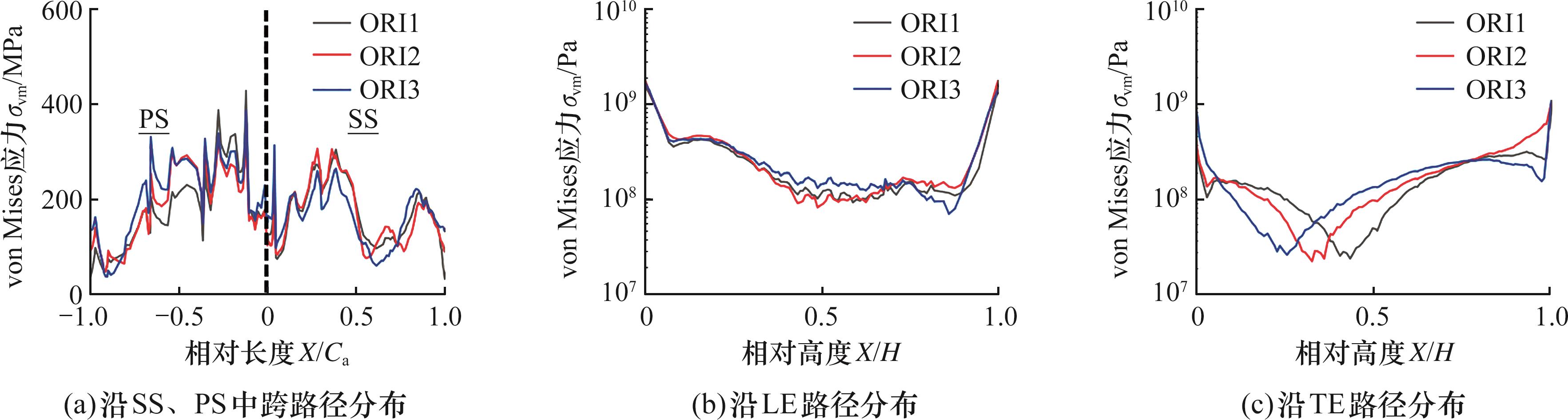
图18 不同取向设置条件下von Mises应力分布曲线
Fig.18 von Mises stress distribution profiles under varying material orintation configurations
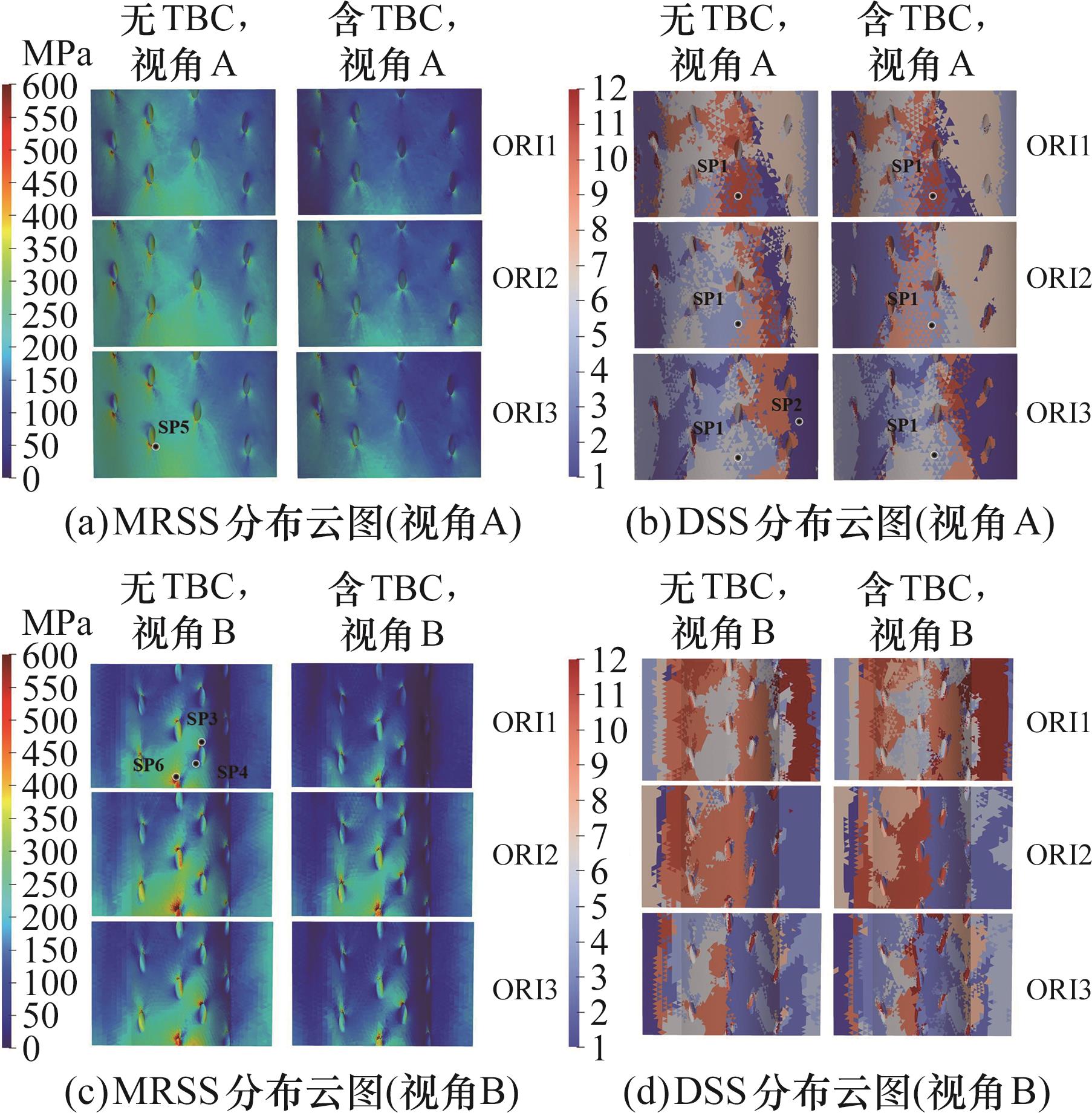
图19 前缘气膜孔列区域力学指标云图
Fig.19 Contour plots of mechanical parameters in leading-edge film cooling hole array
| 采样点及条件设置 | 位置 | 应力状态 | 应力 三轴度 | 材料响应 | DSS/MRSS | 滑移系激活信息 (滑移系编号; | 累积塑性变形量 |
|---|---|---|---|---|---|---|---|
| SP1-ORI1-NoTBC | 气膜孔干涉区 | 介于单轴压缩、纯剪切 | 剪切主导 | 11/234.63 | 11(0.642/0.509/0.424/0.525) 2(0.580/0.460/0.373/0.470) | <1×10 | |
| SP1-ORI2-NoTBC | 气膜孔干涉区 | 介于单轴压缩、纯剪切 | 剪切主导 | 4/233.78 | 4(0.578/0.461/0.387/0.475) 9(0.554/0.442/0.376/0.457) | <1×10 | |
| SP1-ORI3-NoTBC | 气膜孔干涉区 | 介于单轴压缩、纯剪切 | 剪切主导 | 6/231.55 | 6(0.582/0.481/0.438/0.500) 4(0.582/0.481/0.425/0.496) | <1×10 | |
| SP1-ORI1-TBC | 气膜孔干涉区 | 介于单轴压缩、纯剪切 | 剪切主导 | 11/163.23 | 11(0.587/0.496/0.423/0.505) 2(0.556/0.470/0.392/0.473) | <1×10 | |
| SP1-ORI2-TBC | 气膜孔干涉区 | 介于单轴压缩、纯剪切 | 剪切主导 | 4/173.76 | 4(0.570/0.468/0.400/0.479) 9(0.569/0.467/0.403/0.479) | <1×10 | |
| SP1-ORI3-TBC | 气膜孔干涉区 | 介于单轴压缩、纯剪切 | 剪切主导 | 4/168.23 | 4(0.561/0.480∥0.429/0.490) 6(0.553/0.473/0.436/0.487) | <1×10 | |
| SP2-ORI3-NoTBC | 前缘侧 | 介于单轴、双轴压缩 | 剪切主导 | 1/158.48 | 1(0.467/0.517/0.452/0.479) | <1×10 | |
| SP3-ORI1-NoTBC | 孔周 | 多轴压缩 | 压缩主导 | 1/92.14 | 1(0.360/0.478/0.436/0.424) 3(0.327/0.435/0.352/0.371) | <1×10 | |
| SP4-ORI1-NoTBC | 孔周 | 多轴压缩 | 压缩主导 | 6/104.58 | 6(0.388/0.498/0.484/0.456) 10(0.349/0.448/0.443/0.413) | <1×10 | |
| SP5-ORI1-NoTBC | 气膜孔应力 集中处 | 介于单轴、双轴拉伸 | 0.47 | 拉伸主导 | 3/536.51 | 3(0.352/0.394/0.467/0.404) 8(0.302/0.339/0.353/0.331) | 2.6×10 |
| SP6-ORI1-NoTBC | 气膜孔应力 集中处 | 接近单轴压缩 | 压缩主导 | 6/564.70 | 6(0.406/0.411/0.419/0.412) 5(0.397/0.403/0.428/0.409) | 8.45×10 |
表10 应力状态和滑移变形信息采样
Tab.10 Stress state and slip deformation indices sampling
| 采样点及条件设置 | 位置 | 应力状态 | 应力 三轴度 | 材料响应 | DSS/MRSS | 滑移系激活信息 (滑移系编号; | 累积塑性变形量 |
|---|---|---|---|---|---|---|---|
| SP1-ORI1-NoTBC | 气膜孔干涉区 | 介于单轴压缩、纯剪切 | 剪切主导 | 11/234.63 | 11(0.642/0.509/0.424/0.525) 2(0.580/0.460/0.373/0.470) | <1×10 | |
| SP1-ORI2-NoTBC | 气膜孔干涉区 | 介于单轴压缩、纯剪切 | 剪切主导 | 4/233.78 | 4(0.578/0.461/0.387/0.475) 9(0.554/0.442/0.376/0.457) | <1×10 | |
| SP1-ORI3-NoTBC | 气膜孔干涉区 | 介于单轴压缩、纯剪切 | 剪切主导 | 6/231.55 | 6(0.582/0.481/0.438/0.500) 4(0.582/0.481/0.425/0.496) | <1×10 | |
| SP1-ORI1-TBC | 气膜孔干涉区 | 介于单轴压缩、纯剪切 | 剪切主导 | 11/163.23 | 11(0.587/0.496/0.423/0.505) 2(0.556/0.470/0.392/0.473) | <1×10 | |
| SP1-ORI2-TBC | 气膜孔干涉区 | 介于单轴压缩、纯剪切 | 剪切主导 | 4/173.76 | 4(0.570/0.468/0.400/0.479) 9(0.569/0.467/0.403/0.479) | <1×10 | |
| SP1-ORI3-TBC | 气膜孔干涉区 | 介于单轴压缩、纯剪切 | 剪切主导 | 4/168.23 | 4(0.561/0.480∥0.429/0.490) 6(0.553/0.473/0.436/0.487) | <1×10 | |
| SP2-ORI3-NoTBC | 前缘侧 | 介于单轴、双轴压缩 | 剪切主导 | 1/158.48 | 1(0.467/0.517/0.452/0.479) | <1×10 | |
| SP3-ORI1-NoTBC | 孔周 | 多轴压缩 | 压缩主导 | 1/92.14 | 1(0.360/0.478/0.436/0.424) 3(0.327/0.435/0.352/0.371) | <1×10 | |
| SP4-ORI1-NoTBC | 孔周 | 多轴压缩 | 压缩主导 | 6/104.58 | 6(0.388/0.498/0.484/0.456) 10(0.349/0.448/0.443/0.413) | <1×10 | |
| SP5-ORI1-NoTBC | 气膜孔应力 集中处 | 介于单轴、双轴拉伸 | 0.47 | 拉伸主导 | 3/536.51 | 3(0.352/0.394/0.467/0.404) 8(0.302/0.339/0.353/0.331) | 2.6×10 |
| SP6-ORI1-NoTBC | 气膜孔应力 集中处 | 接近单轴压缩 | 压缩主导 | 6/564.70 | 6(0.406/0.411/0.419/0.412) 5(0.397/0.403/0.428/0.409) | 8.45×10 |
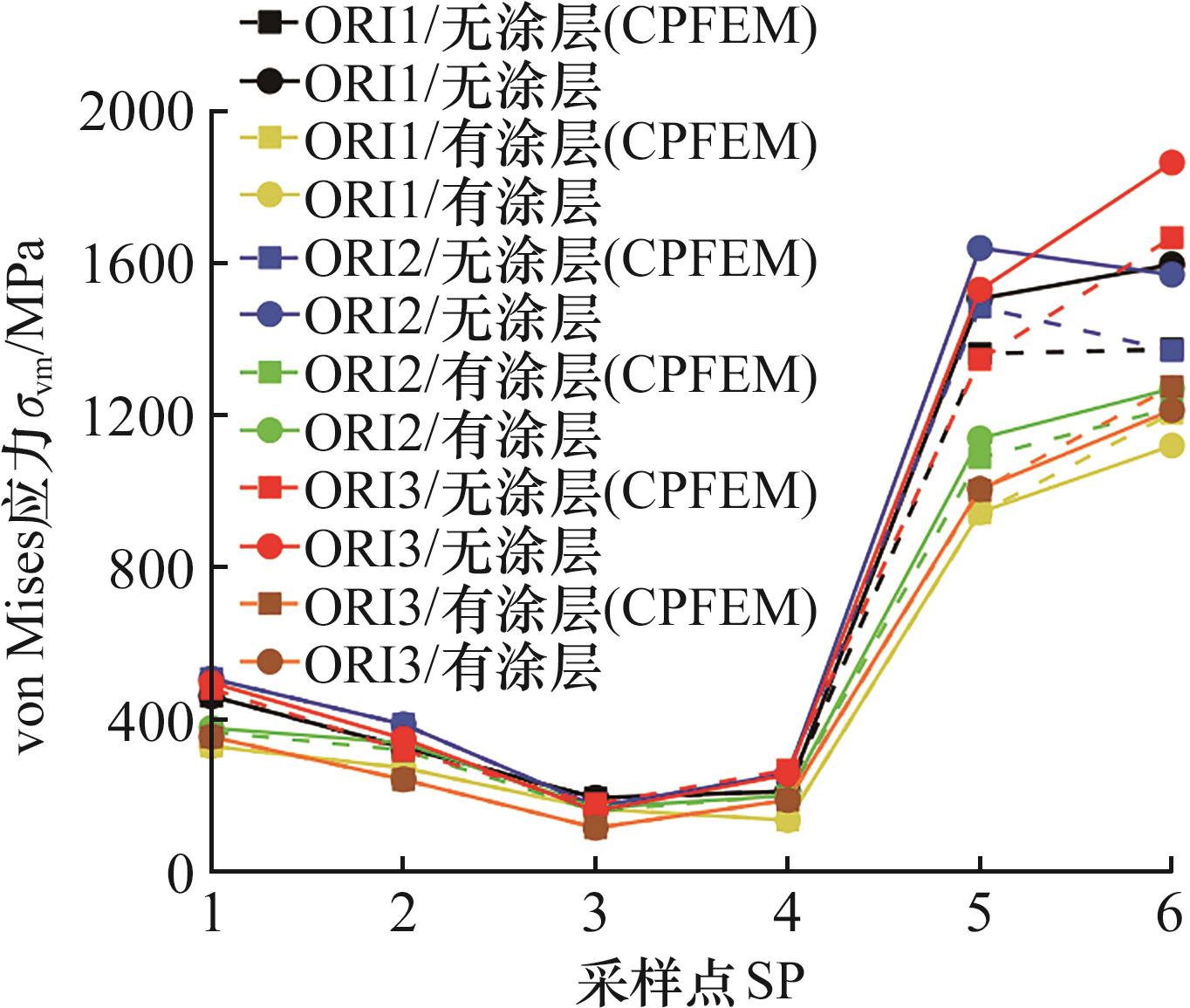
图20 不同取向设置和TBC条件下各取样点处von Mises应力分布
Fig.20 von Mises stress distribution at each sampling point under different orientation settings and TBC conditions
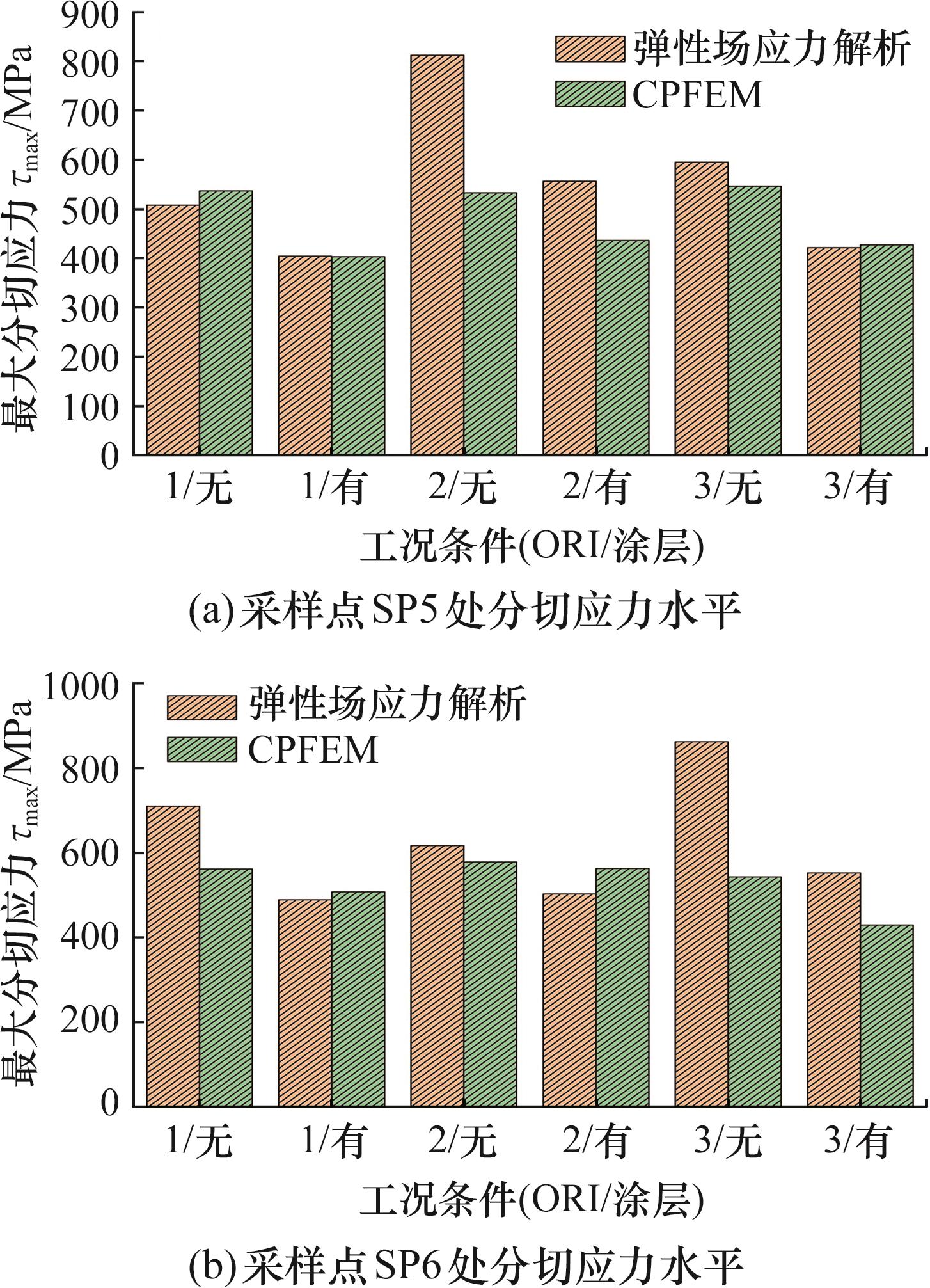
图21 弹性应力解析及晶体塑性有限元在应力集中处MRSS水平对比
Fig.21 Comparison of elastic stress analysis and CPFEM in MRSS level at stress concentration
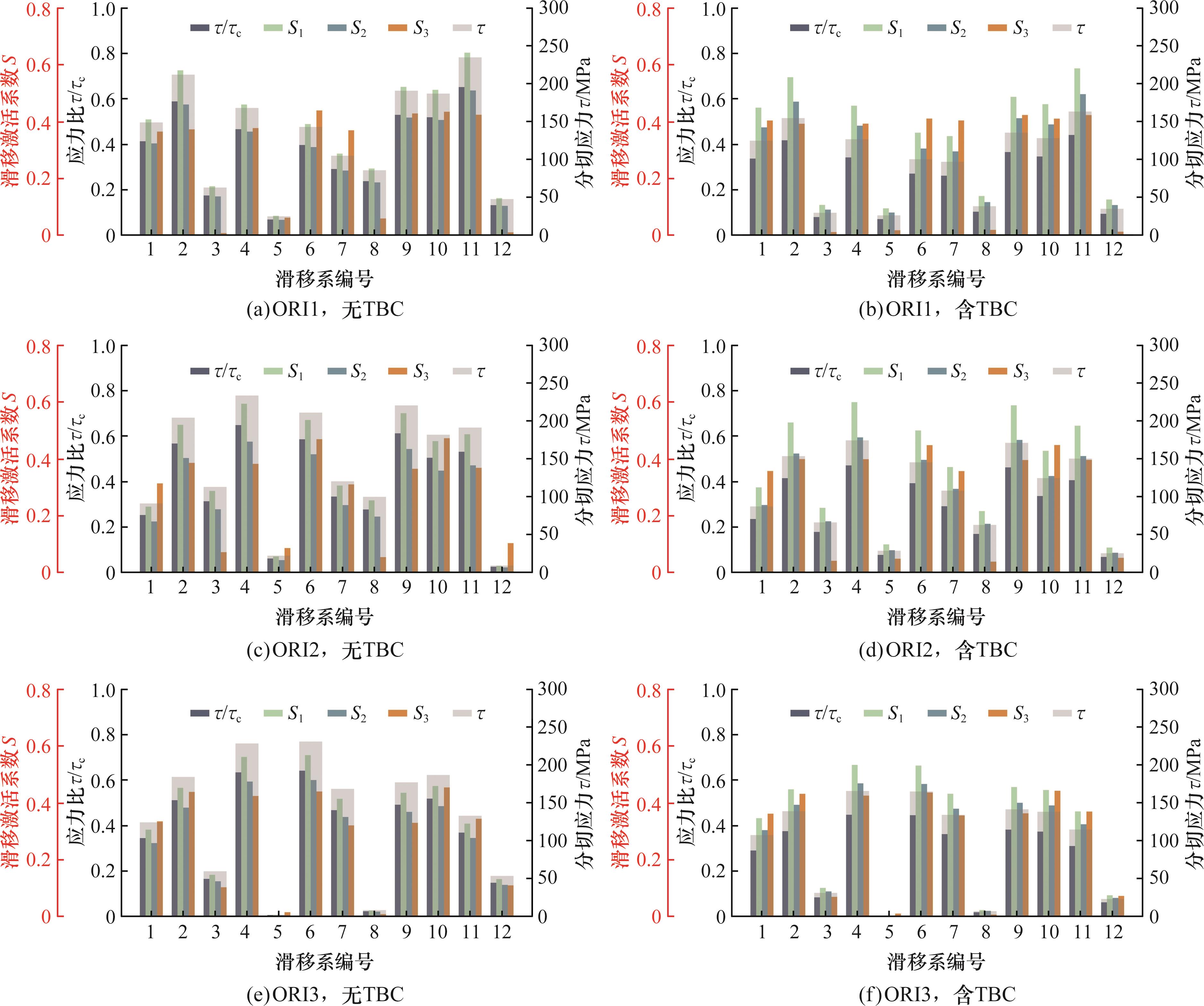
图22 不同TBC设置及取向条件下采样点SP1滑移趋势指标
Fig.22 Slip trend indices of sampling point SP1 under different tbc configurations and orientation conditions
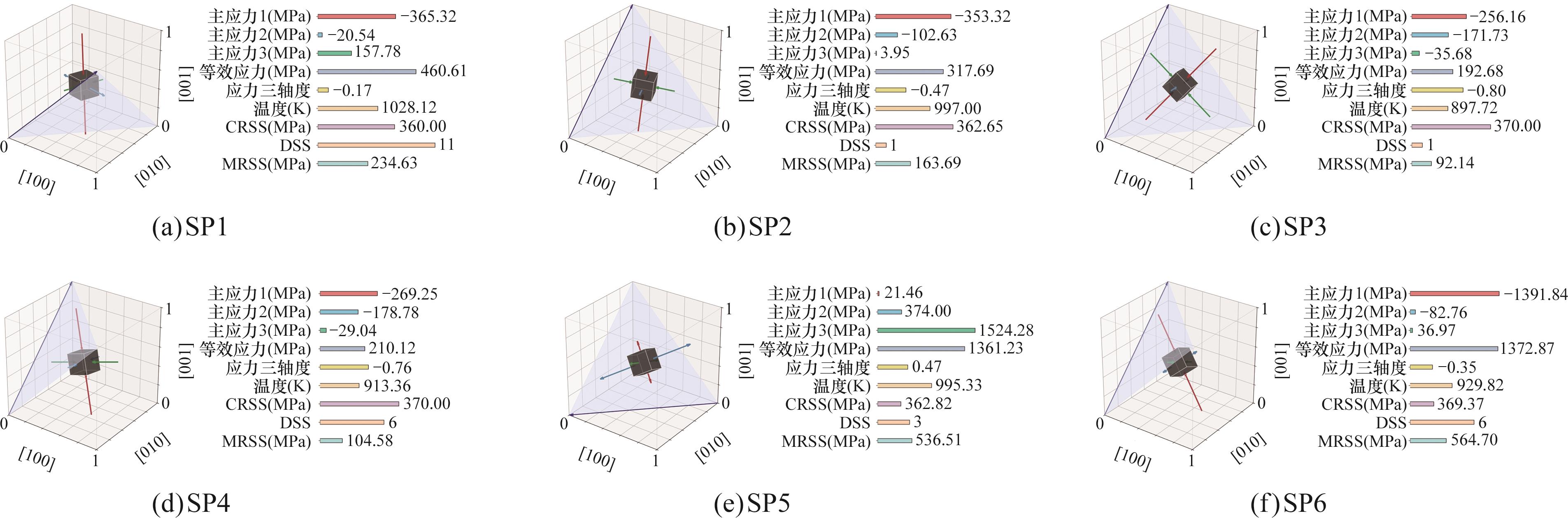
图23 各采样点载荷指标与应力状态示意
Fig.23 Schematic illustration of load index and stress state at sampling points
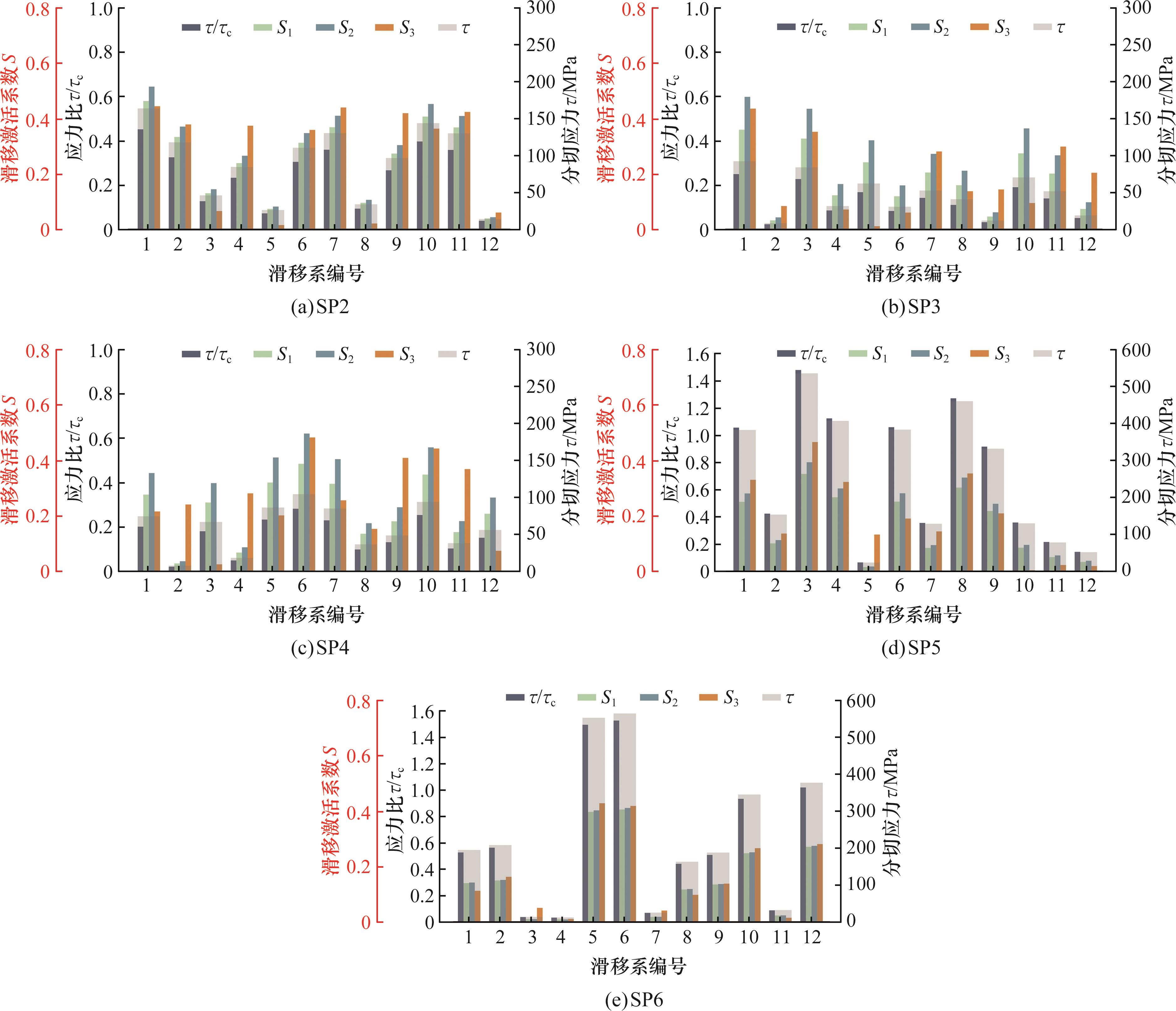
图24 各采样点滑移系指标数据示意
Fig.24 Schematic illustration of slip system parameters at sampling points
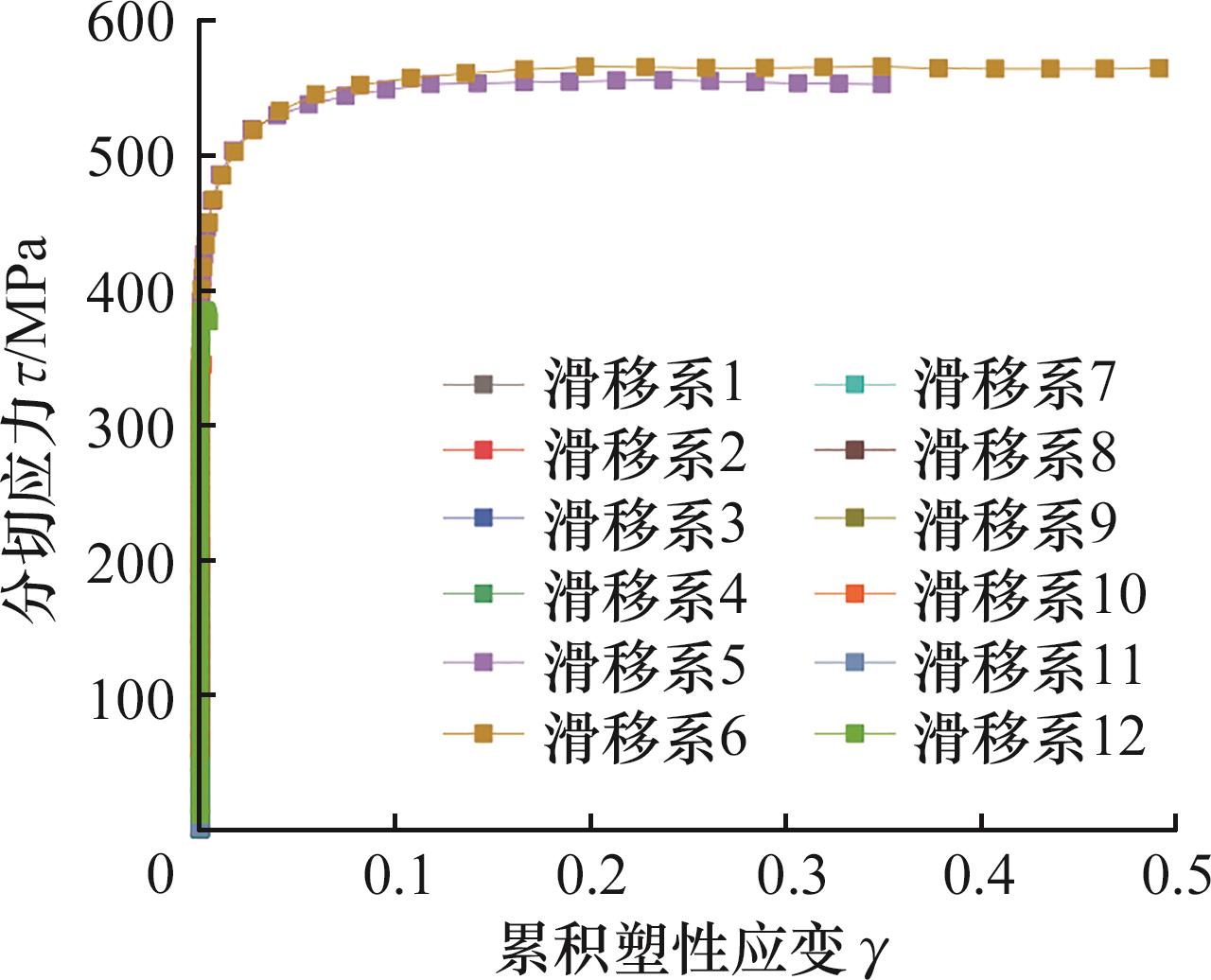
图25 各滑移系激活行为对比(SP6)
Fig.25 Comparison of activation behaviors for various slip systems(SP6)
| [1] | 张俊红, 刘萌, 付曦, 等. 复杂载荷作用下压气机叶片疲劳寿命数值分析[J]. 中国机械工程, 2017, 28(12): 1442-1448. |
| ZHANG Junhong, LIU Meng, FU Xi, et al. Numerical Analyses on Fatigue Life for Compressor Blades under Complex Loads[J]. China Mechanical Engineering, 2017, 28(12): 1442-1448. | |
| [2] | CHOWDHURY T S, MOHSIN F T, TONNI M M, et al. A Critical Review on Gas Turbine Cooling Performance and Failure Analysis of Turbine Blades[J]. International Journal of Thermofluids, 2023, 18: 100329. |
| [3] | KUMAR A, KUMAR S, PANDEY K N. Life Prediction of Thermal Barrier Coated C3X Gas Turbine Blade of CMSX-4 Material[C]∥ASME 2021 Gas Turbine India Conference. New York, 2021: V001T12A002. |
| [4] | CAI L, HE Y, WANG S, et al. Thermal-fluid-solid Coupling Analysis on the Temperature and Thermal Stress Field of a Nickel-base Superalloy Turbine Blade[J]. Materials, 2021, 14(12): 3315. |
| [5] | 窦学铮, 蒋立武, 宋尽霞, 等. 镍基单晶高温合金力学性能各向异性的研究进展[J]. 材料导报, 2022, 36(24): 154-168. |
| DOU Xuezheng, JIANG Liwu, SONG Jinxia, et al. Research Progress on Anisotropy of Mechanical Properties for Nickel Based Single Crystal Superalloys[J]. Materials Reports, 2022, 36(24): 154-168. | |
| [6] | 张健, 王莉, 谢光, 等. 镍基单晶高温合金的研发进展[J]. 金属学报, 2023, 59(9): 1109-1124. |
| ZHANG Jian, WANG Li, XIE Guang, et al. Recent Progress in Research and Development of Nickel-based Single Crystal Superalloys[J]. Acta Metallurgica Sinica, 2023, 59(9): 1109-1124. | |
| [7] | PALMERT F, MOVERARE J, GUSTAFSSON D, et al. Fatigue Crack Growth Behaviour of an Alternative Single Crystal Nickel Base Superalloy[J]. International Journal of Fatigue, 2018, 109: 166-181. |
| [8] | LI Y, WANG L, ZHAO S, et al. Creep Anisotropy of a 3rd Generation Nickel-base Single Crystal Superalloy in the Vicinity of [001] Orientation[J]. Materials Science and Engineering: A, 2022, 848: 143479. |
| [9] | 崔海涛, 钱春华. 镍基高温合金的热机械疲劳寿命预测模型研究[J]. 中国机械工程, 2024, 35(1): 67-73. |
| CUI Haitao, QIAN Chunhua. Research on Thermo-mechanical Fatigue Life Prediction Model of Ni-base Superalloy[J]. China Mechanical Engineering, 2024, 35(1): 67-73. | |
| [10] | 郑松林. 晶体塑性有限元在材料动态响应研究中的应用进展[J]. 高压物理学报, 2019, 33(3): 030108. |
| ZHENG Songlin. Advances in the Study of Dynamic Response of Crystalline Materials by Crystal Plasticity Finite Element Modeling[J]. Chinese Journal of High Pressure Physics, 2019, 33(3): 030108. | |
| [11] | SKAMNIOTIS C, COCKS A C F. Creep-plasticity-fatigue Calculations in the Design of Porous Double Layers for New Transpiration Cooling Systems[J]. International Journal of Fatigue, 2021, 151: 106304. |
| [12] | SKAMNIOTIS C, COURTIS M, COCKS A C F. Multiscale Analysis of Thermomechanical Stresses in Double Wall Transpiration Cooling Systems for Gas Turbine Blades[J]. International Journal of Mechanical Sciences, 2021, 207: 106657. |
| [13] | BŁACHNIO J, SPYCHAŁA J, ZASADA D. Analysis of Structural Changes in a Gas Turbine Blade as a Result of High Temperature and Stress[J]. Engineering Failure Analysis, 2021, 127: 105554. |
| [14] | 于海明, 邓杰文, 周岭. 流体力学[M]. 北京: 机械工业出版社, 2022. |
| YU Haiming, DENG Jiewen, ZHOU Ling. Fluid Mechanics[M]. Beijing: China Machine Press, 2022. | |
| [15] | 张行, 王晋军. 热弹性力学基础[M]. 北京: 科学出版社, 2021. |
| ZHANG Hang, WANG Jinjun. Fundamentals of Thermoelasticity[M]. Beijing: Science Press, 2021. | |
| [16] | PEIRCE D, ASARO R J, NEEDLEMAN A. An Analysis of Nonuniform and Localized Deformation in Ductile Single Crystals[J]. Acta Metallurgica, 1982, 30(6): 1087-1119. |
| [17] | TIMKO L P. Energy Efficient Engine High Pressure Turbine Component Test Performance Report[R]. Washington D C: NASA, 1984. |
| [18] | QIAN X, YAN P, WANG X, et al. Numerical Analysis of Conjugated Heat Transfer and Thermal Stress Distributions in a High-temperature Ni-based Superalloy Turbine Rotor Blade[J]. Energies, 2022, 15(14): 4972. |
| [19] | QIAN X, YAN P, WANG X, et al. Effect of Thermal Barrier Coatings and Integrated Cooling on the Conjugate Heat Transfer and Thermal Stress Distribution of Nickel-based Superalloy Turbine Vanes[J]. Energy, 2023, 277: 127774. |
| [20] | WANG S, LI X, REN J. Comprehensive Evaluation on Conjugate Heat Transfer and Thermal Stress Performance of Film Cooling[J]. International Journal of Heat and Mass Transfer, 2024, 219: 124850. |
| [21] | MILLS K C. Recommended Values of Thermophysical Properties for Selected Commercial Alloys[M]. Cambridge: Woodhead Publishing, 2002. |
| [22] | MATSUSHITA T, FECHT H J, WUNDERLICH R K, et al. Studies of the Thermophysical Properties of Commercial CMSX-4 Alloy[J]. Journal of Chemical & Engineering Data, 2009, 54(9): 2584-2592. |
| [23] | ZHONG Y H. Study on Thermal Barrier Coating of Gas Turbine Blade[D]. Beijing: Mechanical Science Research Institute,2015. |
| [24] | KIM K M, MOON H, PARK J S, et al. Optimal Design of Impinging Jets in an Impingement/Effusion Cooling System[J]. Energy, 2014, 66: 839-848. |
| [25] | 《中国航空材料手册》编辑委员会. 中国航空材料手册:第2卷 变形高温合金 铸造高温合金[M]. 2版. 北京:中国标准出版社, 2002. |
| Editorial Committee of China Aeronautical Materials Handbook. China Aeronautical Materials Handbook: Vol. 2 Wrought Superalloys and Cast Superalloys[M]. 2nd ed. Beijing: China Standard Press, 2002. | |
| [26] | 刘金来, 叶荔华, 周亦胄, 等. 一种单晶高温合金的弹性性能的各向异性[J]. 金属学报, 2020, 56(6): 855-862. |
| LIU Jinlai, YE Lihua, ZHOU Yizhou, et al. Anisotropy of Elasticity of a Ni Base Single Crystal Superalloy[J]. Acta Metallurgica Sinica, 2020, 56(6): 855-862. | |
| [27] | 郝义意. 涡轮叶片力-热耦合响应分析[D]. 北京: 北京化工大学, 2023. |
| HAO Yiyi. Analysis of Force-thermal Coupling Response of High-temperature Turbine Blades[D]. Beijing: Beijing University of Chemical Technology, 2023. | |
| [28] | SAVAGE M W R. The Influence of Crystal Orientation on the Elastic Stresses of a Single Crystal Nickel-based Turbine Blade[C]∥Structures and Dynamics, Parts A and B. ASMEDC, 2011: 37-46. |
| [29] | 尹泽勇,岳珠峰,杨治国,等. 各向异性单晶合金结构强度与寿命[M]. 北京: 国防工业出版社, 2003. |
| YIN Zeyong, YUE Zhufeng, YANG Zhiguo, et al. Structural Strength and Life of Anisotropic Single Crystal Alloy[M]. Beijing: National Defense Industry Press, 2003. | |
| [30] | DING Q, BEI H, YAO X, et al. Temperature Effects on Deformation Substructures and Mechanisms of a Ni-based Single Crystal Superalloy[J]. Applied Materials Today, 2021, 23: 101061. |
| [31] | SHI L, SUN Z, LU Y. The Combined Influences of Film Cooling and Thermal Barrier Coatings on the Cooling Performances of a Film and Internal Cooled Vane[J]. Coatings, 2020, 10(9): 861. |
| [32] | MADEC R, DEVINCRE B, KUBIN L, et al. The Role of Collinear Interaction in Dislocation-induced Hardening[J]. Science, 2003, 301(5641): 1879-1882. |
| [1] | 鲜超1, 3, 辛红敏2, 3, 代辉2, 程清思2. 砂布轮抛光航空发动机叶片温度仿真与试验研究[J]. 中国机械工程, 2025, 36(04): 802-810. |
| [2] | 张申1, 梁嘉炜2, 吴动波3, 王辉4, 赵兵1, 许立君5, 周奋5. 航空发动机精锻叶片榫头加工夹具设计[J]. 中国机械工程, 2025, 36(04): 703-714. |
| [3] | 詹梅, 雷煜东, 郑泽邦, . [成形过程仿真优化与集成计算材料工程]集成计算材料工程在精确塑性成形中的应用现状与发展趋势[J]. 中国机械工程, 2020, 31(22): 2663-2677. |
| [4] | 牛小强1;雷基林1;邓晰文1;文均2;温志高2. 活塞顶面热障涂层对活塞热负荷的影响[J]. 中国机械工程, 2018, 29(12): 1499-1506. |
| [5] | 钟颖虹, 陆辛, 计亚平, 冯泽舟, 王林, 冯艳玲, 于浩, 李飞. 等离子喷涂ZrO2-8%Y2O3热障涂层的组织与性能研究[J]. 中国机械工程, 2016, 27(07): 965-969,993. |
| [6] | 林富华, 徐颖强, 靳少杰. 热障涂层粗糙表面弹塑性接触应力分析 [J]. 中国机械工程, 2010, 21(19): 2375-2378. |
| [7] | 徐颖强;汪震隆;李剑锋. 热障涂层抗氧化夹层界面残余应力分析[J]. J4, 2008, 19(16): 0-1897. |
| 阅读次数 | ||||||
|
全文 |
|
|||||
|
摘要 |
|
|||||
