



ISSN 1004-132X
CN 42-1294/TH
CN 42-1294/TH
中国机械工程 ›› 2026, Vol. 37 ›› Issue (9): 2205-2215.DOI: 10.3969/j.issn.1004-132X.2026.09.013
• 机械基础工程 • 上一篇
严康为( ), 鲁军勇(), 曾德林, 程龙, 谭赛
收稿日期:2025-08-14
出版日期:2026-09-25
发布日期:2026-10-21
通讯作者:
鲁军勇
作者简介:严康为,男,1996年生,助理研究员。研究方向为机电结构健康监测、诊断与维护技术。E-mail:sqlasource@nue.edu.cn基金资助:
YAN Kangwei(), LU Junyong(), ZENG Delin, CHENG Long, TAN Sai
Received:2025-08-14
Online:2026-09-25
Published:2026-10-21
Contact:
LU Junyong
摘要:
针对高速移动载荷作用下的轨道动态响应问题,提出一种考虑轨道垂-轴向耦合变形与装配界面摩擦滑移的弹性梁动态响应分析框架,综合电磁斥力、电枢扩张力、预紧力、后坐力、摩擦力等输入载荷的时空分布特性,建立了包含轨道垂-轴向耦合振动、封装壳/绝缘体轴向振动以及封装壳-轨道-绝缘体装配界面动态滑移特性的完整结构动力学模型。通过与光纤光栅传感器实测应变数据对比,检验了所提模型的准确性。研究表明,电枢通过后直至出口前,在电磁后坐力和枢轨摩擦力的共同作用下,轨道中前段区域存在显著的轴向变形,可能引发低周疲劳和蠕变等劣化损伤。此外,在电枢前方轨道观察到高速前驱波特征,推断其源于电磁后坐力所致轴向应力波的前向传播。研究结果弥补了当前轨道动态响应研究缺乏垂-轴向耦合变形分析的缺陷,为封装壳-轨道-绝缘体装配结构的延寿优化与可靠性评估提供了理论依据。
中图分类号:
严康为, 鲁军勇, 曾德林, 程龙, 谭赛. 高速移动载荷作用下的垂-轴向耦合弹性梁动态响应分析[J]. 中国机械工程, 2026, 37(9): 2205-2215.
YAN Kangwei, LU Junyong, ZENG Delin, CHENG Long, TAN Sai. Dynamic Response of Axial-Vertical Coupled Elastic Beams under High-speed Moving Loads[J]. China Mechanical Engineering, 2026, 37(9): 2205-2215.
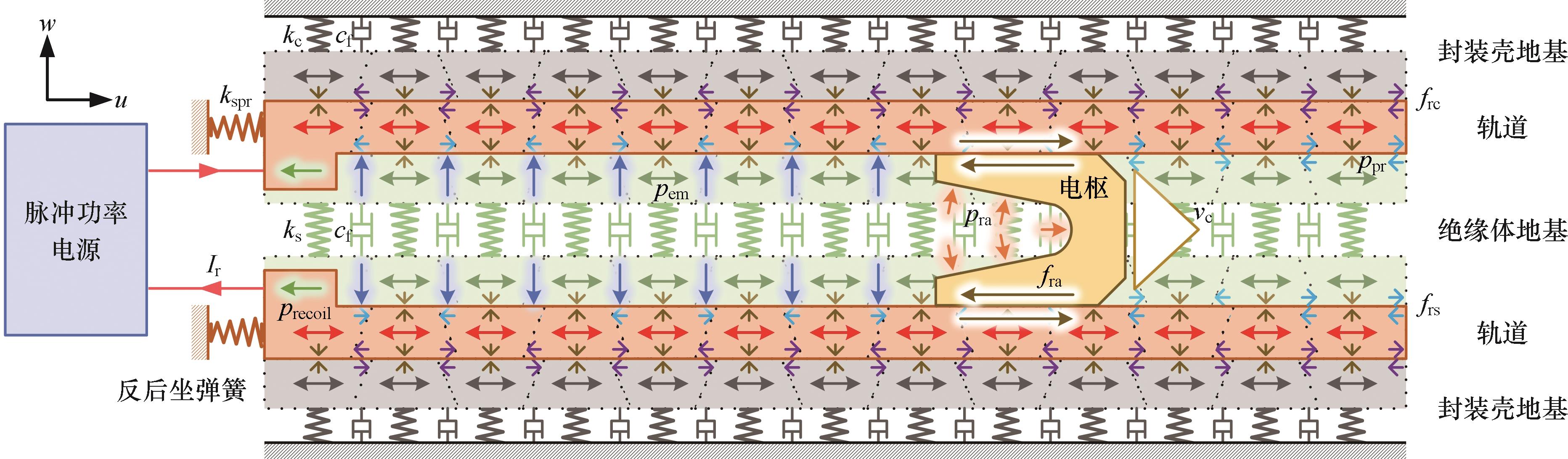
图1 电磁发射器结构受力示意图
Fig.1 Schematic of force distribution in electromagnetic launcher structure
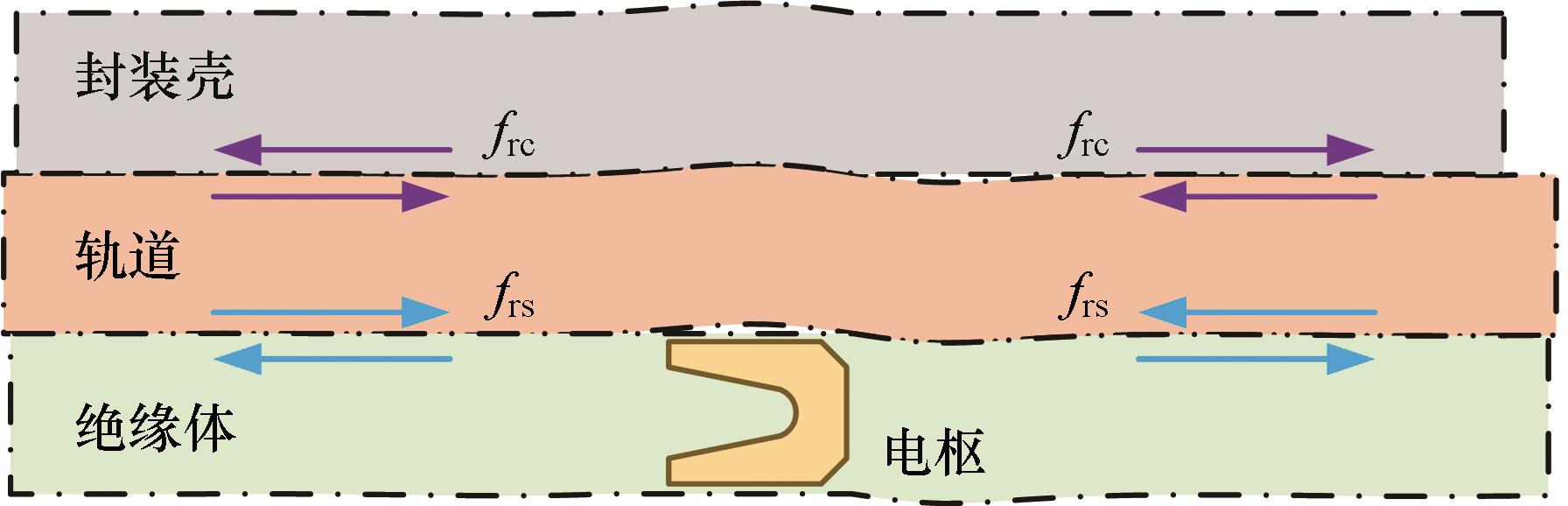
图2 封装壳-轨道-绝缘体界面滑移示意图
Fig.2 Schematic of slip occurring at the interfaces between containment, rail, and insulator
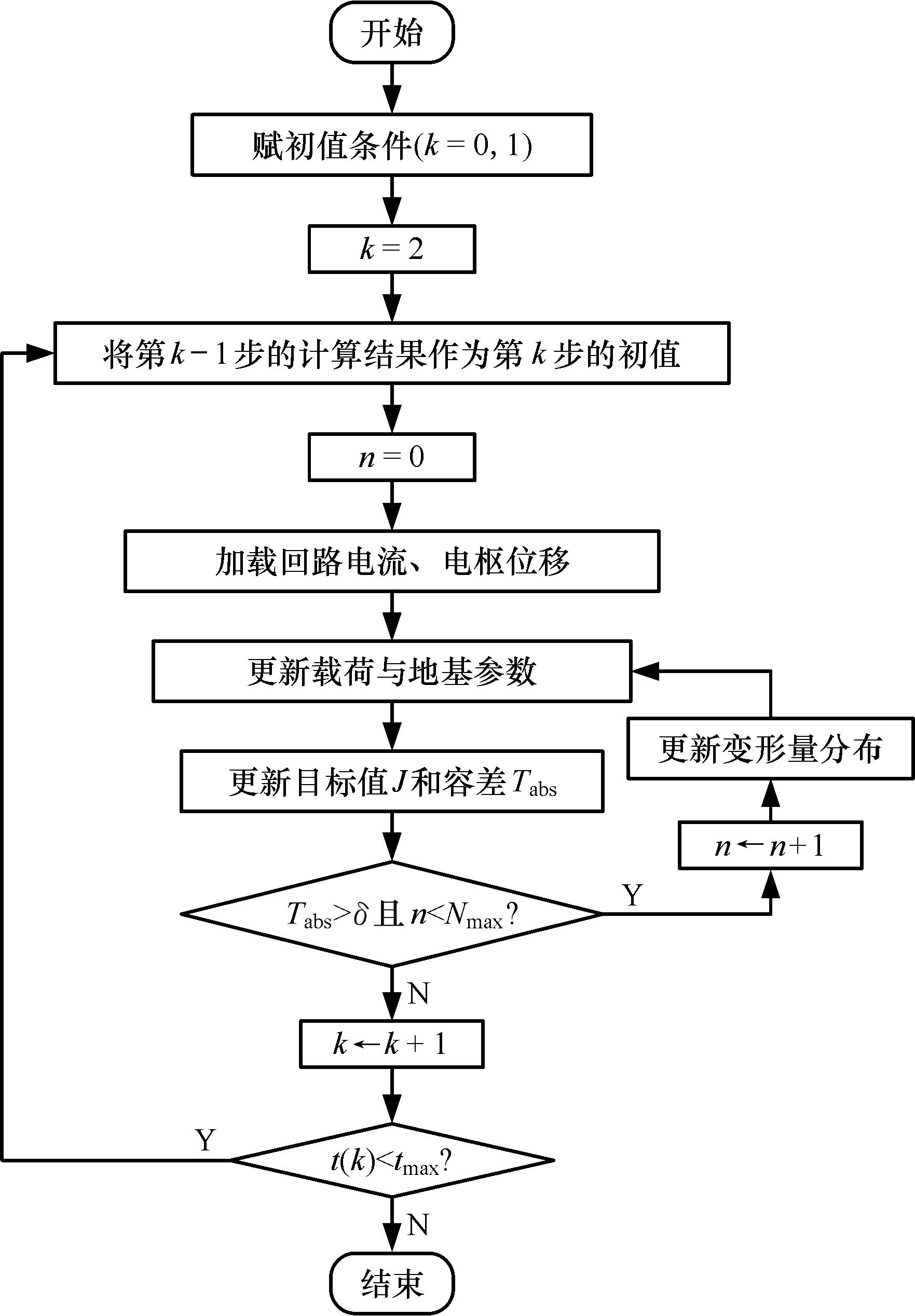
图3 模型计算流程图
Fig.3 Flowchart of model calculation
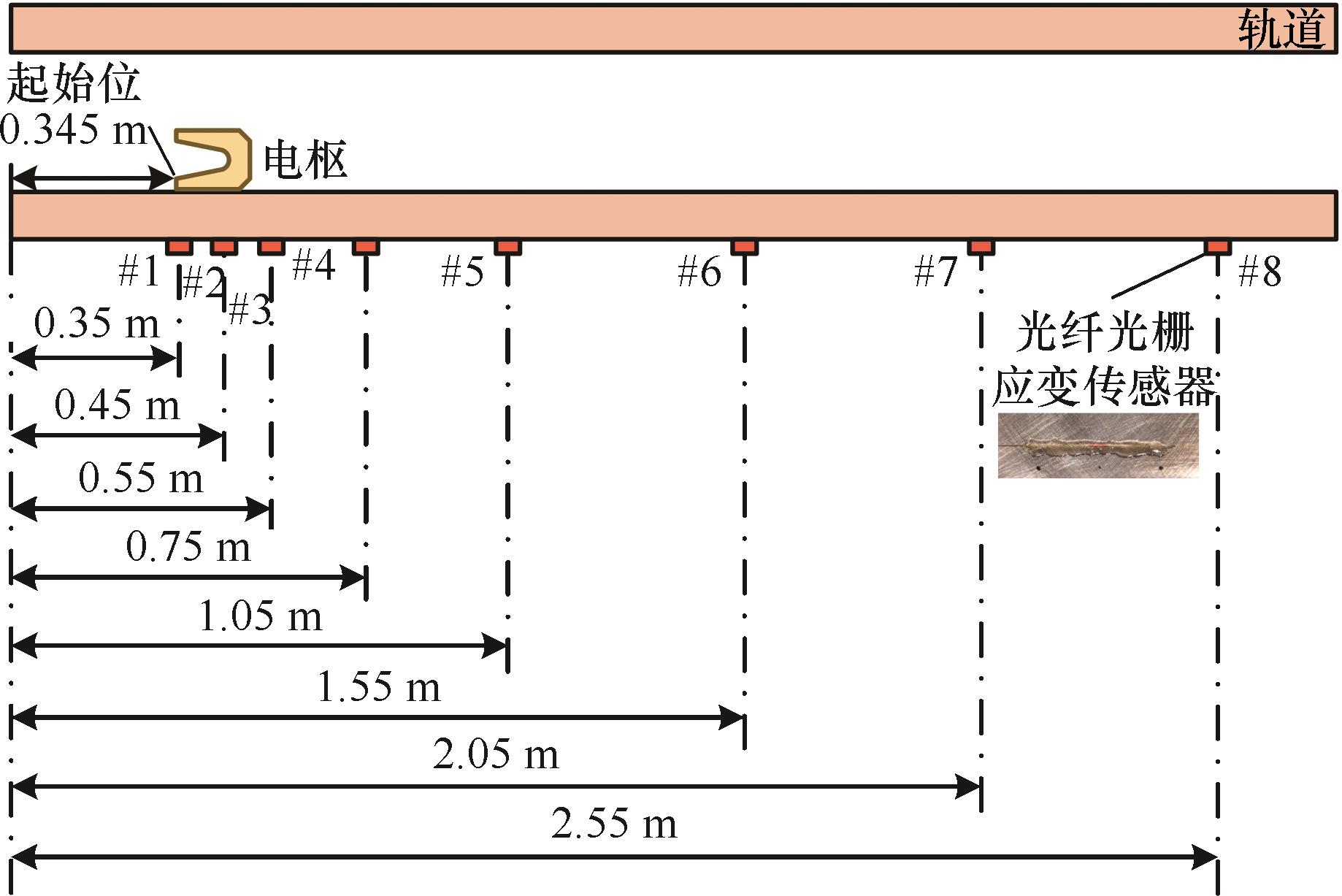
图4 应变传感器沿轨道布置图
Fig.4 Layout diagram of strain sensors along the rail
| 参数 | 数值 | 参数 | 数值 | 参数 | 数值 |
|---|---|---|---|---|---|
| 轨道长度L/m | 2.8 | 轨道截面惯性矩I/m4 | 1.31×10⁻⁷ | Stribeck特征速度/(m · s-1) | 800 |
| 轨道弹性模量E/Pa | 128×109 | 轨道间距s/m | 0.05 | 封装壳与轨道摩擦因数μrc | 0.03 |
| 封装壳弹性模量Ec/Pa | 206×109 | 轨道厚度h/m | 0.032 | 绝缘体与轨道摩擦因数μrs | 0.1 |
| 绝缘体弹性模量Es/Pa | 25×109 | 枢轨接触长度la/m | 0.055 | 反后坐弹性系数kspr/(N · m-1) | 1.2×10⁶ |
| 轨道密度ρ/(kg · m | 8450 | 馈电区域长度lb/m | 0.2 | 发射器预紧载荷ppr/Pa | 0.5×10⁶ |
| 封装壳密度ρc/(kg · m | 7545 | 封装壳侧地基系数kc/Pa | 72×109 | 发射器电感梯度L | 0.48×10⁻⁶ |
| 绝缘体密度ρs/(kg · m | 1850 | 绝缘体侧地基系数ks/Pa | 8.6×10⁹ | 时间步长Δt/s | 1×10⁻⁶ |
| 轨道截面积A/m2 | 1.38×10⁻³ | 阻尼系数cf/(kg · m-1 · s-1) | 0.2×10⁶ | 空间步长Δx/m | 1×10⁻³ |
| 封装壳截面积Ac/m2 | 6.56×10⁻³ | 枢轨静摩擦因数μra,s | 0.25 | 隐式迭代允许容差δ/m | 1×10⁻⁶ |
| 绝缘体截面积As/m2 | 0.45×10⁻³ | 枢轨库仑摩擦因数μra,c | 0.08 | 隐式迭代最大次数Nmax | 20 |
表1 模型参数
Tab.1 Model parameters
| 参数 | 数值 | 参数 | 数值 | 参数 | 数值 |
|---|---|---|---|---|---|
| 轨道长度L/m | 2.8 | 轨道截面惯性矩I/m4 | 1.31×10⁻⁷ | Stribeck特征速度/(m · s-1) | 800 |
| 轨道弹性模量E/Pa | 128×109 | 轨道间距s/m | 0.05 | 封装壳与轨道摩擦因数μrc | 0.03 |
| 封装壳弹性模量Ec/Pa | 206×109 | 轨道厚度h/m | 0.032 | 绝缘体与轨道摩擦因数μrs | 0.1 |
| 绝缘体弹性模量Es/Pa | 25×109 | 枢轨接触长度la/m | 0.055 | 反后坐弹性系数kspr/(N · m-1) | 1.2×10⁶ |
| 轨道密度ρ/(kg · m | 8450 | 馈电区域长度lb/m | 0.2 | 发射器预紧载荷ppr/Pa | 0.5×10⁶ |
| 封装壳密度ρc/(kg · m | 7545 | 封装壳侧地基系数kc/Pa | 72×109 | 发射器电感梯度L | 0.48×10⁻⁶ |
| 绝缘体密度ρs/(kg · m | 1850 | 绝缘体侧地基系数ks/Pa | 8.6×10⁹ | 时间步长Δt/s | 1×10⁻⁶ |
| 轨道截面积A/m2 | 1.38×10⁻³ | 阻尼系数cf/(kg · m-1 · s-1) | 0.2×10⁶ | 空间步长Δx/m | 1×10⁻³ |
| 封装壳截面积Ac/m2 | 6.56×10⁻³ | 枢轨静摩擦因数μra,s | 0.25 | 隐式迭代允许容差δ/m | 1×10⁻⁶ |
| 绝缘体截面积As/m2 | 0.45×10⁻³ | 枢轨库仑摩擦因数μra,c | 0.08 | 隐式迭代最大次数Nmax | 20 |
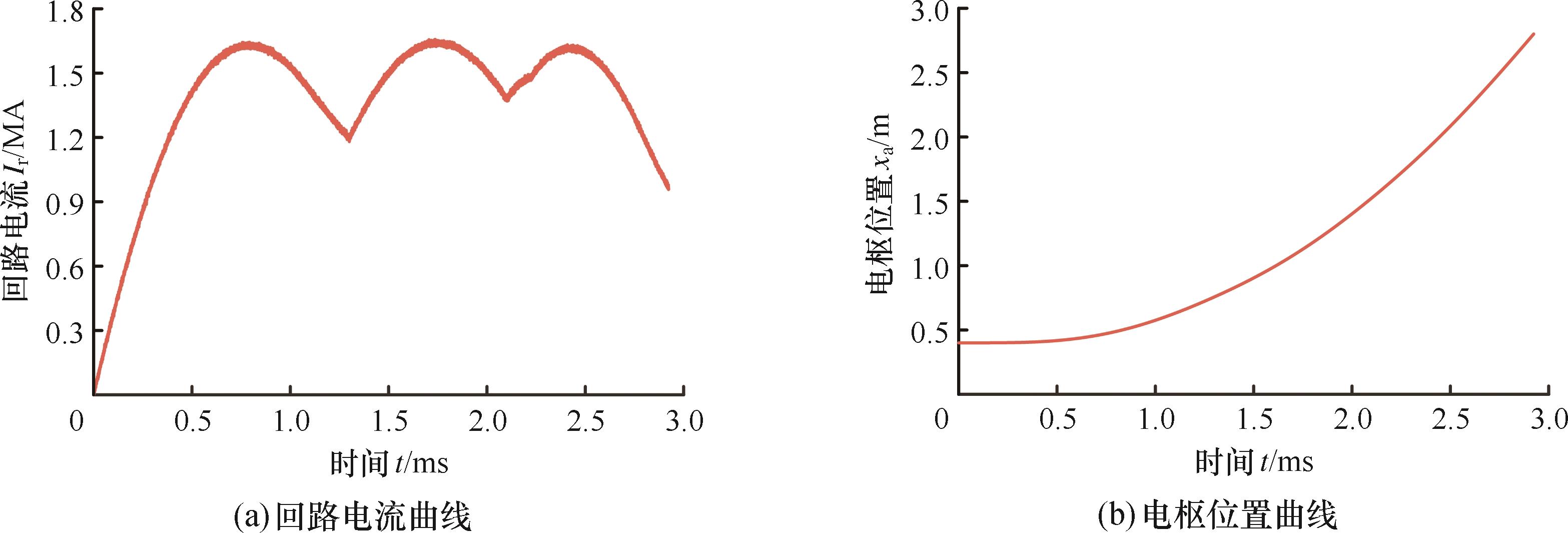
图5 模型加载条件
Fig.5 Model loading conditions
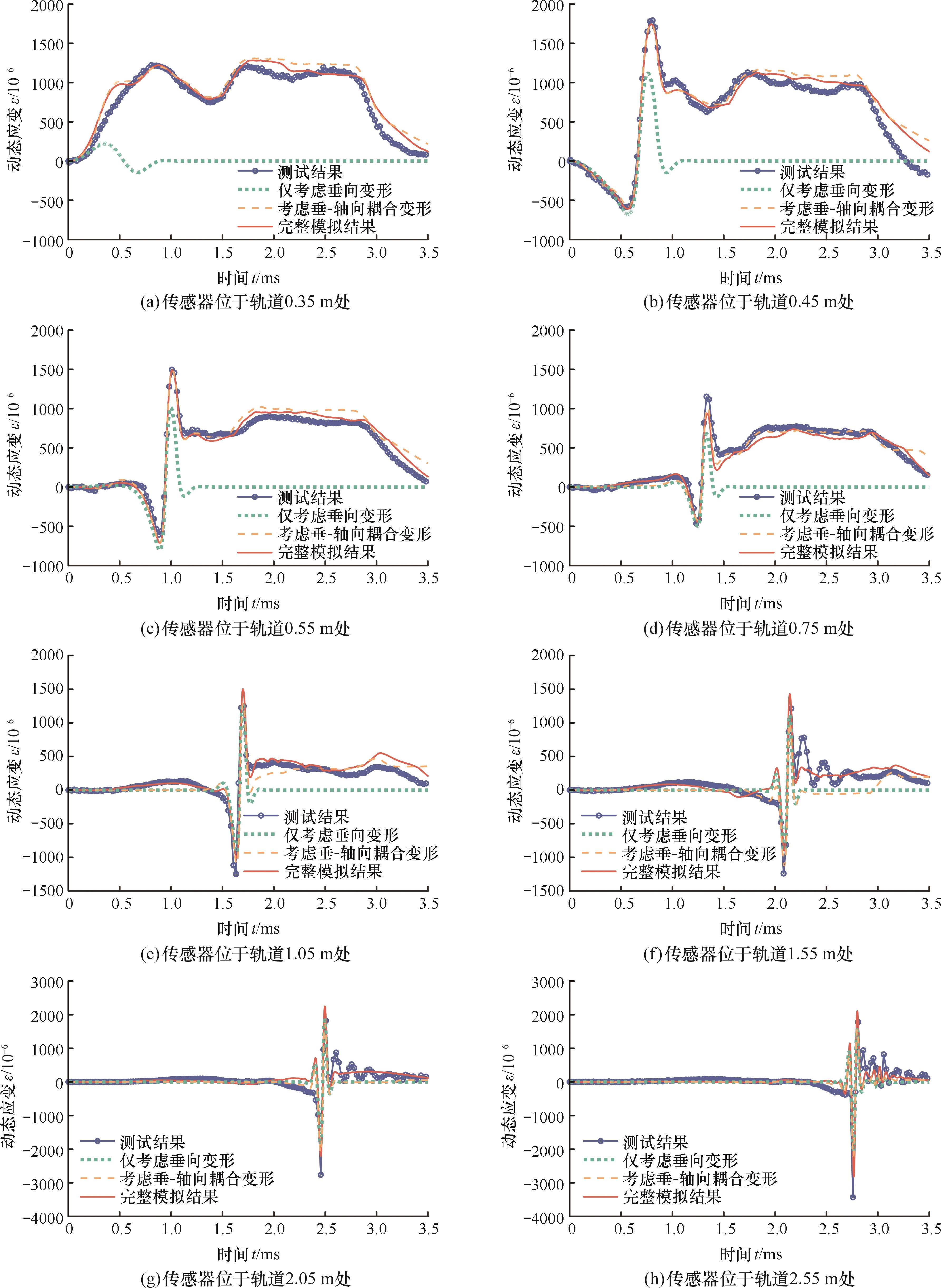
图6 不同测量点位的计算应变与实测应变随时间变化曲线对比
Fig.6 Comparison of calculated and measured strain over time at different measurement points
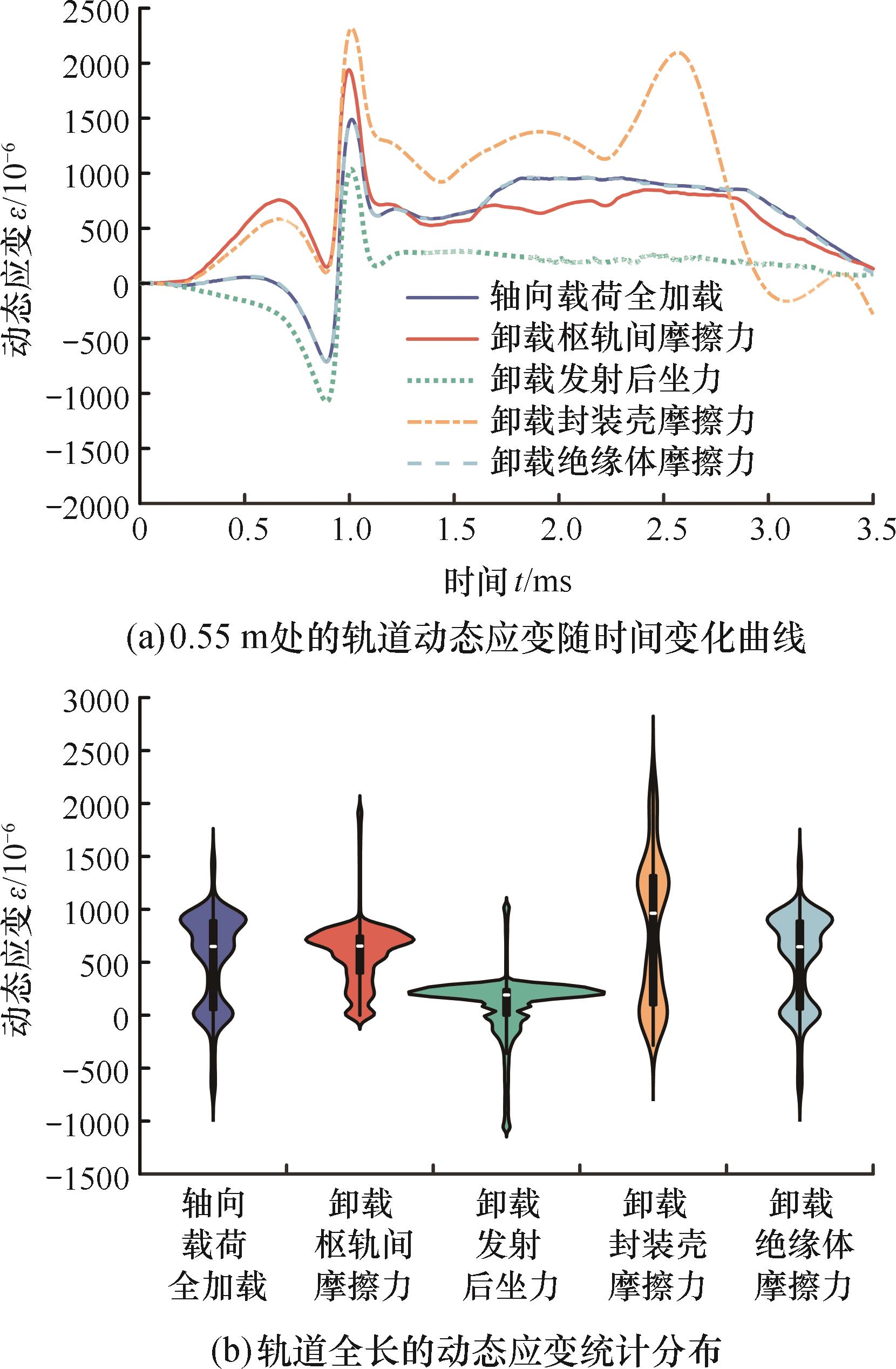
图7 轴向载荷逐项卸载分析
Fig.7 Axial load sequential unloading and analysis
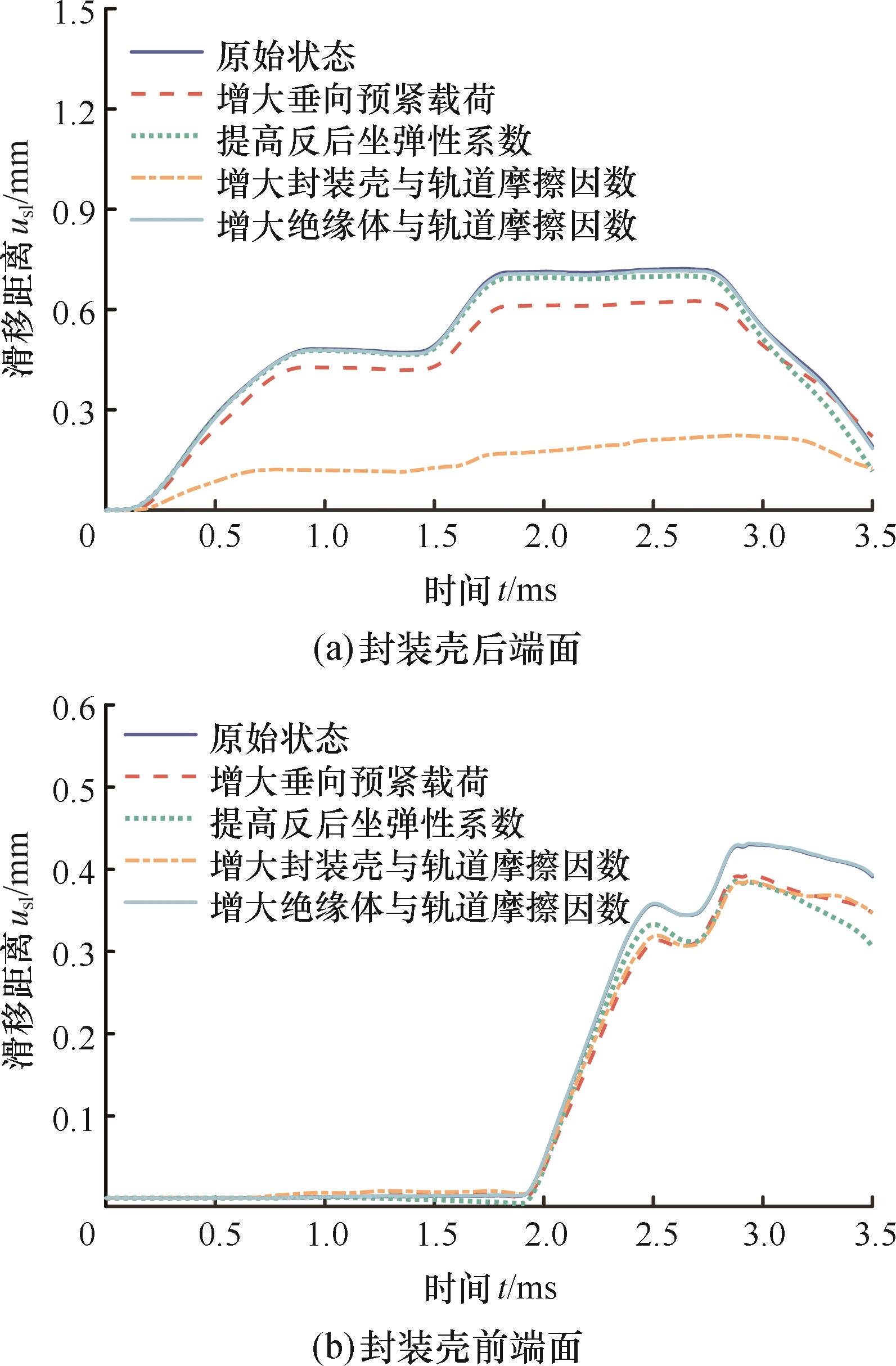
图8 不同抑制措施下的封装壳滑移距离
Fig.8 Sliding distance of containment under different mitigation measures
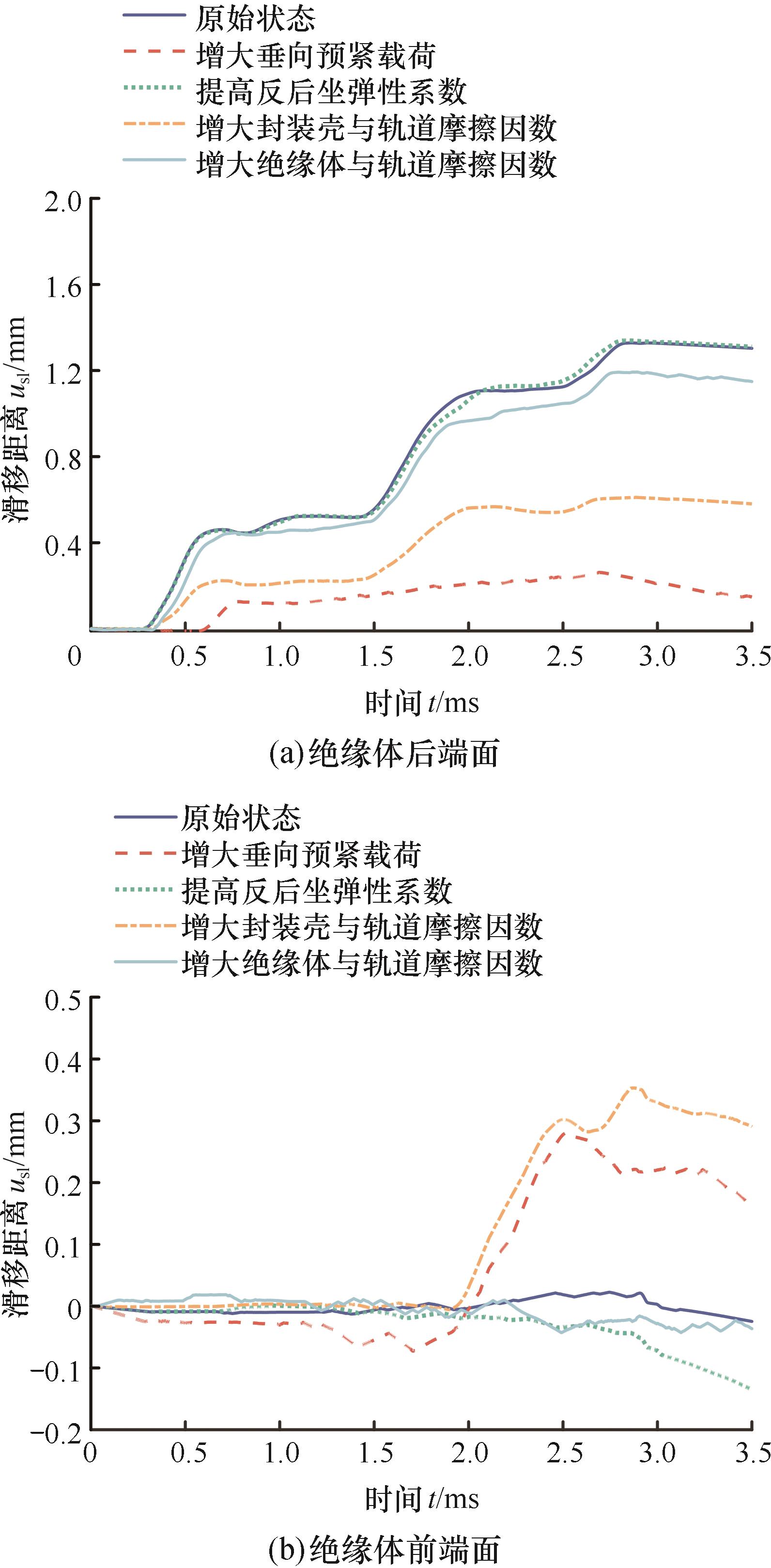
图9 不同抑制措施下的绝缘体滑移距离
Fig.9 Sliding distance of insulator under different mitigation measures
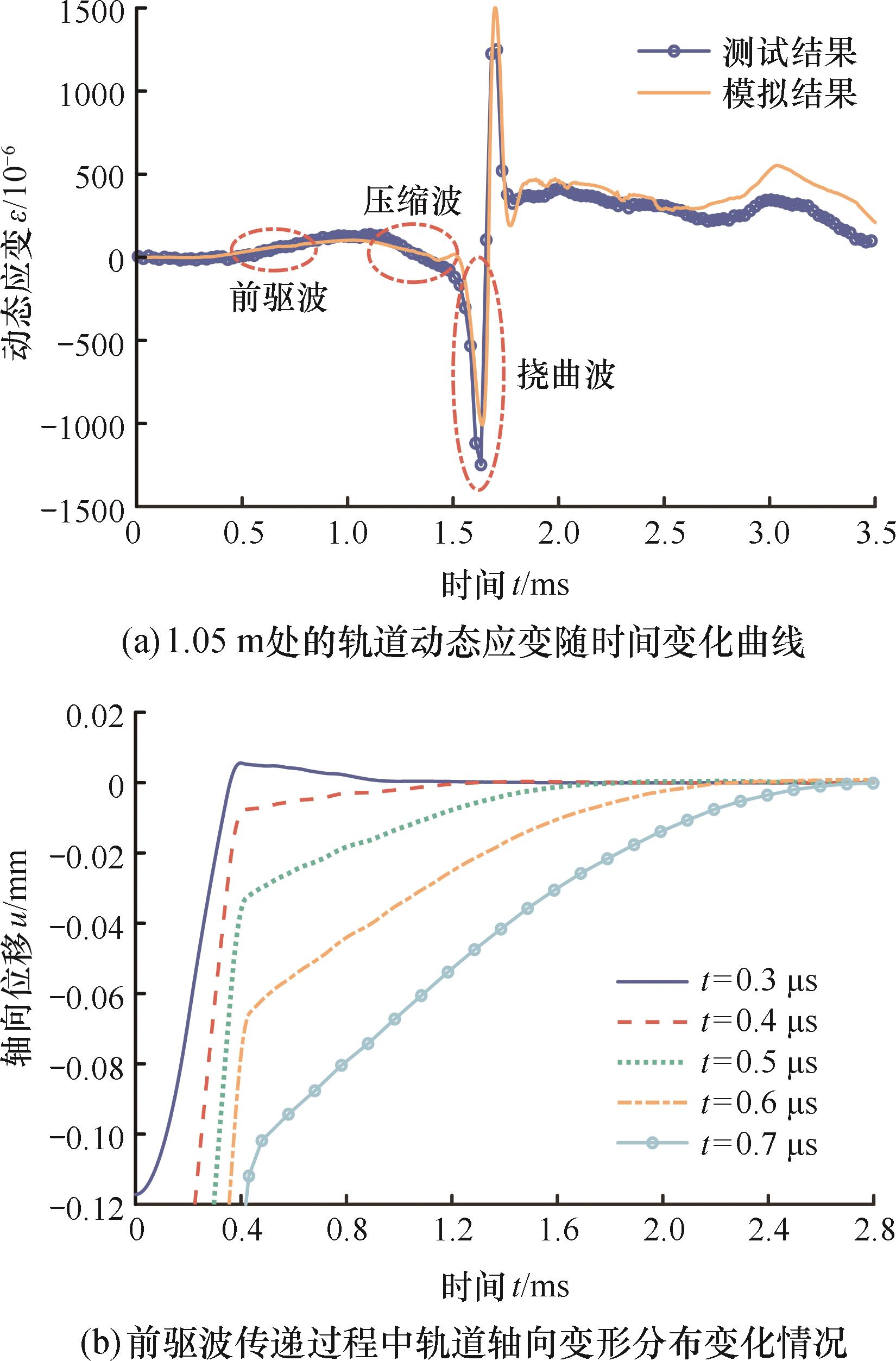
图10 观察到的前驱波现象及其成因分析
Fig.10 Analysis of the observed precursor wave phenomenon and its causes
| [1] | QIAO Wanzhi, GUO Tieding, KANG Houjun, et al. Nonlinear Coupled Vibration of an Arch-beam Structural System[J]. Communications in Nonlinear Science and Numerical Simulation, 2024, 138: 108155. |
| [2] | 袁志群, 李曰瀚, 林立, 等. 风-车-桥气动干扰作用下的汽车纵横向协调控制[J]. 中国机械工程, 2024, 35(4): 731-741. |
| YUAN Zhiqun, LI Yuehan, LIN Li, et al. Longitudinal and Lateral Coordination Control of Cars with Aerodynamic Interference of Wind-vehicle-bridge System[J]. China Mechanical Engineering, 2024, 35(4): 731-741. | |
| [3] | HAN Wanshui, LIU Xiaodong, GUO Xuelian, et al. Research Status and Prospect of Wind-vehicle-bridge Coupling Vibration System[J]. Journal of Traffic and Transportation Engineering (English Edition), 2022, 9(3): 319-338. |
| [4] | 靳智超, 梁红琴, 卢纯, 等. 考虑车轮多边形的动车组车轴疲劳寿命预测[J]. 中国机械工程, 2024, 35(7): 1299-1307. |
| JIN Zhichao, LIANG Hongqin, LU Chun, et al. Fatigue Life Prediction of Multiple Unit Axle Considering Wheel Polygon[J]. China Mechanical Engineering, 2024, 35(7): 1299-1307. | |
| [5] | 张笑, 池茂儒, 谢雨辰, 等. 基于逆向法的变轨距列车踏面优化设计[J]. 中国机械工程, 2023, 34(22): 2746-2757. |
| ZHANG Xiao, CHI Maoru, XIE Yuchen, et al. Optimization of Variable Gauge Train Wheel Treads Based on Reverse Design Method[J]. China Mechanical Engineering, 2023, 34(22): 2746-2757. | |
| [6] | CHEN Yuhao, WU Jin, LIN Dadi, et al. Research on Dynamic Response of Vertical Displacement of Runway Pavement Slab End under Aircraft Taxiing Using Novel FBG Sensors[J]. Measurement, 2025, 243: 116296. |
| [7] | 马伟明, 鲁军勇. 电磁发射技术的研究现状与挑战[J]. 电工技术学报, 2023, 38(15): 3943-3959. |
| MA Weiming, LU Junyong. Research Progress and Challenges of Electromagnetic Launch Technology[J]. Transactions of China Electrotechnical Society, 2023, 38(15): 3943-3959. | |
| [8] | LI Weihao, HU Qiancheng, LI Chengcheng, et al. Investigation of Current-carrying Oblique Impacts on the Copper–Aluminum Interface for Damage Characteristics[J]. IEEE Transactions on Plasma Science, 2024, 52(6): 2349-2358. |
| [9] | GHASSEMI M, VARMAZYAR M. Stress Analysis of the Rails of a New High Velocity Armature Design in an Electromagnetic Launcher[J]. International Journal of Impact Engineering, 2008, 35(12): 1529-1533. |
| [10] | TZENG J T, SUN Wei. Dynamic Response of Cantilevered Rail Guns Attributed to Projectile/Gun Interaction—Theory[J]. IEEE Transactions on Magnetics, 2007, 43(1): 207-213. |
| [11] | JOHNSON A J, MOON F C. Elastic Waves in Electromagnetic Launchers[J]. IEEE Transactions on Magnetics, 2007, 43(1): 141-144. |
| [12] | PAI P F, KAUFMAN C A. Characteristic Speeds and Influences of Cross-sectional Warpings on High-speed Beam-foundation Structures[J]. International Journal of Mechanical Sciences, 2012, 59(1): 8-21. |
| [13] | LEE Y H, KIM S H, AN S, et al. Dynamic Response of an Electromagnetic Launcher Accelerating a C-shaped Armature[J]. IEEE Transactions on Plasma Science, 2017, 45(7): 1639-1643. |
| [14] | RECK B, HUNDERTMARK S, VINCENT G, et al. Investigation of Rail Deformation and Stress Wave Propagation in the ISL-NGL60 Railgun[J]. IEEE Transactions on Plasma Science, 2019, 47(5): 2556-2559. |
| [15] | HE Wei, WEI Yanjing. Dynamic Response of Double Elastic Cantilever Beam Attributed to Variable Uniformly Distributed Load[J]. Mathematical Problems in Engineering, 2019, 2019: 2657271. |
| [16] | DU Peipei, LU Junyong, LI Xiangping, et al. Interior Ballistic Characteristics of Electromagnetic Rail Launcher Considering the Dynamic Characteristics of Real Launcher[J]. IEEE Transactions on Industrial Electronics, 2021, 68(7): 6087-6096. |
| [17] | WANG Jun, LI Baoming. Dynamic Response and Critical Velocity of Rails in Electromagnetic Rail Launcher Due to Axial Force[J]. IEEE Transactions on Plasma Science, 2020, 48(10): 3714-3719. |
| [18] | WU Jinguo, YANG Bin, ZHOU Pan, et al. Dynamic Response Analysis of Rails on Viscoelastic Support Stimulated by Superspeed Moving Loads[J]. IEEE Transactions on Plasma Science, 2022, 50(4): 1018-1025. |
| [19] | ZHANG Bao, KOU Yong, JIN Ke, et al. Dynamic Response of Electromagnetic Railgun under Time-dependent Electromagnetic Moving Loads[J]. Journal of Sound and Vibration, 2020, 483: 115451. |
| [20] | ZHANG Bao, KOU Yong, JIN Ke. Dynamic Behavior of Beam with an Elastic Foundation under the Extended Moving Load for Electromagnetic Launch Rail-structure[J]. Journal of Sound and Vibration, 2025, 596: 118756. |
| [21] | 杜佩佩, 鲁军勇, 冯军红, 等. 电磁轨道发射器电磁结构耦合动态发射过程数值模拟[J]. 电工技术学报, 2020, 35(18): 3802-3810. |
| DU Peipei, LU Junyong, FENG Junhong, et al. Numerical Simulation of Dynamic Launching Process of Electromagnetic Rail Launcher with Electromagnetic and Structural Coupling[J]. Transactions of China Electrotechnical Society, 2020, 35(18): 3802-3810. | |
| [22] | CHEN Lixue, XU Xuan, WANG Zengji, et al. Melting Distribution of Armature in Electromagnetic Rail Launcher[J]. IEEE Transactions on Plasma Science, 2023, 51(1): 234-242. |
| [23] | LIU Yong, ZHANG Tao, HUANG Pinhua, et al. Influence of Breech Busbar on the Recoil Force of Railgun Launcher[J]. IEEE Transactions on Plasma Science, 2020, 48(6): 2301-2307. |
| [24] | XU Yingtao, TANG Bo, LI Baoming. Research on Momentum Transfer in Simple Railgun[J]. Defence Technology, 2019, 15(5): 735-740. |
| [25] | MA Shuo, LU Shilei, MA Hongting, et al. Investigation on the Spatial-Temporal Distribution of Electromagnetic Gun Rail Temperature in Single and Continuous Launch Modes[J]. IEEE Transactions on Plasma Science, 2022, 50(7): 2270-2278. |
| [26] | MA Shuo, LU Shilei, MA Hongting. Study on the Active Cooling Effect and Convective Heat Transfer Performance Inside the Rail[J]. International Communications in Heat and Mass Transfer, 2024, 154: 107411. |
| [27] | 邢誉峰, 梁昆. 梁纵向与横向耦合非线性振动分析[J]. 北京航空航天大学学报, 2015, 41(8): 1359-1366. |
| XING Yufeng, LIANG Kun. Nonlinear Vibration Analysis of Longitudinal-Transverse Coupled Beam[J]. Journal of Beijing University of Aeronautics and Astronautics, 2015, 41(8): 1359-1366. | |
| [28] | NAYFEH A H, MOOK D T. Nonlinear Oscillations[M]. New York: John Wiley & Sons, 1995. |
| [29] | 吴金国, 林庆华, 栗保明. 电磁轨道发射装置导轨动力学响应分析[J]. 振动工程学报, 2019, 32(1): 120-127. |
| WU Jinguo, LIN Qinghua, LI Baoming. Dynamic Response Analysis of Conducting Rails in Electromagnetic Rail Launcher[J]. Journal of Vibration Engineering, 2019, 32(1): 120-127. | |
| [30] | 李白, 鲁军勇, 谭赛, 等. 高速滑动电接触电枢表面动态磨损过程研究[J]. 电工技术学报, 2023, 38(1): 131-139. |
| LI Bai, LU Junyong, TAN Sai, et al. Research on Dynamic Wear Process of Armature Surface in High-speed Sliding Electric Contact[J]. Transactions of China Electrotechnical Society, 2023, 38(1): 131-139. | |
| [31] | SCHUDERER M, RILL G, SCHAEFFER T, et al. Friction Modeling from a Practical Point of View[J]. Multibody System Dynamics, 2025, 63(1): 141-158. |
| [32] | ALI S, HAWWA M A. Dynamics of Axially Moving Beams: a Finite Difference Approach[J]. Ain Shams Engineering Journal, 2023, 14(1): 101817. |
| [33] | YANG Kai, LI Fei, JIANG Linshan, et al. Effect of Shock/Expansion Wave on Ignition and Combustion Characteristics of Supercritical Kerosene with Cavity in Supersonic Flow[J]. Aerospace Science and Technology, 2026, 168: 111021. |
| [34] | YAN Kun, YI Zhixiong, LI Qi, et al. Analysis of Strain Transfer Efficiency Coefficient of a Novel High-strength Steel Wire FBG Sensor[J]. KSCE Journal of Civil Engineering, 2024, 28(10): 4423-4435. |
| [35] | REDDY J N. Theory and Analysis of Elastic Plates and Shells[M]. Boca Raton: CRC Press, 2006. |
| [36] | JOHNSON A J, HARAN T, MOON F C, et al. Stress Wave Measurements in an Electromagnetic Launcher[C]∥2008 14th Symposium on Electromagnetic Launch Technology. Victoria, 2008: 1-6. |
| [1] | 郭闯, 赵二辉, 权龙, 汪成文. 载荷对油膜界面滑移及弹流润滑特性的影响研究[J]. 中国机械工程, 2024, 35(09): 1567-1574. |
| [2] | 徐晓华, 蒋桂平, 韩兴国, 张政泼. 滚珠丝杠支承系统滚珠丝杠轴承综合轴向变形分析计算[J]. 中国机械工程, 2023, 34(07): 830-837. |
| [3] | 吴家腾;杨宇;程军圣. 基于参数反求的齿轮裂纹时变啮合刚度计算方法[J]. 中国机械工程, 2019, 30(24): 2916-2924. |
| [4] | 骆振兴, 董明明, 曾荣兵. 悬架弹簧工作应力和刚度分析[J]. 中国机械工程, 2014, 25(22): 3119-3123. |
| [5] | 房怀英, 李远, 徐西鹏. 轴向力对圆锯片轴向变形的影响研究 [J]. 中国机械工程, 2011, 22(8): 966-970. |
| [6] | 李凌丰, 刘彩芬. 滚珠丝杠副轴向变形分析 [J]. 中国机械工程, 2011, 22(7): 762-766. |
| [7] | 李峰;刘晓晶;李超;石连升;;. 复杂锻件成形中塑性应变的测试新方法及应用[J]. J4, 2009, 20(12): 0-1390. |
| [8] | 范迅;刘宪伟;. 惯性和滑移对弹性金属塑料轴承的影响研究[J]. J4, 2008, 19(22): 0-2649. |
| 阅读次数 | ||||||
|
全文 |
|
|||||
|
摘要 |
|
|||||
